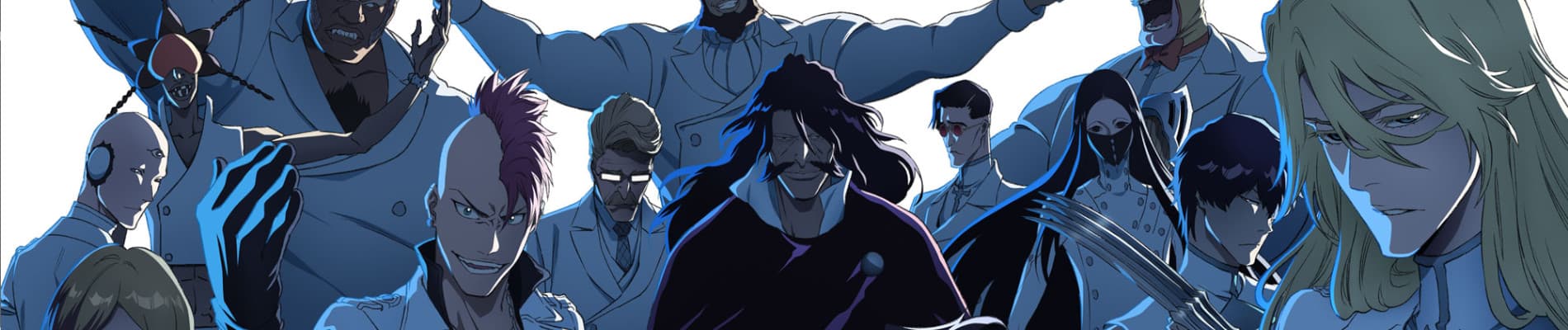

The Thousand Year Blood War is a story that I have read before, it’s a story that I have re-read even; that’s why in this analysis I aim to not only comment on elements which make bleach a fantastic story, but also comment on what this adaptation does to enhance it.

The Poems
In the past few years, a prevailing narrative within the community has been that Tite Kubo is an unskilled writer, and by extension, Bleach is a lackluster story. This was a point I never cared to argue against before, however, revisiting the world of soul reapers and magic swords through this anime has made it clear to me that these preconceptions are unsubstantiated, it just takes a little effort to uncover Kubo’s strengths as a writer.
The poems are the first little thing that the team behind this anime adaptation uses to show that they truly understand Kubo’s style.
If you’re a manga reader you might have noticed that every volume begins with a poem which gives a hint to what you are about to see. Not only do these old poems show up to replace the usual episode previews, the care has been taken to include new poems written by Kubo so that each episode can feature one. These poems betray Kubo’s sensibilities and they are the first step to seeing how the writing in Bleach is more like poetry, full of metaphors and symbolism.

The Battle
One of the most frequent themes of Bleach is that through conflict people can reach an understanding. This is often exemplified through Ichigo and his fights against Aizen, Byakuya, and Ginjo, to name just a few. It’s no surprise that for the final arc of the story this theme would make a return in its most extreme form yet, through the battle between Kenpachi Zaraki and Yachiru Unohana, this is the battle.
This exchange of sadistic sword swinging and murderous maiming maneuvers is in fact the deepest display of affection that this anime has to offer. This duel plays out with enough passion to make me shudder even now after seeing it happen so many times before. The battle delivers scenes unlike anything I have seen from a shounen anime despite it not looking as flashy as what the competition is offering. In moments like these you learn to appreciate the brilliant direction put on display, the choreography, and the sound design, everything coming together to form one of the most memorable scenes of the genera.

These two characters who are seemingly polar opposites are in fact so perfect for each other that they cannot help but to destroy themselves, the only scars that hurt are the ones they gave each other. The understanding I mentioned earlier reaches its most heightened state in the brief moments before Unohana’s life is taken. The dreamlike image of two skeletons duking it out in battle evokes the meaning of the fight, two people locked in a deadly trance which strips them to their most base forms, unchained from any limit. It’s only after Zaraki awakens that we break away from this imagery.
All throughout this encounter Unohana has been stronger, more powerful, more agile, but when the battle reaches its climax, they are finally on a level playing field. Their monologues merge into a dialogue, and they achieve a perfect state where they can communicate almost telepathically, simply by exchanging blows. In the end it’s the strength they both sought that gives them their purest moment of bliss and also takes them away from the only person who could match them.
I used to interpret the passion of this fight as two lovers in a self-destructive dance, now through the anime I can also see a motherly love coming from Unohana, her life culminating in this final trial where she gives all she had to awaken the true Kenpachi.

The Rain
This is the all-encompassing element of Bleach. Sadness embodied.
Every crucial moment of this story has been enveloped by the cold mantle of rain; I don’t even have to name them because I’m sure some have already sprung to your mind.
To see everything but the rain is to see only the happy moments of life, but sadly not us nor the characters in Bleach can escape the rain forever. Its uncomfortable, it might challenge us, but enduring the rain is what makes us grow. When Ichigo is thrown out of the soul society his entire sense of self is thrown into confusion, it’s only after he can face his past marred by the rain that he can reclaim the symbolic manifestations of his identity: his zanpakuto and the combat pass left with Ikumi.

The Fire
Symbolically, fire can be seen as many different things, destruction, growth, purity, rebirth. I find that all of these meanings are represented perfectly within Yamamoto. He is the fire that defeated Yhwach’s army a thousand years ago, the same fire that nurtured the soul society and its Shinigami, and in the end, the fire that burns out without resistance in the face of an overwhelming force.
Yamamoto’s demise was tragic, his mental fortitude flickering akin to a candle in the wind. He was far from perfect as someone like Mayuri would point out but he was the beacon which guided the Gotei 13, and now that his fire is gone it’s time for a new leader to rise from the ashes of war. Kyoraku’s promotion to head captain was something cleverly foreshadowed by the opening of this anime, and the direction of the anime works towards showing how intertwined his fate is with his old teacher.
In many ways his opposite, Kyoraku is forced to mature quickly, and pick up the mantle left by his predecessor, but that’s all I can say for now. The future will definitely test Kyoraku again and I will definitely be there to talk about it.

The Conclusion
In many ways I feel like the anime is filled with these small gestures of affection towards the original work. The poems, the battle, the rain, the fire. Every tiny thing converges to create a product which pays respect to the source material while also elevating it with a stellar directorial style and solid animation and music.
I’ve been a fan of bleach for so long that I wasn’t sure if the anime could ever surpass my expectations, but I found that it managed to do much more than that, it has returned to me in equal all of the love which I’ve been pouring into it. I don’t have to live in fear of lost happiness because I know, Bleach has come back.
