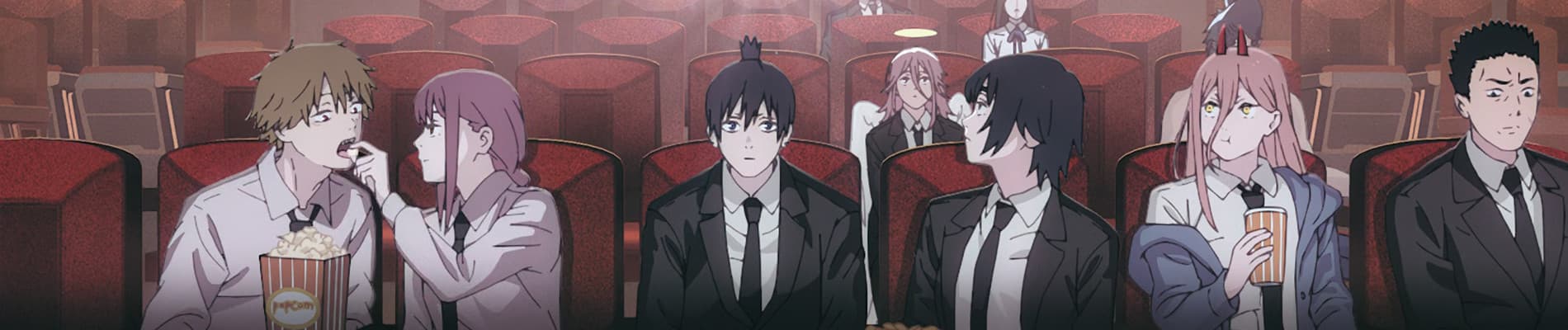
Chainsaw Man
a review by Magenta
a review by Magenta
Preface: This review is primarily a comparison of the anime adaptation of Chainsaw Man and its source material. If you clicked on this review just for an actual review of the first season of Chainsaw Man’s story, only read the introductory paragraph inside of the quote bubble.
Chainsaw Man’s draw lies in chaos. It may be mentioned in the same breath as other modern shounen, but it is the odd one out. At times, it can feel like it goes out of its way to break norms and conventions. Its main characters are more governed by primal instincts than those of typical heroes. Characters that are more anchored to reality either die or start to become more detached as the world and characters around them. For nearly half of the entire season, its main character’s primary motivation is to fondle a girl’s boobs. This type of chaotic attitude can get out of hand quickly, leading to an incoherent story. However, Chainsaw Man pulls a very important trick. While it poses under the illusion of chaos, under closer inspection, it's supposed chaos starts to become far more orderly. Chainsaw Man examines what constitutes a normal life as a human being. What does it mean to have a normal life? What does it mean to be human? In its more deranged characters, like Denji and Power, these themes manifest themselves by developing them in ways where they are learning how to feel basic emotions of life, like empathy and motivation. By contrast, the one main character that already has actual motivation and drive, like Aki, learns to detach themselves from it in ways that lets them enjoy the pleasures of life. This is the consistent thematic throughline in this story, even if it is intentionally invisible. It is the glue that keeps Chainsaw Man coherent in its chaos. And it is also what makes it click. What makes Chainsaw Man work is in how it imbues its characters, world, and story with seemingly idiosyncratic elements. Even if these elements don’t seem like they fit together at all, when taken in its whole, it forms a beautiful picture. Although its themes surrounding the nature of humanity aren’t fully matured yet, the seeds are planted for a beautiful blossom.
8.5/10
However, to leave a review at just that is to be a tad disingenuous. My short write up can easily apply to both the anime and manga versions of this story, since it only touches on story and plot details. This is a by-product of the anime being extremely faithful to its source material storywise. There is very little deviation from the original storyline, not even breaking from the manga’s weaker plot elements. It is a very faithful adaptation in that sense. Plot is always half of the picture though. In the transition of mediums, presentation needs to be taken as much, if not more into account. Here is where the problem with a Chainsaw Man adaptation lies. Chainsaw Man’s manga is a convention-breaker in the plot-sense, and it also is that way in its presentation.
Compared to most contemporary popular manga, Chainsaw Man is crude. It lacks much consistency when it comes to art quality, with faces commonly being underdrawn and environments being under detailed or blank. But what it lacks in the detail it gains unique in framing and paneling. In comparison to its competitors, Chainsaw Man’s manga possesses a paneling style that is reminiscent of live action cinematography. There is a real feeling of kinetic motion that can be a bit hard to describe in words.
Here is an example, take the end of the Leech Devil fight when Aki summons the Fox Devil.

It is hard to express manga panels through AniList images without clogging up the review, so it is best to experience this moment through the turn of a page and not through a horizontal image of all four pages laid out. This moment is Chapter 10, Pages 12-15.
In three of the four pages where the summoning takes place, the point of view remains stationary. This stationary point of view familiarizes ourselves with the space that is established, from Aki’s point of view. When Aki’s hand moves upwards, it goes from the bottom panel of the first page into encompassing the full second page. Although it cuts back to Aki briefly, the fourth panel features the Fox Devil encompassing the full page, eating the Leech Devil. The framing of objects in the moment leads to a feeling as if we are looking at Aki’s point of view, staring down at the Leech Devil. What makes this moment most impressive is that motion is established through the simple turn of a page. Our brains can fill in what happened within the page turn, leading to an illusion of movement. It is like how animation fools our minds with smooth movement despite being a series of moving images, but it is through a medium made up of solely stationary pictures.
Here is that same moment in the anime:
The end of the Leech Devil fight in the anime has the animation, it has the higher visual fidelity, it has the sound effects, but it isn’t nearly as special as its manga counterpart. This isn’t due to any changes in the framing of the moment, because it is nearly the same. By complete necessity, the motion of Aki’s hand movement has to be explicitly stated by the animation. However, a sense of motion in a medium where things don’t typically move is different from a sense of motion in a medium where everything moves. It is just that this moment specifically works because it is in a manga format. Although its techniques are replicants of those found in audiovisual mediums, the end product ends up having an impact that only something in a manga might have. Any attempt to transition it into animation would water it down due to the juxtaposition of techniques and mediums being completely gone. In transitioning into an audiovisual medium like animation, much of the appeal of a moving camera being emulated on paper is lost when it no longer becomes emulated. Much of the more clever moments of paneling get dampened in their anime-equivalents just due to them not being in a manga format anymore. Moments where techniques that were adapted into the manga medium were used can’t have nearly the same impact just due to those techniques being used prevalently elsewhere. Other moments where this type of paneling technique that is lost in adaptation happens in moments like when Power kills the Sea Cucumber Devil, the beginning of the Katana Man fight, etc.
Much of a Chainsaw Man adaptation would be difficult just due to Tatsuki Fujimoto’s idiosyncratic style of art and manga. He is an unconventional mangaka, but he is one that would squeeze the most out of the medium he is working within. Chainsaw Man is great because he can consistently push the medium to its near limit. However, an anime adaptation of Chainsaw Man can’t do that without a direction that is comparable to the manga’s creation of cinematography in a flat space. That is a hard task, and any attempt to create a new direction without a strong idea or foundation could lead it to easily backfire. So the anime adaptation plays things very safe in terms of visual direction for the most part. Although a scene like the Fox Devil summoning is far better in manga format, the anime adaptation of it was probably the safest way to adapt it. The risk of unwatchability of a scene is persistent when not every element of it is in tune.
At the end of the day, adaptation relies on interpretation. How one would understand Chainsaw Man is key to knowing what they would think about the manga or anime. Is it prestige shounen or is it something else entirely? If you have been reading this review, you may see that I have a very strong preference towards the “something else” angle, but all pieces of media are subject to one’s own interpretation, and to act like there is a correct answer to this question is to be a ridiculous person. Media is made for its medium, and to adapt it into something else will naturally involve infusing one’s interpretation of the work within it. MAPPA’s anime adaptation of Chainsaw Man leans a lot more towards the “prestige shounen” angle, which is a very valid interpretation of what Chainsaw Man as a story is. Even if the visual direction isn’t in the direction that I would like, it is still visually stunning. I know that I have been poo-pooing this entire adaptation for this entire review, but just know that it is because of very subjective factors that are inevitable. Just know one thing,
Just because Chainsaw Man stands out among prestigious shounen, doesn't mean its anime adaptation loses out on the full love and care that other prestige shounen have in their adaptation. As a matter of fact, saying something is “prestige shounen” is usually far from derogatory when discussing presentation. Like others like it, the visuals and animation is top-class. Obviously, the fight scenes are a feast for the eyes. Sure, the CGI is a bit noticeable at times, but it doesn’t look so bad that I would start an online petition over it. That is the thing that jumps out the most with the visuals, as is with any of the anime’s contemporaries. However, the anime has an absurd amount of detail in its environments. The manga’s underdeveloped backgrounds are now contrasted with the anime’s overdetailed backgrounds.
~~ ~~
~~
Combined with extraordinary sound design, the Chainsaw Man anime becomes one of the most immersive anime in recent memory. This culminates in the sequence of Aki’s morning routine, a nearly two minute long anime-original sequence at the end of Episode 4. His morning routine is absurdly overdetailed and absurdly well animated.
However, if there is one singular blemish on this adaptation, it would have to be the rather dull color palette. Chainsaw Man is a chaotic story, and judging from many of the volume covers, and even the EDs, it should have a very colorful color palette. A chaotic story and a chaotic cast of characters should breed chaotic colors. However, the color palette of the anime remains extremely dull. Compare this moment from the anime and the manga.


The manga lacks any color, but it makes up for it in contrast. That contrast between the light outside and the darkness in the cart car is what sells the moment in the manga. In the anime, there is a little bit of contrast, but it is dampened by everything looking extremely gray. Considering the existence of nearly every piece of Chainsaw Man media and the colorful color palettes of most other prestige shounens, this is a very weird flaw for this show specifically to have.
Well that was a bit of a negative note to leave on. I can’t think of a better way to transition into the conclusion though, so yeah.
Chainsaw Man’s anime provides a good lesson in adaptation. The change in medium will always lead to a different story being told. Even if all plot beats are completely retained, there will always be a wrench that forces a change to happen. The more entrenched that piece of media is within its source medium, the harder it becomes. Going from manga to anime is comparatively way easier than say, from anime to live action, but it still provides its own challenges. Losing aspects in adaptation is inevitable. To try to adapt everything completely faithfully is to play a fool’s game. If you fail, people will just go and see the source material since it does everything you tried to do but better. The key in adapting faithfully is to build off its own strengths completely unique to it while still retaining the original’s feeling and story.
Is the Chainsaw Man anime better than its manga? I don’t really think so. The manga provides a far more unique experience that would be hard to find elsewhere. The anime is forced to whittle down many of its more unique elements, and just for that, I think that it is worse. However, there is a very strong argument to be made that it is better. The truncated uniqueness of the story is made up for by having some of the best animation there is to offer in the industry as well as being one of the most immersive. Chainsaw Man’s anime and manga are both very good pieces of media that I would highly recommend. It is just that they are very good in two different directions.
Thank you for reading to the end of the review if you did. If you have any criticisms of how this review was made, you are free to message me or reply under this activity to critique what I had to say.
Also, please don’t like or dislike the review without reading it.
252.5 out of 282 users liked this review
