

This review is spoiler free
INTRODUCTION
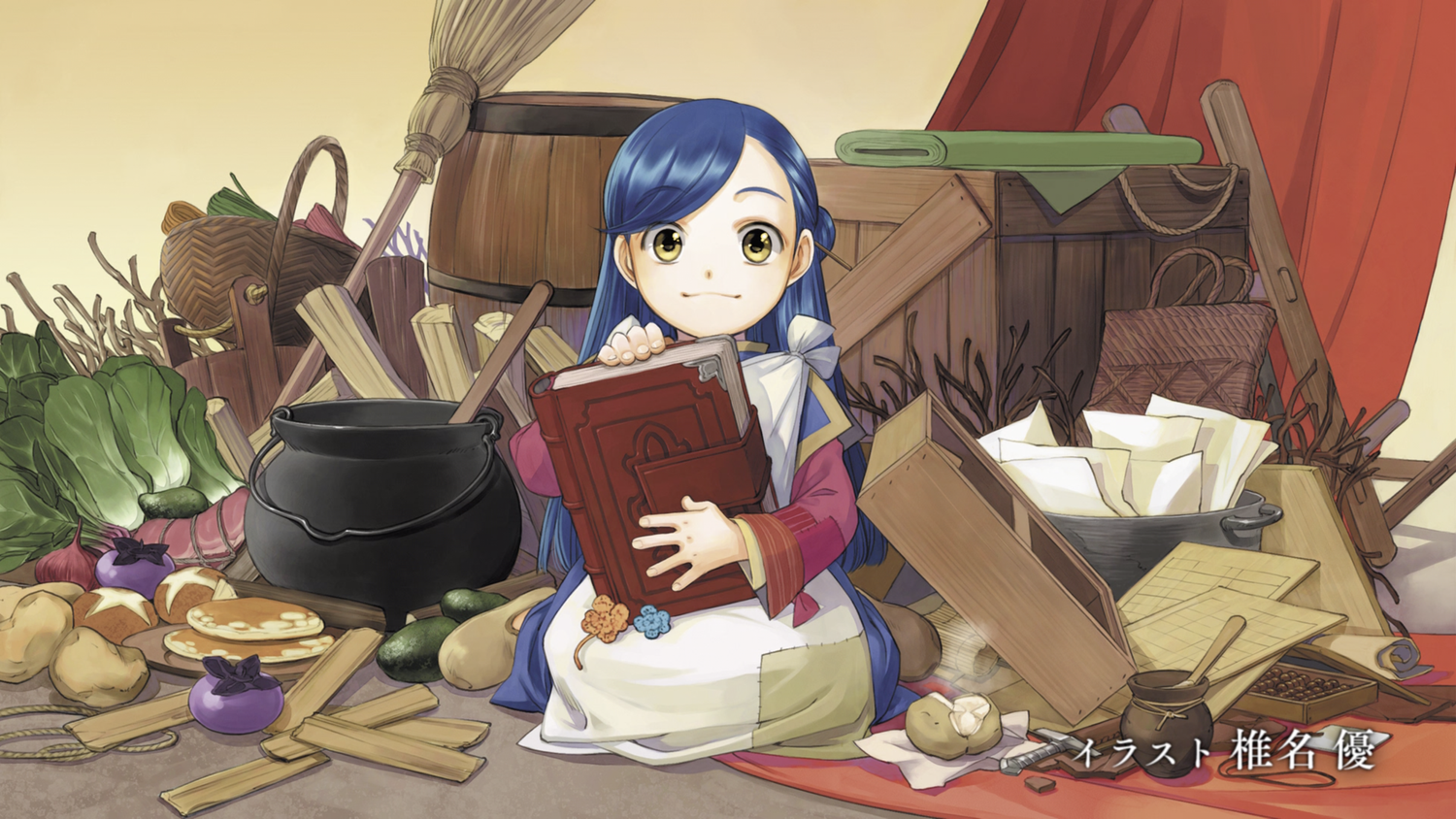
Ascendance of a Bookworm starts, in typical isekai fashion, with the main character dying (crushed by books in a library due to an earthquake) and finding herself in the body of a sickly child in a different world. She has a new name, Myne, but she’s still the same person who only cares about books. That ends up being quite the problem - not only is her body weak, she is poor. And in a world without a printing press there is no hope of a poor person getting their hands on a book. This however doesn’t discourage her. She does what she can to overcome these barriers and make her own books. This leads to one thing and another, from becoming involved with merchants, the church, and eventually nobility and their cutthroat politics.
Ascendance of a bookworm is split into 5 different parts. The first is titled “Daughter of a soldier”. Each part involves a noteworthy shift in her societal position. The original japanese title uses the word “下剋上” (gekokujou) which means “inferiors overthrowing their superiors”. This should give an idea of how while perhaps seeming like quite a peaceful story of books, Ascendance of a Bookworm in fact is a story of the chaos, conflict and developments resulting from Myne ascending the society of Yurgenschmidt with her books and various inventions.
Bookworm is one of my favourite stories ever. Looking at its themes, worldbuilding of gigantic scale, brilliant characters, and finally interesting ethics, I’ll try to convey why this is.
THEMES
Bookworm has many interesting themes, not limited to “the power of stories”, “class”, “family”, “traditions” and “doing what you enjoy”. One particular theme however stands out to me as exceptionally well done. This theme is the importance of understanding others. At the very start, Myne is transported to a world she doesn’t understand. Her common sense doesn’t match with the common sense of the people around her at all. She thinks they’re stupid, and they think she’s weird. They misunderstand each other, make wrong assumptions, and there’s a lot of difficulties as a result.
Eventually she starts to make sense of the many odd traditions and ways of doing things in this world. The world after all is different to her own, in wildlife, culture, politics and more. What seemed strange to Myne, slowly starts to make sense as she gets a more holistic view of things. Even so, her old perspective is still valuable - the society of this new world is different, and while not everything different is necessarily bad, that doesn’t mean her perspective doesn’t offer anything new. This can be books, technology, or even ethics.
And so, the power of mixing cultures is brilliantly shown, how enriching oneself in multiple viewpoints allows you to view them fairly, and improve them, where someone who is stuck in one or the other couldn’t. Thing is, this is only the start. After all, this world has more than just the poor lower class citizens Myne starts among. Merchants, clergy, nobility (and within nobility you have the laynobles, mednobles, archnobles, archdukes and royalty). Each of these groups too has their own culture, and they are rather segregated from one another. As Myne ascends the society of Yurgenschmidt, she has to understand the different groups and their cultures. She not only enriches each with her own world’s culture. She enriches them with the other cultures of the world! A thing she is uniquely capable of, having experience within each..
I’ve lived in differing cultures myself. Doing so you experience misunderstandings and difficulties, but its also very enriching. I found Bookworm really manages to encapsulate that. While I emphasise the cultural aspect of this theme of mutual understanding, A great sub plot involves a father and son who get into a big fight due to misunderstandings. Even without a cultural barrier, communicating with people is difficult, and Bookworm explores the highs and lows of this process excellently.
This theme I think is not something commonly done, certainly not as well as Bookworm. The reason it works exceptionally well in Bookworm in particular I think, is because of the stellar worldbuilding. The true complexities of different cultures clashing and coming to an understanding after all cannot be accurately portrayed unless said cultures have enough depth to have a meaningful clash. This brings me to my next major point.

WORLDBUILDING
A big, complex world is a must have for any fantasy story. Yet the difficulty of a complex world is less designing it, and more so introducing the world to the reader in such a way that they grow invested. Bookworm does this excellently. At the start of the story, Myne is basically bedridden. The scale of her world is incredibly limited. She has her family, and rarely goes outside. She has a limited circle of people she meets and interacts with. She learns intimately what life is like for the poor commoners she lives with.
Only once this way of life has sunk in does her health improve, and allow her to venture out further, to the forest, and to meeting merchants. From merchants she learns of the commerce in this world. While poor commoners barely interact with other groups of society, merchants sometimes get involved with nobles. This gives her first look, although it is but a glimpse, of the wider world. Eventually her business ventures bear fruit, and Myne gains further contacts and influence.
Following this slow, gradual process of Myne ascending society, the world opens up at just the right pace. While other stories might tell you that there is a king, who rules a country of several million people, the scale of this doesn’t really sink in. Yet in bookworm, we are made familiar with the very smallest groups in society at first. When you look at a map of Yurgenschmidt this scale can be felt if you’ve read the books. The kingdom has 20 duchies, plus the sovereignty at the centre where the royal family rule. Of these 20 duchies, one is Ehrenfest, the Duchy Myne finds herself in. It’s the 13th ranked one. Ehrenfest itself has 28 provinces ruled by different Giebes, and it also has the central district, where the identically named capital city, Ehrenfest sits. This city has a noble district, with ivory buildings, and a lower city, where all the commoners, rich and poor live. It is here that Myne starts, but all of the above is relevant.
Though this scale might seem excessive, trade, all manners of politics, geography, wildlife, and history of this country are explored at micro scale, macro scale, and everything in between. For one example, there’s a minor subplot which involves a noble from the neighbouring superior duchy marrying into Ehrenfest. There are political difficulties. She feels isolated because there is suspicion towards this duchy that it is trying to interfere with Ehrenfest. In a hope to have her integrate, Myne tries to get her to bring over recipes from her duchy - after all, it borders the sea and should have fish. Myne hopes to use these fish to make Japanese style dishes for a restaurant she wants to earn money and political influence with, while simultaneously allowing this noble to prove herself useful and fit in with the other noblewomen here. Unfortunately the fish from this duchy are magical, and far more dangerous than what Myne is expecting. This is a minor subplot, yet it ties in to basically every facet of worldbuilding
This multifaceted worldbuilding with both massive depth and scale is something very unique to Bookworm. Yet the world is not the only thing in Bookworm which is massive in scope, yet with great depth. Characters are arguably the most important part of any story. If you have a story in a wonderfully complex world, but don’t care about anyone in it, the story has basically failed. Fortunately Bookworm succeeds in making a massive cast of excellent characters, which is the next major point I’ll be discussing.

CHARACTERS
If we are to talk about characters, the most important one would have to be the main character. Myne in my opinion is the best character in Bookworm. She’s obsessed by books, and basically orients everything in her life around obtaining and reading them. At the end of the day, if she could sit in her room all day, reading books, she would. I can understand this kind of feeling well. Yet as the story progresses, she grows considerably. In her struggle to get what she wants (books) she learns to understand and appreciate the people who help her. The fact she is from our world is quite important. She grows to regret how she died early. She worries how the people she left behind must have felt. Additionally, the fact she effectively took over the body of this other girl, and is unnaturally knowledgeable in this new world are not conveniently ignored or forgotten by the other characters - they are challenges she has to address. Most importantly though, experiencing the story through her eyes is just plain fun. She’s always entertaining. She’s a book obsessed gremlin who is basically trampling through the well thought out customs of Yurgenschmidt, a kingdom of traditions spanning hundreds if not thousands of years. She causes chaos everywhere she goes, and then has to deal with the consequences. We’re over 20 volumes in now, and it’s still not gotten old. I don’t think it ever will.
She also has an excellent chemistry with all the main cast. There’s her childhood friend, who grows up alongside her trying to become a merchant. He effectively becomes her supervisor, making sure she calms down when she gets over excited, and doesn’t overexert herself, while helping her reach her goals of making books. There’s the merchant, who on the one hand wants to use her books, printing, and other revolutionary ideas inspired by our world to grow his business, but also goes crazy trying to keep up with her insanity and inability to follow conventional rules, potentially angering nobles and getting into serious trouble. Then there’s Ferdinand, the high priest of the church. He sees the political implications of what Myne is doing and wants to guide her. Yet he is troubled by her emotional needs. He’s a noble - from a young age he’s had to hide, if not kill his emotions to fit in, while at no point trust anyone but himself lest he be assassinated. He’s also someone who does not take care of himself, and it takes a lot of hard work from Myne to get him not to overwork, meaning while he only intended to guide Myne, she ends up helping him as much in return.
These however are only the major characters. Bookworm is absolutely filled with side characters. It may seem like there are too many to be able to follow along, but each character cleverly gets an arc where they are relevant which will make them stick in your memory before you need to remember them in any great detail. Fitting the immensely complex world, there are characters for each aspect of it. From commoner neighbours living next door, to noble archduke candidates attending the royal academy seeking a suitable marriage partner to strengthen their position as the next archduke of their duchy.
What is especially nice about the Bookworm characters is how they in themselves offer unique perspectives on the world. The prologue, epilogue, and odd side stories in the books follow their perspectives. While Myne has her own perspective of all of the chaotic rampages she goes on, there are as many alternative perspectives as there are characters. Seeing how they view her adds a great depth to the narrative. For example Myne might only see the benefit of her inventing a printing press in terms of her getting more books, other characters would see how a - this makes information accessible to people who would otherwise be too poor to own handwritten books, b - how the people who previously transcribed books have been financially hurt, c - how getting a printing press for ones province as a new industry could be beneficial politically, d - how the value of paper has suddenly jumped, e - how one could now make a lot of money if you were to write stories people would want to read, to name but a few. These side stories also do wonders bringing home the previously mentioned theme of understanding one another. Many stories are about characters finding out something valuable and how this has changed their life, thanks to the ideas from other cultures Myne has introduced.
The world of Bookworm, despite the cute looking characters, is surprisingly dark. More so than due to monsters, this is thanks to the strict social hierarchy. Nobility stand above the common people, and if you as a commoner were to do as little as look at them funny, not much is stopping them from executing you on the spot. This leaves a lot of room for unscrupulous nobles to abuse their position, with little others can do to stop them. This means some forms of prostitution and slavery are basically state sanctioned. Many similar problems exist, and the people of this world rarely think twice about them.After all, one’s ethics is largely based on the norms of the place you grow up. Effectively, beyond there just being misunderstandings between Myne and the other characters, there is a significant gap in ethical values. The way every character individually processes, understands, justifies, or deals with the questionable ethics of this world makes them very interesting. Beyond that however, the series’ handling of the ethics of the other world in and of itself I find very interesting. As such, my final major point I’ll be looking at is Bookworm’s handling of this.

ETHICS
So the world of Bookworm is surprisingly dark. Some stuff about it is really messed up. Slavery, oppression, immense disparity of wealth. A lot of these issues aren’t even seen as problems by the people in power. This is how it has been forever, after all. Additionally, these are very complex problems, and unless you have a deep understanding of the history, culture, and politics of this world, you won’t have a hope in solving them. For example, orphans are taken in by the church, and forced to work for the noble priests. Sometimes female commoners taken in are made to do “flower offering” which is a fancy euphemism for sexual services. They have basically no choice in the matter. If they defy the nobles, their life is forfeit. Any normal person can tell you this is very messed up. But what could actually be done to help them?
Punish the nobles who do this? Well, they are nobles, so they have mana. Mana is a very valuable resource, and its needed to power all kinds of implements, as well as to guarantee successful harvests. The reason nobles can exert their power is due to the inherent need there is for them thanks to their mana. If one were to get rid of the noble priests, the country would face far greater troubles. Similarly, simply banning this kind of abuse of the orphans would make the orphans worthless. The nobles effectively feed them after all - if they had no benefit from having them, they wouldn’t do this. Overall, there doesn’t seem to be a satisfactory solution to this situation. Fortunately, Bookworm’s message isn’t to give up in the face of this. Myne’s actual ethical integrity is questionable at times, clearly caring more about books than most things. Still, she’s a decent person who doesn’t like people in front of her suffering, so she does what she can and is within her power. Through carefully understanding the many powers, systems and traditions at play manages to slowly work out a way to greatly improve the quality of life of the orphans.
Overall, the complex world of Bookworm, and the major theme of mutual understanding work in tandem to make the ethical conundrums faced by Myne actually meaningful, and require actual thought and navigation to find satisfying solutions. A lot of Isekai in terms of ethics are stuck either with an absolutist or extreme relativist ethical stance. In the one, the main character's morals are “correct” and he just needs to get his way for things to have ended well. There isn’t much, if any, depth to the ethics of the other cultures, and there isn’t any consideration of how they might be different due to the differences in culture or environment, instead of “wrong”. In the other type of isekai, the MC is expected to adapt to the culture of the world they find themselves in, and accept that what they find is normal here. In Rome do as the Romans do, as it were. The problem with this is that this can legitimise highly questionable practices. Slavery in particular is a favourite of isekai these days. Bookworm however finds the perfect middle ground, showing that such issues are complex and nuanced. You shouldn’t abandon your own sensibilities, but still need to think carefully about the deeper purpose of the values and circumstances of this world, so as to find a solution with finesse, rather than a blunt instrument. While this seems like it should be common sense, actually achieving the necessary nuance for this to be conveyed so clearly I think takes great skill from the author. All the previously discussed points of Bookworm’s strengths, a world of great depth with a variety of well realised cultures, plus complex characters, combine to make this ethical nuance really land.

CONCLUSION
Thank you for reading my recommendation/review of the Ascendance of a Bookworm light novel. Hopefully I’ve given a glimpse of what makes the series special, the excellently executed theme of understanding one another, the worldbuilding with real scale, the brilliant characters, and nuanced ethics. The author of bookworm clearly planned their story and worldbuilding from the start, meaning the progression of the story is incredibly smooth, deliberate, and I’m sure the conclusion it is heading towards is going to be amazing (the web novel readers who’ve gotten to it seem to say so). It’s a bit of a commitment to get into, but I wholeheartedly recommend it if you liked the sound of what I was talking about in this review!
