(Mostly spoiler-free, significant spoilers are marked.)
Do you like any semblance of slice of life? Do you have crippling social anxiety? Have you ever wanted to be recognized, to be acknowledged by people? If you answered yes to any of these questions, watch Bocchi the Rock!. Otherwise, read on, then go watch Bocchi the Rock!.
(Note: Throughout this review, I’ll refer to the character of Bocchi-chan/Gotou Hitori as either “Gotou” or “Bocchi” and to the show Bocchi the Rock! as BtR, as trying to distinguish Bocchi the character and Bocchi the show would be obtuse.)
Synopsis
Gotou Hitori is a social anxiety-ridden wreck of an introvert high school girl. To try to get out of her shell and achieve her goal of fame and band stardom, she decided to learn how to play the guitar in middle school, getting good very quickly. Since then, however, she still hasn’t made a single friend, much less joining or performing in anything. One afternoon, Gotou meets a girl who is looking for a new guitarist for her band. Gotou accepts, though more so because she can’t bring herself to refuse, and thus begin the antics of the Kessoku Band.
Story: 10/10
Bocchi the Rock!’s premise is not difficult to grasp: a slice of life comedy with music as a backdrop and one lonely guitarist at its center. The execution of this concept, though, is nearly flawless; BtR may very well be the new peak among slice of life comedy anime.
First and foremost, BtR’s comedy is golden. At the forefront are Bocchi’s social anxiety gags, which range from “haha I do that” to “pure, unadulterated cringe but really funny after,” helped greatly by the glorious adaptations of these moments on screen. Sometimes when Bocchi sinks into the doom and gloom, worrying about the one mistake she thinks she’ll make or her bleak future as a shut-in if she can’t be successful, the show’s vibe gets almost too real—but only briefly, as it always circles around back to hilarity again. Character banter, jokes, and puns are also directed and delivered perfectly, altogether making for a genuinely hilarious show that had me in stitches multiple times an episode. To add onto that, BtR thrives in both the slice of life and music aspects as well, as the former is just plain fun with its fair share of cute anime shenanigans while the latter presents a remarkably down-to-earth portrayal of being a musician and live house culture. On all three of its major fronts, BtR is wholly successful, and this alone would already be enough to be very, very good in my book.
To leave it at that, however, would be a reductive disservice, as BtR’s story is surprisingly layered despite its notably simple premise. Underneath the highly entertaining exterior of music, slice of life, and comedy is an excellent coming of age story, and the straightforward story beats allow the show to spend time focusing on its characters without bogging down the pacing. It’s especially heartwarming to witness Bocchi’s development throughout the 12-episode run as she is pushed and dragged by her new friends, and occasionally her own will, towards self-improvement, no matter how much she wants to wither away in the moment. Bocchi falters from self-doubt and uncertainty multiple times but continually gets back up, getting just a little bit better each time. The other three members of the Kessoku Band also go through their own, more subtle arcs as well to complement Bocchi’s, forming a feelgood and inspiring depiction of growth and youth.
For a show that bases much of its premise and comedy on the very real issue of social anxiety, one might imagine its handling in BtR to be either somewhat callous or surface-level. Instead, the opposite is true: BtR’s depiction of social anxiety is the most genuine I’ve seen, even as the show continually rags on Bocchi to much amusement. Even though I don’t have social phobia myself, I am very much a textbook introvert who overthinks sentences a minimum of three times before saying them, so seeing the relatable mental gymnastics of a pink-haired anime girl reflected on screen, albeit a tad exaggerated, is hilariously gratifying in a morbidly fun way. Yet the relatability doesn’t just stop at the socially anxious and introverted, as even Kita, the most extroverted and sunshiny of the group, has her insecurities that she works to overcome. What ultimately results is a smart portrayal of social anxiety and the difficulties of social dynamics that is equal parts funny and grounded.
That leads me to the moe elephant in the room that I’ve avoided thus far, which I want to springboard off to highlight what I believe is one of the greatest assets of BtR’s story. Given their similarity in concept, it’s no surprise BtR gets compared to K-ON!, something that Hamaji Aki, the original creator of BtR, obviously recognized. Anyone who has watched these two shows, however, (I hope) can quickly understand that Hamaji-sensei succeeded in going around this giant mountain in the anime landscape, as K-ON! and BtR aren’t really that similar past the surface. In my view, the main difference comes from both playing to their specific strengths: if I had to use one word each, K-ON!’s would be “fluffiness,” while BtR’s is “groundedness.”
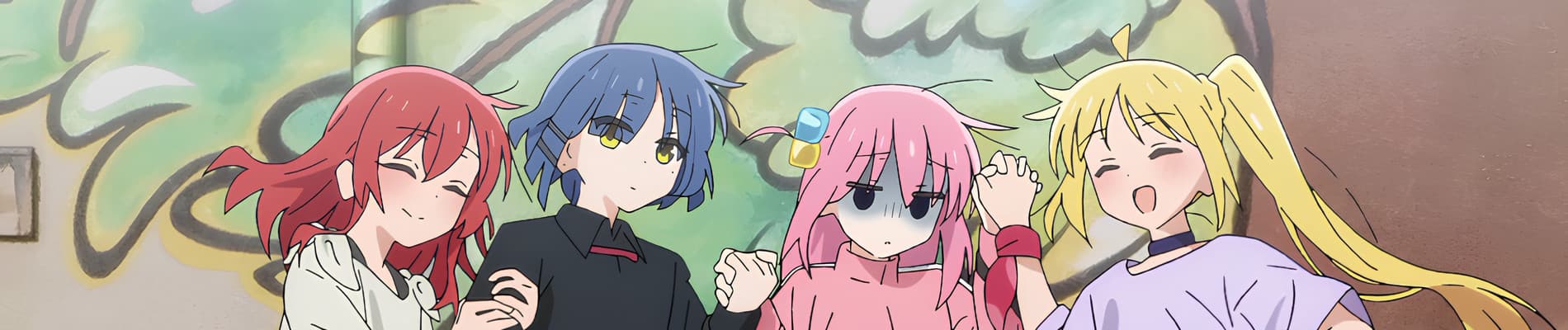
While K-ON! relaxes in its good vibes driven by pure moe all the way through, BtR, when it’s not going off the rails with Bocchi, is notably down-to-earth. This is especially true with the music aspects, as I’ve briefly mentioned—the life of a musician is not shown to be easy, even if you don’t crumple at the sight of a crowd, and the balance struck between realism and humor helps maintain both seriousness and levity. Another minor point I personally found interesting was the friendship dynamic between the four Kessoku Band members. Bocchi, Nijika, Ryou, and Kita obviously feel like friends but there’s also a slight degree of distance between them as well, which paradoxically makes their friendship feel more realistic. This comes to a head in one episode where it’s revealed the four haven’t spent time together at all for most of their vacation outside of the live house—which, frankly, sounds pretty accurate for even best friends.
I’ve also already discussed the depiction of social anxiety, but in other serious moments with some heavy stuff, as well as the climactic performances, BtR shows remarkable restraint that helps highlight this sense of “groundedness.” Bocchi has heart-to-hearts with her three bandmates individually at different points in the story, but these moments have no yuri bait (arguable, I guess), no Bocchi time—just a genuine conversation between two friends opening up a little bit. In the performances, which interestingly occur at the beginning of episodes rather than the end as a climax, the music doesn’t slow down to accommodate the characters and there’s no significant fanfare once they’re done—good vibes during the musical performances themselves but restrained in their presentation, and it’s always right back to usual life once the music stops. A little jarring to snap back to reality, sure, but in a sense, it almost feels like BtR is saying to cherish those moments, because they’re what you’ll remember once it’s over.
(Spoilers for final episode)
Characters: 10/10
(An easter egg: Search up the names of the members of the Japanese band Asian Kung-Fu Generation, then take a look at the names of our four main characters in BtR. They were a huge inspiration for Hamaji-sensei, after all.)
Most slice of life anime have pretty straightforward casts, often hinging on their charm and likability rather than character complexity. BtR impressively succeeds with both, especially with its main quartet. Each of the four, Bocchi, Nijika, Ryou, and Kita, have strong, memorable personalities and compelling character arcs that already make them stand out, but they also share meaningful dynamics with each other that are just as significant. While being fan favorites is by no means an indication of good characters, the monstrous popularity of every one of the four Kessoku Band members does say something about their appeal. The supporting cast, while relatively small, also has several stand-outs who work to great effect, such as giving Bocchi a small push when her bandmates aren’t there or adding to the already stacked comedy. As a whole, Bocchi’s cast gets a lot of love from both the creators and fans alike, and deservedly so.
(Specific character analyses ahead, so full spoilers)
Nijika, as the character that essentially kickstarts the series by meeting Bocchi and dragging her to Starry, is almost a deuteragonist of sorts. She’s initially presented as a typical, bubbly high school girl with a penchant for cracking jokes, who Bocchi immediately recognizes as her polar opposite. Certainly a winning formula for a popular character, if a little one-note, but Nijika distinguishes herself with understated maturity and thoughtfulness. From the start she is essentially the de facto mom of the band, planning things and keeping the others in check, even taking responsibility for Kita leaving the band. Many times, Nijika also shows a great deal of attentiveness to those around her, especially Bocchi, in some of the smallest moments: she ends practice early when she notices Bocchi is out of it; she orders karaage at the party in episode 8 after she sees Bocchi perk up when Bocchi’s mom brings out karaage at home in episode 7; she asks Bocchi during their heart-to-heart in episode 8 if she’s okay with cola after seeing her drink one on their outing in episode 4; and, of course, she identifies Bocchi as “guitarhero.” Nijika’s backstory, while not necessarily as novel as it is surprisingly heavy for a slice of life, contextualizes in a heartwarming way her strong emotional intelligence and tight-knit relationship with her older sister. Her story is followed by one of the best moments of the show: Nijika’s sharing of her dream with Bocchi. Before, she was alone in pursuing her dream, her thoughtfulness preventing her from sharing it lest she burden others; but now, seeing Bocchi save the band on multiple occasions has given Nijika faith that Bocchi, her “guitar hero,” can help achieve her dream together. Definitely my favorite character as well.
The embodiment of positively sunny energy, Kita is a bit of a force of nature. While Nijika is plenty extroverted herself, Kita takes things to a whole new level. Her “Kita energy” is not only infectious for viewers, but also hilariously effective in-universe as well, especially at melting Bocchi in positive vibes—that maid cafe moment is really something else. With this positivity, however, also comes a degree of impulsivity. Unlike Nijika, Kita is not quite as responsible, and sometimes causes trouble because of it: she initially joins Nijika and Ryou because she wants to get closer to Ryou but quits out of shame, and she turns in Bocchi’s application to play at the cultural festival without asking her. Of course, in a wholesome show, all’s well usually ends well, and Kita makes up for her mistakes through her character arc, defined primarily by two words: “effort” and “growth.” This aligns similarly with Bocchi’s arc as well, but Kita’s development understandably doesn’t get nearly as much screen time and is instead largely shown visually. When she first joins the other three in the band, Bocchi notices that Kita’s fingers have calluses, meaning she’s been practicing guitar on her own—her will and effort are there, but simply need a bit of direction for her to be great. At that time, she can barely hold chords or even tell the difference between a bass and a guitar. On matters pertaining to the band, at the start, like Bocchi, she takes up a passive role, deferring to the older two. In the band’s first live performance, Kita’s movements come off as stiff and unfamiliar, and in episode 8, the glances she gives Bocchi are ones of worry and surprise. Flip forward, and Kita is now mediating the occasional arguments during practice sessions, planning outings, and generally being much more active and motivated with the band. Ultimately, her arc is capped off with her demonstration of the effort she’s put in and the personal growth she’s had in the form of the cultural festival live: her performance on stage feels natural, the glances she gives Bocchi even as Bocchi is panicking internally are reassuring and confident, and she steps up to save the band and Bocchi with her improvisation as a backing guitarist. Her growth and development mirror Bocchi’s, a testament to the two’s strong bond as friends and fellow makers of music. After all, it was Bocchi who got Kita back into being part of the Kessoku Band, so it makes sense for Kita to want to be better for her in return, even if Bocchi doesn’t realize what she’s given to Kita. Granted, Kita does also forget Bocchi being absolutely terrible with crowds and public speaking, but hey, she’s still got something to work on. Definitely my favorite character, too.
Ryou presents a particularly interesting case as a character. First impressions mark her as the silent but cool type, and her initial status as the mature, knowledgeable senior of the group is appealing from the start. She even stands out in her design color-wise, being the cool color among the pink, yellow, and red of her fellow bandmates. Unlike the other three, however, who grow as the story goes on and we learn about their motivations and inner thoughts, Ryou’s development almost goes in reverse. Ryou’s shining moment is her conversation with Bocchi at the cafe in episode 4, where she gives Bocchi some serious advice about musicianship and staying true to yourself, a sentiment that is even repeated in episode 8 to Bocchi by Hiroi. After that moment with Bocchi, though, Ryou starts being more and more of a meme, even straight up having bad behavior: she repeatedly borrows money from Bocchi without returning it, she pokes fun at Kita’s insecurities about her given name, and she usually is the one getting flamed the most by Nijika; granted, it’s all to fantastic comedic effect. When Ryou pops up, it usually ends up with her being the comedic character or the one getting told off. This progression is brilliantly illustrated through Kita’s obsession with Ryou-senpai, with Kita’s idolization of Ryou slowly cracking with each new comedic bit. Ironically, however, this just improves Ryou’s appeal to many. The show’s handling of Ryou’s “backwards development” is carefully balanced by comedy and especially Nijika constantly keeping Ryou in check, adding a side of gap moe to Ryou’s character that’s both irresistible and funny. It doesn’t stop there, though, as perhaps the other most important part of Ryou is her commitment and seriousness with music, shown through a parallel of sorts of Nijika’s attentiveness to others, except with music: she is usually the one proposing ideas and giving advice about performance tips; she recognizes that Bocchi’s initial lyrics draft is insincere and she shares her story with Bocchi to try to help her; she is the first to recognize Kita’s rapid improvement, even if she hits Kita with the dreaded first name in the same sentence. Ryou is often the band’s leader when it comes to the music itself, and she, like the audience, is the one observing the band’s growth as a wonderful mix of individuals—which is just what she wanted to be part of anyway. Also definitely my favorite character.
Visuals: 10/10
You might’ve seen videos floating around about it, but if you haven’t, let me lay the sentiment out straight: Bocchi the Rock! is a masterpiece of an adaptation.
At first glance during a regular scene, BtR’s visuals are just solid—rock solid, you might say. Its style is pretty simple, looks consistently good, and is plenty charming. This simplicity does belie, however, some incredible animation work. Movement especially is extremely smooth, such as some of the most finely animated walking you’ll ever see—said to be done especially carefully to bring out the personality of characters—or the expert blending of 3D motion capture and the anime’s 2D style during performances. The only time I noticed something weird was a single shot where Kita’s neck looked way too long. That’s it.
Where BtR makes even more of its money, however, is its brazen creativity. Often occurring as visual representations of Gotou’s social anxiety-driven breaks from reality are these outlandish scenes ranging from Gotou completely spazzing out cyberpunk style, to a 4:3 sequence of Gotou being burnt at the stake in her imagination, to a low-poly Gotou crashing into a game engine screen, to the fabled use of real-life props and footage, including some very impressive stop-motion animation. Even ignoring the fact that they’re wildly imaginative adaptations from manga to anime, these scenes are simply some of the most creative I’ve ever seen, matching or even surpassing legendary adaptations like Kaguya-sama that similarly emphasize unique visual comedy—and all to just really hit home the gag that Bocchi is very much not okay right now.
As a direct relation of sorts to all the ridiculous sequences in the show are “the meme Bocchi faces.” Because there are so many animators working on a single anime, it can sometimes be difficult to keep character designs, and especially faces, consistent. As the story goes, Kerorira—the show’s character designer, chief animation director, and number 1 BtR manga fan who kept asking when it would be adapted—drew a normal Bocchi and a cute Bocchi as two reference images based on manga appearance. Then he gathered the other animators and told them, “Follow my references under normal circumstances. Otherwise, go wild.” Thus, Bocchi’s expressive repertoire (also applicable to her bandmates) was born, and with it, another demonstration of the dedication to and understanding of the core appeal of BtR and its characters, not to mention memes aplenty.
While much of the focus of the show’s visual appeal rests deservedly with the creativity of the adaptation, there are still plenty of other smaller details that add that icing to the cake. Most prominent in my mind are character designs, especially Kita and her quality drip, and the numerous easter eggs, including parodies of popular Japanese rock bands and other cultural references being everywhere in the show, as well as a set of opening shots in the OP—a globe, a guitar, and a lonely Bocchi—being suspiciously reminiscent of something later in the show.
I could continue to gush about BtR’s visual directing and its interesting shot angles and compositions, or how the performance scenes omit the wild flamboyance of the rest of the show to ground the music and character growth, or the show’s beautifully drawn, semi-realistic backgrounds of real-life locations meshing flawlessly with the animation style of the characters, but I think I’ve gone on for long enough. The point is, Bocchi the Rock! is a visual experience as much as it is an enjoyable story experience: great animation isn’t a given, even when it comes to slice of life comedies that might be “easier to animate,” but BtR takes a step further with quality and uniqueness that not only effectively amplify the show’s story and appeal but also express the effort and passion that has gone into the show’s creation. And of course, at the most basic level, it’s just plain fun to watch.
Audio: 10/10
Fantastic music, of which I primarily want to highlight the variety. Different tracks seem to draw inspiration from numerous sources; off the top of my head, I can remember pieces that range from discordant chaos, to soothing flute, to light-hearted guitar, and even to music that sounds like it comes straight from Naruto.
Thanks to the erratic nature of the show, however, the music also rarely stays in place. This results in quick changes from moment to moment, often without proper conclusions to given pieces: one second the show is bouncing along to bright, Yuru Camp-esque music, then suddenly the next is complete doom and gloom as Bocchi spirals into oblivion. Though this might sound like a bad thing, it fits in perfectly with the spirit of the show and plays into the great timings of comedic moments.
Of course, there’s also the actual music that the Kessoku Band plays. Insert songs in music anime specifically can be pretty hit or miss for me, but much to my surprise I enjoyed all of them in BtR, especially when they’re presented as heartening performances by our main quartet: lead guitar in the right ear, bass in the left, just like it would be in the audience. Having all the vocal music performed by “Kessoku Band” is a nice touch, and I especially liked the fact that the final ED (and final episode title) is a cover of an older Asian Kung-Fu Generation song, “転がる岩、君に朝が降る(Korogaru Iwa, Kimi Ni Asa Ga Furu)” with who else but Bocchi on vocals, as if Hamaji-sensei didn’t express her adoration for the band enough already.
One detail I appreciated in one particular episode’s live, which I won’t be too specific about, is literally just that the Kessoku Band sucks: the vocalist is slightly off-tune on some notes, the drums are rushing, and it’s blatantly obvious both in-world and to the viewer. It adds a dash of realism and makes the resolution even more cathartic—props to the music director and performers, because faking being bad is not easy. That attention to detail also extends to many of the smallest things as well, such as background noise of the sucking on a straw or the soft ding of the vending machine during a nighttime conversation. My personal favorite, though, is (spoiler for final episode)
Finally, the voice acting performances are utterly amazing, especially considering that the main quartet is not your typical blockbuster castings. Aoyama Yoshino takes the cake as Bocchi with her sheer range on display in the show—apparently her guttural scream when Bocchi is going cyberpunk is all natural???—but the other three main characters are also wonderfully expressive. Side characters are also all great as well, though my personal honorable mentions go to Koiwai Kotori’s soporific voice as PA-san and Uchida Maaya being a lot gruffer than I’m used to, though I’m certainly not complaining.
Enjoyment: 10/10 (and Conclusion)
I think it’s probably completely self-evident, if you’ve read everything up to here, that I was entranced by this anime from minute 1. I bought into everything: the infectious story, the charming cast, the wacky scenes. I was laughing all the way to the end and rooting for Bocchi and the band when the going got tough.
So why the appeal? To an extent, it’s definitely due to the show being genuinely great. BtR is so clearly a labor of love by creators who themselves enjoy and understand the source material and its allure, and the show oozes creativity and passion as a representation of that, improving the experience for the viewer on all fronts.
Yet there’s also the distinctly human element to BtR: a sense of resonance, if you will. There are so many levels that someone can probably connect with in this show: the socially anxious, the die-hard introvert, the burgeoning creative, the aspiring musician, hell, maybe even a dude in a mid-life crisis unsure of his next step. That connection can generate laughter, cringe, or that fuzzy warmth—whatever it is, it’s terrifyingly effective at drawing you into Bocchi’s world.
At its core, BtR is about a social wreck working to change and be better with help from those around her, perhaps giving us a little sprinkle of uplift and motivation that we can do so in our own lives. Yet even if you completely disregard this part of the show—which is totally fair, I know I didn’t come into the show expecting anything deep—BtR is still the full package of slice of life comedy fun. I do not give out 10s lightly, but I’ve surprised myself with how impossible it’s been to convince myself to deduct anything; in fact, I seem to be finding something new to appreciate in the show every day.
If your eyes haven’t glazed over 4000+ words in, and I or another random person on the Internet talking about this show hasn’t convinced you to watch it yet, here’s my official pitch for you, the reader: Bocchi the Rock!’s anime adaptation is the new pinnacle of slice of life. It’s got a wholesome and inspiring story, killer comedy, charming and relatable (sometimes painfully so) characters, ridiculously creative visuals, wonderful music, and I haven’t even gotten to the cute girls part yet. Bocchi has blown up across anime communities in the best ways possible and even convinced slice of life haters to watch and enjoy it. What’s your excuse?
10.0 out of 10.0. Fucking awesome.
####Feel free to message me with any feedback you might have, or if you'd like to agree or disagree. I'm always open to a good discussion.
####If you’re curious on how I rate, I have a short explanation, or a much longer write-up if you prefer, on my profile.
127 out of 136 users liked this review