Chainsaw Man
a review by BastBard
a review by BastBard
Chainsaw Man's (anime) issues are largely an inevitability of its blockbuster status. Its edge is a bit dull, which is both really weird (deviating from shounen jump norm was a big part of its immediate appeal as a comic) and not weird at all (of course it would happen, it's how this works).

The driving force behind the adaptation is, following Fujimoto's interests, to capture "film" as something more ambitious and three-dimensional than what anime tends to offer, but it mistakes "film" for a specific unifying trait rather than the diverse well of inspiration it really is. Film, it turns out, means prestige film. Serious film. Washed-out, moody film. Blue and light orange. Rack focus. It's a very coherent aesthetic, well executed despite the usual production issues and never settling for 1:1 recreation; difficult to actively dislike, but lacking tonal flexibility. The manga takes advantage of its chapter-to-chapter structure to widen its range, while the lack of music, SFX and color helps its different elements cohere in a dry ambiguity that allows the reader to dwell on their own approach to the emotion of each moment. It's "real" because it's doesn't drown anything out; always darkly funny and hilariously sad, channeling film in its sense of time and space, its essence. It's a fundamental design choice, while the anime treats tone as color tint, a difference that becomes especially apparent before and after every episode.
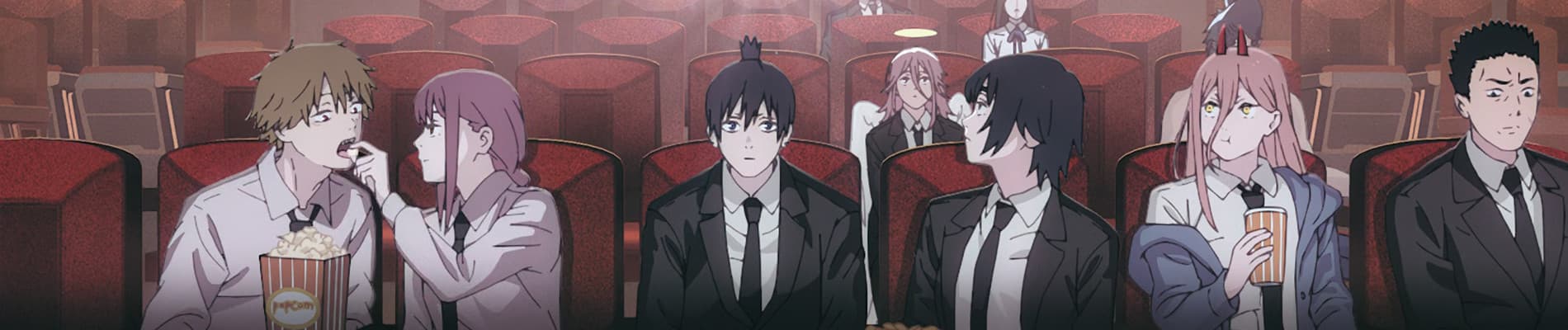
Most of the OP/ED sequences approach the material with the level of creativity and confidence required to really re-imagine Chainsaw Man as film. They get to the core of characters and spaces not just through color or Cinematic™ shot composition, but also line, texture, material and every other building block of animation. They also represent the B-movies the series itself refuses to acknowledge despite their relevance to Fujimoto's vision. I can only dream of what the anime would look like if all that style was weaved into its fabric instead of attached to its limbs as a testament to the sheer size of the IP.
▶ VideoWhat we have now is a very solid product that the team has every right to be proud of. It has its own strengths: a quiet melancholy that suffocates the world and everyone in it, people fighting it in fleeting shows of humanity, an eye for fast, brutal violence and a lot of individually incredible images and sequences. When the tone and content match and the cinematic approach clicks, it's beautiful. It's good enough to get people to care about the manga and, honestly, that's enough for me to be happy, but still, I can't help looking back on the EDs and fan works and wishing that unhinged, freeform enthusiasm for a medium could really go somewhere.
(It did go somewhere. It's Bocchi. It's Bocchi the Rock.)
Thanks for reading! You can comment on this review here. It's not a very comprehensive look, but I think a "big" anime like this one speaks for itself when it comes to technical prowess. I should mention, if only here, that there couldn't have been enough time to make the series as the varied, experimental thing I wanted. It's easier to create individual sequences in different teams than to coordinate a FLCL-type affair, especially in like two years. The team had an assignment and they delivered, it's just that circumstances called for a disappointing approach.
84.5 out of 91 users liked this review
