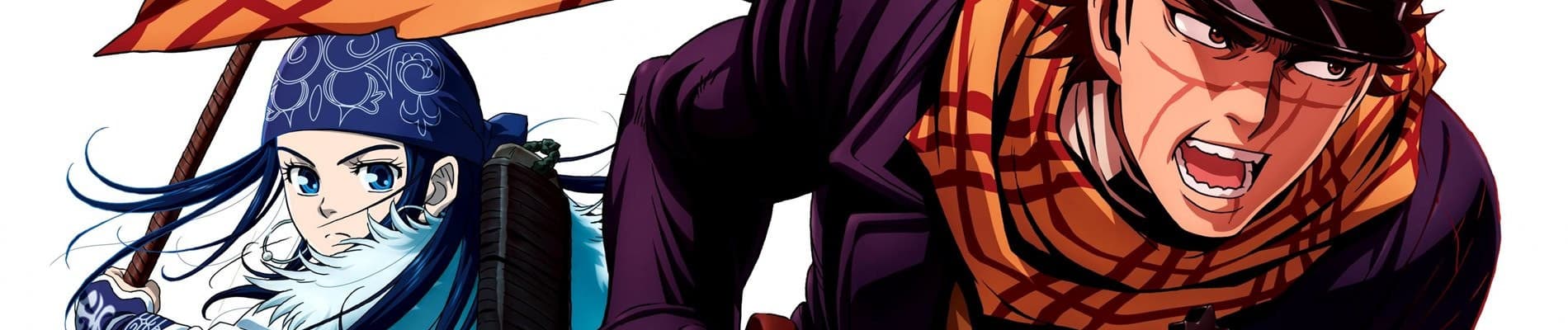
Golden Kamuy
a review by RebelPanda
a review by RebelPanda
Golden Kamuy tells an action-packed treasure hunting story, it deftly weaves in an unflinching portrayal of Ainu culture. The in-depth detail that the culture is shown in is likely thanks to the Ainu consultant on the production staff, ensuring the greatest accuracy possible. Moreover, this series never shies away from discussing the ugly way Japan treated the Ainu in the past either, in turn making the story more realistic and believable.
The story follows Saichi “The Immortal” Sugimoto, a gruff survivor of the Russo-Japanese war. Famous for violently slaughtering his foes to escape from dozens of life-threatening combat situations; as we see in many thrilling action sequences he’ll never be content with death, motivated by his unfinished business. Panning for gold during winter in Hokkaido’s wilderness is how he spends his time nowadays, desperate for money to keep a promise he made to his friend who died during the war. Lucky for him, he hears of a wild tale about a man who murdered a group of Ainu men, stole hundreds of pounds of gold, hid it in Hokkaido before his arrest, then tattooed a treasure map onto the bodies of his fellow prisoners.
In the opening episode, Sugimoto fights for a prisoner’s tattooed body with a bear who wants to make them both its next meal. Through a lucky encounter, he’s saved by a skilled Ainu hunter, a young girl named Asirpa. He confides the tale of hidden treasure in Asirpa, and together they begin their journey in search of it. As the story progresses it takes on a ‘prisoner of the week’ structure, but through constantly adding new characters the series avoids feeling formulaic. The prisoners have their own weird dispositions and stories of their own, gradually forming the greater narrative of what this treasure is all about. Despite its premise, Golden Kamuy’s plot structure flows in a surprisingly natural way. Sometimes an episode may revolve around the duo escaping authorities who are after the treasure as well. A handful of sadistic villains add a constant sense of danger even when they’re not locked in combat with a prisoner. Then there’s the prisoner Shiraishi, a foolhardy escape artist, who joins the lead duo on their journey. This liberated form of writing makes every episode feel like you're getting something new, despite it occasionally causing the pacing to meander on certain parts rather than consistently developing the story.
At first, Sugimoto and Asirpa’s relationship is an uneasy alliance, he needs her help to find the gold and she needs his help to find the man who murdered her father. Despite this beginning, they become friends and genuinely care about one another. Sugimoto sees firsthand how awfully people treat Ainu people by being around Asirpa, and he stands up for when he can because she accepts it being used to the racism. Fantastic commentary and discussion on the Ainu culture are deftly woven into their satisfying character arcs, never sounding preachy and somehow always excitingly presenting historical facts. Seeing them hunt with one another using Asirpa’s Ainu techniques is awesome; she teaches Sugimoto them as well and it brings plenty of chemistry but also strengthens their bond. The hunting methods she uses are always quite clever and lend themselves excellently to action scenes. Like Asirpa may teach Sugimoto and the viewer how to make squirrel traps to foreshadow its use later during a higher stakes combat scene. This is how you write an action scene! We’re presented with clever ideas then they return later on to be used in creative ways, a satisfying outcome for any viewer keeping track of the Ainu lessons. Rewarding payoffs like this make Golden Kamuy such an enjoyable experience.
The show well to avoid framing Sugimoto as better than Asirpa’s at the Ainu techniques that she taught him. Many stories land in this pitfall while trying to portray indigenous tribes, having the foreigner beat them at their own game not realizing how condescending that framing could be seen by the natives. Thankfully this does not happen in Golden Kamuy because it is intelligently and respectfully written.
Weighing down Golden Kamuy's adaptation the most is the mediocre visuals that fail to elevate the strong writing beyond the manga. It's clear the newly opened Geno Studio tried their best, but picking an action series to work on may have been out of their full capabilities. Backgrounds are messy and flat, character animation is passable but oversimplifies the manga’s great designs, and that hideous CGI bear looks like something out of a PS1 game. However, the opening "Winding Road" by Man With a Mission is fantastic, well-edited, and intensely performed, it's well suited to a survival series like this one. The ending theme "Hibana" is also one of the best of the season, a great alternative rock that showcases detailed art from the manga.
Even with all of the high points Golden Kamuy has, I would consider the pitch-perfect tone to be its biggest strength. The show blends comedy with the gritty premise, the tone is balanced amazingly. Noboru Takagi, the guy who adapted Baccano also adapted this series’ already great source material, which is likely why the dialogue is so snappy and never feels slow or lacking. And this writing is only elevated by the fantastic voice acting; Asirpa’s seriousness played to comedic effect, Shiraishi’s goofy disregard for danger, Sugimoto’s fierceness in action sequences, it’s all excellent. The banter between Asirpa and Sugimoto is wonderfully lighthearted too, some of their expressions are hilariously exaggerated too. The action scenes are typically over-the-top with gore because of the wild personalities of all the characters, there is a scene with Sugimoto punching a bear! None of the violence feels like it's there for shock value either; they are in a survival situation, after all. Their lives are constantly in danger from enemies and their hunting for food is shown in visceral but realistic detail.
The tone is further balanced by the wonderful detail put into describing the food the group eats, using Ainu’s strangely delicious-looking recipes to showcase their culture. While there’s a fair share of dramatic scenes, the show always maintains its wry charm thanks to the characters. Regardless of how absurdly dangerous their survival situation might be.
Regardless of Golden Kamuy’s production flaws, its writing is way too good to not recommend. I would also recommend seeking out the manga as well if you want to see the series art at a higher quality. With a second season coming in the Fall Season, we can only hope it is produced by someone other than Geno Studio. Nevertheless, Golden Kamuy is an insightful and worthwhile adventure that manages to thrill with compelling action and endear with its fantastic characters in equal parts.
28.5 out of 35 users liked this review
