In/Spectre
a review by RebelPanda
a review by RebelPanda
Words, words, words. What the hell do they even mean? Well, I don’t know! But someone has to figure out what the hell this show is about and whether or not it’s good. Lucky for you, I happen to be extremely qualified in deciphering bullshit, and In/Spectre certainly is grade-A bullshit.
Where do I even begin untangling this web of nonsense? First of all, there’s so much goddamn talking. If you want to see some good animation, find a different anime! But is the dialogue good or bad? Let’s establish a criterion. Dialogue-heavy anime can work well if the writing is witty, informative, believable, and INTERESTING! We’ve seen this done right in Monogatari, Tatami Galaxy, and Oregairu. In/Spectre is comparatively very lacking. Simply put, this is like a battle shounen, very drawn out fights, but replace fights with people talking in one place. Exciting, right? Now imagine five episodes of people talking in a car about ghosts, meanwhile, there’s a never-ending fight happening between two people who cannot die. Have I sold you yet?
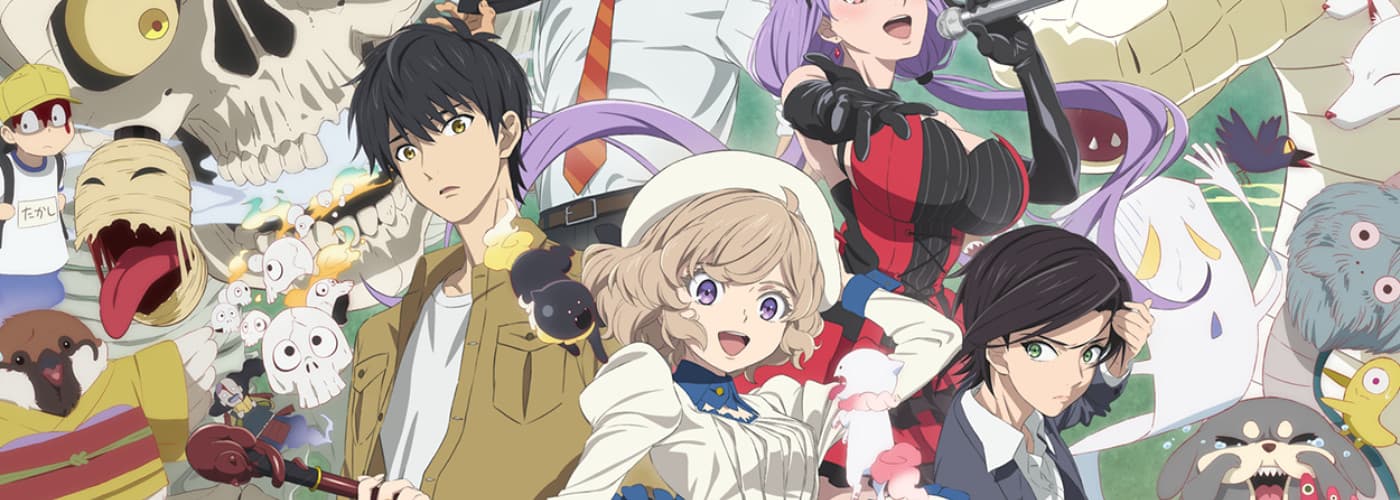
The script is drier than a desert, but occasionally there’s some wit. The main character, Big Brain Goddess Kotoko, seems very self-aware that she’s an annoying little gremlin. Her design is cool, stylish, composed, and she’s missing an eye and a leg. Comparatively, her boyfriend, Kuro, is pretty bland—both his looks and personality. He’s only interesting because he can heal instantly and his blood poisons spirits (this is barely used). Together, their banter is witty when they’re not droning on about things that have nothing to do with them, or things that have no bearing on the plot. Unfortunately, this is like 90% of their dialogue. I can’t even tell you why they’re dating. Kotoko meets him at a hospital, falls in love because he reminds her of a goat (this is seriously what happens), then the nurses tell her his life story. I have no clue why this quiet, reserved guy told all of his business to a bunch of random nurses, but we’re supposed to believe he did. This is how we get any information, people dump exposition onto us.
Look, Mr. Author, I know writing is hard. But you should consider actually integrating information organically into your story, not vomiting exposition onto the audience. Actually, I have a bone to pick with you, Mr. Author. Your story treats the audience like idiots—constantly telling us things we can figure out on our own. We’re not babies! Yet the writing is full of nonsense and artificial plotting. It’s as if you thought we were too stupid to notice the flaws, so you brazenly covered them up with pretentious platitudes! Banter aside, I don’t hate this anime. There are a few good things about it. There’s a funny scene when Kotoko randomly meets Kuro’s ex, Saki. She falls on Saki, then when asked if she’s ok, Kotoko says “Yes, this is nothing compared to being deflowered,” in a completely serious voice. What she’s saying is totally uncalled for, and Saki was just as shocked as I was. This kind of juxtaposition between presentation and dialogue makes for the best humor in the show. It’s just like the sassy giant serpent spirit in the second episode. When it embraces its goofiness, it’s fun enough to forgive how contrived it is. During the more serious second half, it feels very forced when they try adding humor. This is the bad kind of juxtaposition. When two tones are constantly conflicting, neither work.
My next gripe I have with you, Mr. Author, is the internal logic. I’m willing to indulge you by suspending my disbelief, but you broke it just like you broke my hopes this anime would be good. In one scene, Kotoko rides a ten-story tall skeleton like the badass bitch she is, and she can also physically interact with ghosts. Normal people cannot see spirits, as shown in prior scenes, so she would just be flying in their eyes. Let’s say spirits gravitate towards her and she can see them because she’s a priestess. However, Saki is also able to see ghosts, so what’s happening here? How is everyone else unable to see spirits? How are people able to see Steel Lady Nanase? What is the distinction? How am I supposed to suspend my disbelief if you haven’t shown me the rules of your world? If I missed crucial details, I will be happily proven wrong.
Early on, I didn’t mind the dialogue-heavy script. In the second episode, Kotoko is enlisted to solve a murder mystery. It has the tropes of a CSI TV show, with the addition of a cheeky serpent spirit who Kotoko questions. She speculates possible motives based on facts of the crime available to her, running through different scenarios with the addition of a spirit’s witness testimony. She’s an inspector of ghosts and spectres. Perhaps you could call her an… In/Spectre! This one self-contained story ended with a satisfying conclusion. It thrilled me for what the rest of the anime would be. For episodes 4-12, the main plotline is about solving the mystery of Steel Lady Nanase. It was disappointing that they scrapped the mystery-of-the-week structure for one long story, but I held out hope it’d be good. Initially, I didn’t hate Nanase. After eight episodes going in circles talking about her, with clues being very slowly revealed, I did hate her. She’s dead, we have no attachment to her, why should I care about this mystery? I liked the first story because it was fast-paced and entertaining, it didn’t overstay its welcome. But Nanase did. Rather than learning new intriguing things about her, all we got were people discussing the same questions. Is she real? Is she a ghost? Is she a manifestation of mass hysteria? Are her huge boobs fake? The answer is... Who the cares, stop playing 3D chess against your own brain and get a real hobby.
In/Spectre flies off the rails around the eighth episode. There’s a new concept at play—some people have the ability to basically open their third eye and choose their fate. It’s visualized as branching paths, which looks cool, but it makes no goddamn sense. If you can pick your fate, then you’ve already won, there’s no competition. But! If there are two people who can pick their fates, it would be a stalemate. The author seems to this would be exciting, once again, he was wrong. The stalemate becomes an excuse to draw out the final episodes to the point that you could just skip four of them and lose nothing. The story transitions from a mystery based on facts and clues to a pointless debate that boils down to sophistry to fill up screentime. In/Spectre’s author gets tangled up in his own web of bullshit so badly, I couldn’t care less about the result, I just wanted it to end. Please for the love of God do not make a sequel.
25 out of 41 users liked this review
