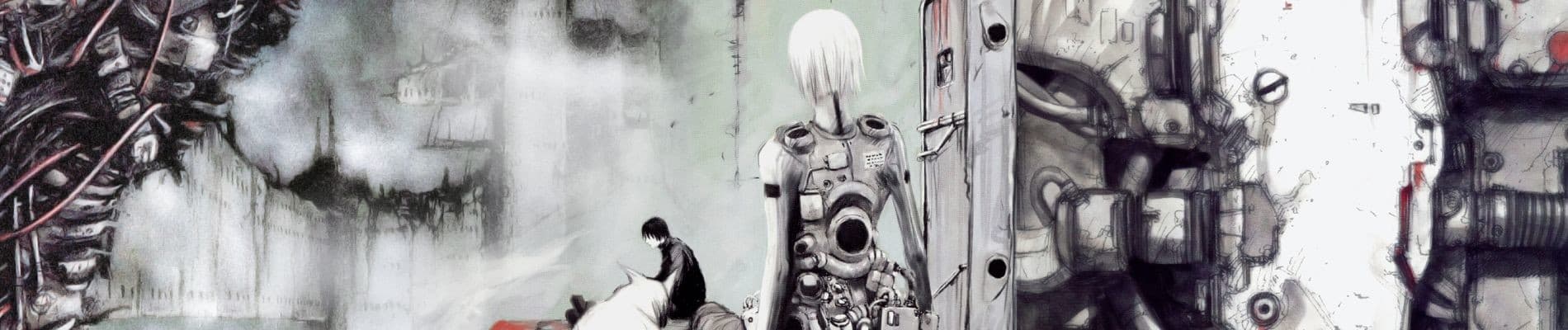
BLAME!
a review by MattSweatshirT
a review by MattSweatshirT
(some of the images in this expired ill fix it eventually or whatever)
"Maybe on Earth. Maybe in the Future."
Blame! is a series I’ve had a long relationship with that has developed continuously over time. It has always been something I’ve been innately pulled to. From the first time I saw a panel of it I knew it was a story I wanted to experience; a world I wanted to visit. My understanding of why I was so entranced by it has changed over the course of my revisiting it, consuming media about or adjacent to it, and just generally thinking about it a LOT.
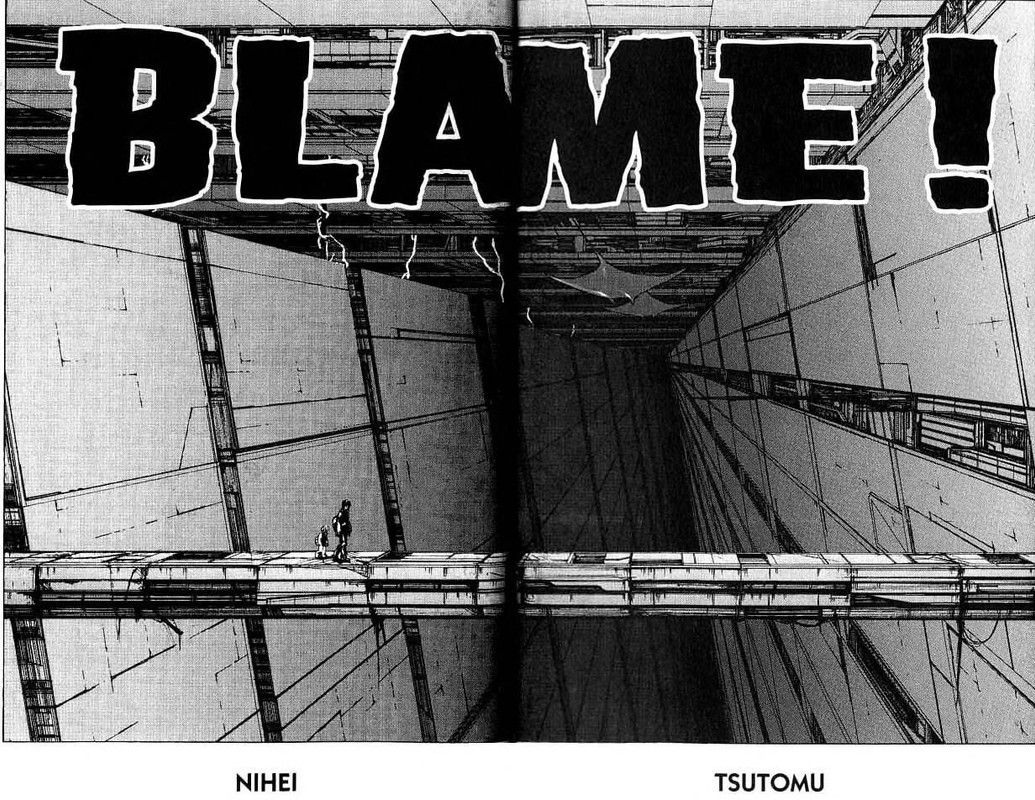
On its surface and for the most part, Blame! is just a high-intensity sci-fi action series strangely lacking in dialogue or exposition. And it succeeds quite well in this regard. The constant use of scale, innovative framing and paneling, and just ridiculously cool character/monster designs sell the impact of the various action scenes, even if they start out near incomprehensible. It’s a power fantasy, in a lot of ways. It puts the reader in the shoes of a self-insert main character who uses a gun to defeat anything and everything in his path, no matter how tremendous the task.

As simply a sci-fi, it has a wide array of incredibly imaginative ideas that it incorporates into the world and details all throughout. It’s significantly ahead of its time in its exploration of an advanced state of the internet and the ways it interacts with the physical world. It crafts an immense, sprawling world, wholly unlike our own. And it is its commitment to this world that I think is most impressive about it. Every organization, community of people, and system in place feels grounded in its own set of rules and way of existing within the world. It is a living, breathing ecosystem; unflinchingly real, rather than feeling fabricated for the sake of a narrative. The way the story itself is told echoes this commitment as well–with every character interaction and scrap of exposition being delivered in a grounded way, uncompromising for the sake of the audience’s convenience. The broken people left in this decrepit world, the indifferent emotional state of the main character, Killy, who has essentially lost any trace of his humanity at this point–everything in this story feels naturally conveyed for the purpose it serves. We only get a brief glimpse of the goings-on, because we are only following the perspective of one insignificant person within it all. Accessibility is sacrificed at every turn for this unified vision.
Beyond any other more technical world-building or narrative feats, though, the main reason I value this series so highly is its atmosphere and the more implicit, fundamental things it is able to express. In the downtime from the action, a powerful, existentially dreadful feeling is presented. So much time is spent in silence, with the art painting a picture of an empty, esoteric landscape. Its stature as a power fantasy is flipped on its head when Killy is faced with the world around him; The very nature of why we seek out power fantasies in the first place is deconstructed.

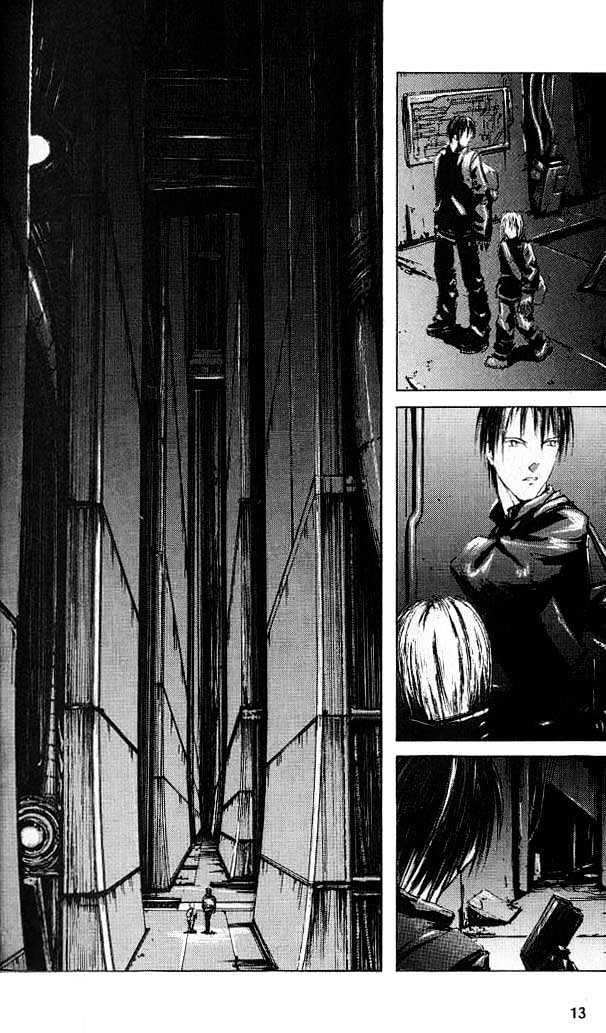
A small insignificant man wanders for an unknowable amount of time for unknown reasons through an immense, ruinous, overwhelming industrial landscape that seems to sprawl to the ends of the universe. The cavernous, organic biomechanical structures and world cascades in incomprehensibly complex ways as the comparatively minuscule man walks solemnly through it all. Hallways lead to nowhere. Huge villages are carved within cliff-like walls. Grand scientific facilities lay strewn about, abandoned. A world that seemingly once had a purpose, or perhaps never did, is now left facing the endless march of time with no meaning at all. An immense amount of mysteries are left unsolved, details left ignored, and things left to ponder about this world and the things going on in it. In this ambiguity, an entire universe of possibility is crafted–much like our own. This isolating depiction of this man in this world creates a claustrophobic and indescribable, yet somehow obsessively alluring, feeling.
Killy wanders through this never-ending structure, powerless in the face of it all. We seek out a fabricated, imagined power through stories, like most isekai for example, because we are powerless in relation to our universe. The world around us goes on, entirely uncompromising for our wants or needs–just as Blame!’s story is told in relation to the reader. We are forced to confront the world, to search for meaning, despite its apparent lack of anything of the sort–just as the reader is forced to do with Blame!.

In reading through it, you can’t help but feel a sense of desperation within Killy. A sense that he is lost, stuck searching for the unattainable, endlessly. Perhaps this is an expression of the plight of the artist, fleetingly attempting to capture their emotions through art. Perhaps it’s a more general depiction of the precarious existential nature of all of humanity. A striking embodiment of the simultaneously dreadful and beautiful feeling created by the universe and mortality’s endless mysteries and incomprehensible grandeur. An understanding of the insurmountable push of time and the inevitable unknown of death is what is ultimately at the root of this feeling. So much of what we strive to express, especially through the immortalization of our emotions into art, ends up reflecting this fleeting nature of life, often subconsciously. Knowing we are going to die someday is dreadful; But it’s also incredibly inspiring. This overwhelming nature of existence is both endlessly frightening and limitlessly freeing.
This paradoxical experience is particularly relevant in a sci-fi story that deals with the advancement of technology–which seems to further highlight that exact phenomenon. In Blame!, humans have created the Netsphere, an advanced state of the internet where they could materialize anything they imagined within the digital template. The further interconnectivity and communication technology brings to us is a double-edged sword. It offers us seemingly endless possibilities to learn about whatever we wish to, consume any kind of media at all times, and broaden our understanding of what we might do with and who we might become in our lives. It is also incredibly overwhelming. The sheer amount of information at our fingertips can contradictingly stop us from actually seeking out or doing various things with our lives. The scale of it all is incomprehensible. What is the point of seeking it out when it will never be enough? When you can know so much and still see no meaning to it all, it strips away any kind of fabricated power you felt you had at being in control of it. The advancement of technology can make each of us into a god, which is both endlessly frightening, and limitlessly freeing.


Now, I want to further discuss the architecture present in Blame! In the construction of the City, the mega-structure that constitutes Blame!’s world, people created Builders. Builders are enormous A.I. machines that have been programmed to create and expand the City. Humanity has long since lost control of the Builders, however, so now they create and expand perpetually, for no real purpose. This has resulted in the City’s construction to become almost absurd–with staircases to nowhere, proliferating pipes that serve no purpose, and all kinds of confounding architecture. Humanity’s attempt to seize control over the very structure of the universe, to create a world which is built entirely for the purpose of serving them, has broken free from their grasp and materialized an unassailable creation of its own instead.


Blame! to me is an inexhaustible source of wonder. Every time I revisit it I seem to discover a whole new branching aspect of its world’s history and narrative. The power dynamics and motivations of the various factions, the integration of unfathomable forms of technology, and the variety of just really cool character and world design is immensely impressive in itself. But more than that, Blame! will keep me coming back to it because of the masterfully well-realized, brooding atmosphere it creates, and the endless questions it forces me to ponder within it. This is what sci-fi should be–a unique and extensively thought-out extrapolation of society and the issues within it, or more intimate issues fundamental to humanity. An artistic landscape which uses every facet of its depiction to aid in the expression of those issues. Maybe through the use of a world wholly in our hands, a story, we can shed light on things in the real world and ourselves, which so often feel as though they are out of our hands.

41.5 out of 42 users liked this review
