
Fullmetal Alchemist (2003),
is amazing, it has staying power. It looks beautiful, sounds great and tells a story while not being canon, feels like you could slot it right in, like it's an alternate universe. I am glad I watched this after reading the manga and seeing Brotherhood as I am completely unbiased to nostalgia. My praise of this anime is not to sell the people on it who haven't seen it and are only interested in Brotherhood or the manga, but more so my genuine love for it as a standalone show.
- #Animation (9.4/10)
This is Studio BONES renaissance era. They started pushing the visual bar for TV anime around this time with things like Rahxephon, Wolf's Rain, Eureka Seven, Soul Eater, Darker than Black, etc. It just all around looks excellent, it's very clean for a show from its time and looks sharper resolution wise than Brotherhood a lot of the time. It is also helped and backed by a stacked staff team. Yutaka Nakamura is all over this show and he is always legendary, he only has one cut in Brotherhood. Underappreciated animation master, Norimitsu Suzuki also delivers in this 2003 adaption with some of the best character art you will see, I think he is the person who has gotten closest to how the FMA manga looks. It was very disappointing to see Yutaka Nakamura's lack of involvement on Brotherhood, but Yoshimichi Kameda picked up his slack in that adaption, another legendary animator. Although I think Brotherhood overall looks better, this is still amazing. There are strengths here Brotherhood lacks, like Yutaka Nakamura's fight animation, and atmosphere.
- # Sound (9/10)
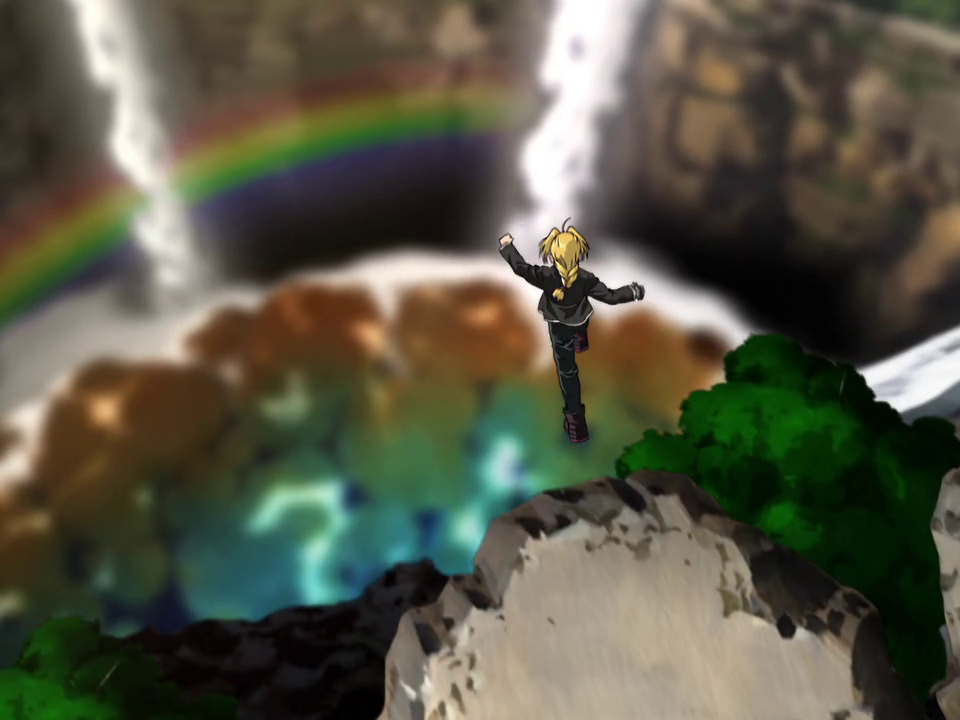
Michiru Oshima composes the soundtrack for this anime and the movie accompanying the anime. She also has done Tatami Galaxy and Little Witch Academia. It is moody while at the same time being mystical, it fits the mood and atmosphere of what is on display almost perfectly. The only reason it is not at a 10 is because I personally think Brotherhood has a slightly better soundtrack. Standout tracks are "Brothers", "Way Home" and "Dante". This show also has absolutely spectacular openings and endings. Opening 4 "Rewrite" by Asian Kung Fu Generation is genuinely my favorite opening of all time, Kou Yoshinari's cut in OP 4 of Edward jumping down into the waterfall will always remain mystical.
- #Story (8/10)
The world is unfair, sometimes you give it all you have and get nothing in return. Essentially just a story about two brothers always getting back up after being knocked down, the 2003 adaption strives for a story that focuses FAR more on the brothers themselves and the bond that keeps them together. At times it can be somber or downright dreadful and depressing. This tone is done very well and does not come off edgy, this is a strength Brotherhood has but doesn't tap into very much. The anime original story it veers into focuses quite a bit on Ishvalans and war as a whole. Things Edward and Al do cause riots and war, which weighs extremely heavy burdens on the boys. Certain Homunculus share names but are new, or might swap their names around, differing from Brotherhood. Homunculus are integral to the plot of this adaption and some of them are very in-depth. Lust is a major improvement in this adaption but I will save her for the characters section. The antagonist Dante is pretty interesting and has a clear motivation and attachment to Edward, she is chaotic. The ending of the show might seem bittersweet and a hard pill to swallow but even by itself I think it delivers on the themes the show has established. If you are reading this review you most likely know the real ending of this show is actually the 2005 movie, Fullmetal Alchemist: The Conqueror of Shamballa. I won't discuss it here but it is a mostly okay conclusion to the anime, it could have not existed and the anime would still hold the same value. The only thing holding this story back is odd pacing, it can be quite slow sometimes. Along with the occasional filler, now you might be asking "Isn't this all filler?" No. It is certainly not, there is anime original content here, and then some episodes that contribute absolutely nothing to the main plot, I think there are about three of them.
- #Characters (8/10)
A strong contingent. The focus on the bond the brothers share emulates somberness and a laser focus Brotherhood does not contain. This might make it seem like it doesn't branch out but it does, just not as much. The Elric brothers will not be a big focus here, they are the main part of the show but besides for having more focus on their bond, both of their ideology follow the manga and Brotherhood for the most part. The focus here should be on the distinct different or new characters this adaption has to offer.
Scar shares traits with his Brotherhood counterpart but is a lot younger and a lot louder. He is brutal and obviously suffering from his past. He's a victim of circumstance and war, given an arm he didn't ask for. He crafts his ideology around this arm he did not ask for, a revenge campaign against the state alchemists who massacred his people. Scar completes his campaign and honors the souls of the Ishvalan massacre inside his brothers arm, by activating the transmutation circle around the city of Reole, passing away soon after. He completed the Philosopher Stone. The Homunculus are basically overhalled in this adaption, some are entirely different or do little. One is a clear standout and improvement over Brotherhood, and that is Lust.
Lust in this adaption is a key player and shows up quite a bit, there is a lot more going on for her here. She was the fiancé of Scar's brother as a human, in this adaption failed human transmutations are what Homunculi are. She was created because Scar's brother attempted to revive his lover, she is the product of it. Her motivation is entirely different in this adaption, she seeks a philosopher stone and will even ally with the Elric brothers temporarily just to use it. She wants to become a human and die, so she can be with her lover, she desperately wants to experience death as she feels no need to live on in this body and wonders where she will end up when she dies. Her inner struggle is that her humanity was stolen from her by a botched transmutation, she hates existing as what she was formed into.
Dante is the main antagonist of this adaption and she is very interesting. Unlike Father from Brotherhood, Dante does not wish to be above
absolutely every being in the world, just the humans. She has a god-complex and thinks humans are useless and stupid beings, very ironic considering she is human and by no means immortal, she refuses to acknowledge any of her hypocrisy though. She is selfish just like the humans she criticizes, and very arrogant which could be seen as ignorance depending on how you convey yourself. She wants mass control over everything in her path so she can use her connections to obtain Philosopher Stones and has no empathy for the wars or lives she starts and ends on the path. Treating humans like beings below her is telling as she relies on Philosopher Stones to survive, without the human race she is nothing, and her race to gather more stones is forfeit. Her ego is massive and it deforms her view of the world, she is just as low as any other human with normal struggles and life. She lives for the control, to become a perfect being and watch the chaos.
Summary
It's dark and depressing but very worthy of the title Fullmetal Alchemist. It might not be Brotherhood, but it is still extremely worthwhile. Great animation, music and atmosphere. Studio BONES did the impossible task of creating and animating their own original plot and having it be high quality. I highly suggest this to FMA fans who haven't seen this adaption and people who just want to watch a good anime, it can be a gateway for new anime fans.