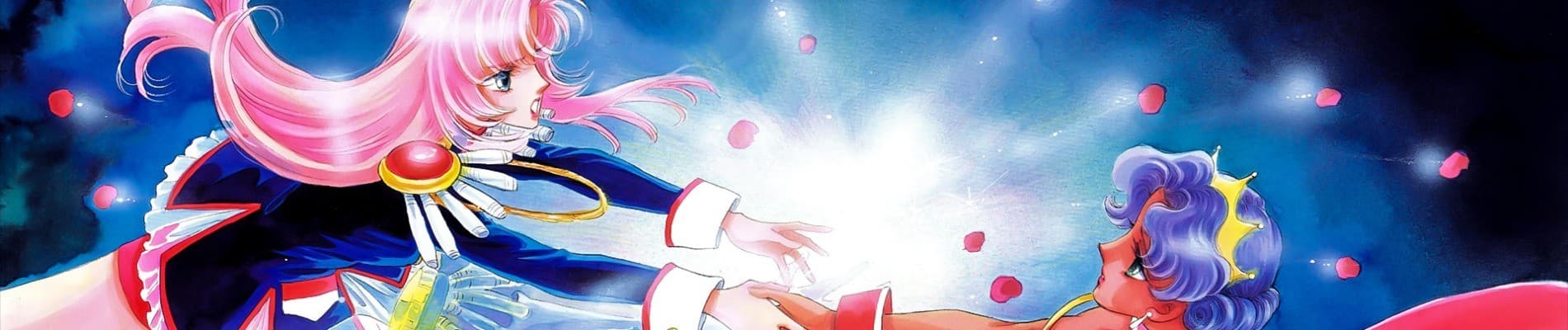

This is my very spoilery love letter to Shoujo Kakumei Utena, my favorite anime of all time.
Utena is an anime that holds a special place in my heart, and one that I believe deserves recognition as one of the most impactful and important anime of all time. This groundbreaking series fearlessly challenges patriarchal norms and harmful ideologies that continue to plague the world and the anime industry to this day. Utena stands for the dismantling of rigid gender roles and the rejection of objectification, misogyny, toxic masculinity, and abusive relationships. It's hard to find another anime that so effectively addresses such a wide range of important issues, and for me, it will be difficult to ever find an anime that surpasses Utena in its ability to make a meaningful impact on viewers.

Utena is a series that reaches new heights of creativity and nuance. From the overflowing symbolism, surrealist imagery, and attention to detail, every aspect of the show feels deliberately crafted to weave a rich web of meaning. As a viewer, you are constantly rewarded for analyzing the symbolism and imagery, as they build upon the world and deepen the already incredibly developed characters. Unlike some shows that use obscure symbolism as a crutch for uninteresting narratives, Utena masterfully balances a compelling and emotional story with rich layers of allegory and allusion, creating one of the most captivating and rewarding watching experiences I have ever had. The fact that director and screenwriter Kunihiko Ikuhara was able to create such a tightly knit and expansive series on a troublesome budget is a testament to his skill and vision.

Ikuhara's work was a revelation to me. As a first-time viewer of his creations, I was immediately struck by his passion for theater and his unique storytelling style. From the recurring motifs to the surrealist imagery, it's easy to tell that his work is like no other in the anime industry. He has quickly and effortlessly become my favorite creator in the field. As a director, Ikuhara embraces symbolism and surrealism, adding a layer of mystery to what could be in-your-face symbolism. He has stated that he deliberately makes his work ambiguous, allowing viewers to come to their own conclusions, rather than being spoon-fed ideas with one distinct answer. This style of writing may take some getting used to, but for me, it quickly became a beloved aspect of his work. It is this ambiguity, coupled with his unique storytelling, that makes Ikuhara's work some of the most compelling and thought-provoking in the medium.

This is just between you and me, but when I was fourteen, I saw a UFO. That UFO telepathically told me this prophecy: "When you grow up, you will direct an anime about girls revolutionizing various things."
Surely you jest.
You must not tell anyone about me. If you ever do...
Wh-What will happen to me?
People will call you a sketchy guy.
Utena is a series that truly excels in its character development. Every prominent character is fully fleshed out, with their own unique strengths and weaknesses, and a depth that goes beyond surface appearances. Even the characters who initially seem like comedic relief are quickly revealed to have their own troubled pasts and become fully realized individuals. The show never treats any character as a one-dimensional stereotype, and instead, gives each person a complex and nuanced personality that makes them feel like real people.
Tenjou Utena, our protagonist, is a complex and dynamic character that embodies the rebellion against gender roles. Desperate to be a prince because of the prince who saved her as a child, Utena's goal is empowering but not foolproof. She is by no means perfect, her actions are often naive and she fails to consider the consequences of her actions and the impact on those she tries to save. She is quickly paired up with Anthy, seeing her as someone who needs to be saved. She is completely blinded by her desire to be a prince. As the story unfolds, Utena learns that perhaps the answer isn't to mirror the prince that saved her, but to become something new and break free from societal norms and expectations. Throughout the show, Utena continues to fight and win both mental and physical battles, but in the end, Utena fails to save her love. She is faced with one final opportunity to save Anthy but ultimately fails. In a powerful moment, she regretfully states, "I guess, in the end, I couldn't be a prince. Forgive me, Anthy, for pretending to be a prince". This show is an ode to the empowerment of oppressed women and the importance of breaking free from societal norms and expectations in order to truly live. It's not an easy task, but it is one that has been important for centuries.

“You really don’t know what happened, do you? It doesn’t matter. By all means, stay in this cozy coffin of yours and continue to play prince. But I have to go now. She’s not gone at all, she merely vanished form your world. Farewell.” – Anthy Himemiya
Anthy Himemiya, the rose bride, is a complex and compelling character that represents the struggles of women and minorities in an oppressive world. Throughout the show, Anthy is subjected to verbal and physical abuse for the smallest of things, leaving the audience questioning why she is treated so horribly. The answer to this question is not fully revealed until the end of the show, where it becomes clear that Anthy embodies the struggles of womanhood under the patriarchy, where women are treated as objects, shamed for their actions, and constantly abused for simply existing. Instead of holding the men accountable for their actions, Anthy is blamed and made to feel like she is at fault for the abuse she endures. This is a representation of the reality of abusive relationships, where the victim often feels trapped and guilty for the abuse they suffer. The show highlights the fact that escaping an abusive relationship is not as simple as leaving, it takes work, and often the effort of both the victim and an outside source to break the cycle. The message is clear that no matter how much one may want to be saved, they must reach out for help themselves. Without self-empowerment, the abuse may go unseen. Anthy will never be able to truly live while she is shadowed by the patriarchy of Ohtori Academy.

“People find it hard to doubt those they’ve fallen in love with. They can’t even imagine they’re being deceived and used.” – Anthy Himemiya
Akio Ohtori, the embodiment of toxic masculinity, serves as the main antagonist of the series. Initially presented as the "prince" Utena aspires to become, Akio is revealed to be nothing more than a shell of a prince, consumed by the harmful expectations placed upon him by society to always act strong and never rely on others for help. The show never justifies his actions, instead it delves deep into his past and the events that led him to become the person he is. When faced with a situation he couldn't control, Anthy stood up for him, but instead of listening to her, the world blamed her, a woman, for holding him back. This is the origin of Anthy's oppression and a reflection of the flawed societal views of gender roles that continue to harm and oppress people. As Akio continues to spiral downward, placing the blame on Anthy and trapping her in an abusive relationship, he uses her as an object to satisfy his anger and lust. This attitude is mirrored onto virtually the entire cast through the horrific "car ride" sequences, highlighting the need to recognize and reject toxic masculinity in all its forms.

“Women who cannot become princesses have no choice but to become witches.” – Akio Ohtori
A testament to the world's flawed view that women must be "pure".
Nanami Kiryuu, at first glance, may seem like just another comedic side character, but as the story unfolds, her own personal struggles are revealed. Behind her façade of poise and confidence lies a young woman desperate to regain the close relationship she once shared with her brother Touga. She watches in dismay as he indulges in his playboy ways, exploiting the hearts of her schoolmates for his own personal gain. In her quest to mature and reconnect with him, she finds herself caught in a web of deceit and manipulation. In a shocking confrontation with her brother, Nanami realizes that he is driven solely by his own desire and lacks any sense of morality. Through this realization, Nanami comes to understand that her own actions were not true to herself and that her true desires were clouded by her longing for familial connection. Though she may be portrayed as stubborn and bratty, Nanami's character is a poignant portrayal of the struggles of young people caught between the expectations of adulthood and the longing for childhood innocence.

"My brother is my brother. I can't just ignore everything that's happened. Because I love him...because I love my brother!" - Nanami Kiryuu
Chuchu, the lovable and quirky mascot character of the series, undergoes a subtle yet profound transformation as the story progresses. Initially, their red and yellow tie serves as a symbol of their connection to the sinister Akio, who uses them as a tool to manipulate and control Anthy. However, as the series reaches its climax, Chuchu sheds this symbol of oppression and declares their independence from Akio and his toxic hold on Anthy. This small act serves as a representation of the journey towards self-empowerment and breaking free from abusive relationships. Chuchu's development, though subtle, serves as a reminder that even the smallest actions can have a big impact in the fight against oppression and abuse.

Throughout the series, there are recurring allusions to time, with a sense that something is amiss with how time flows at Ohtori Academy. The school is not just an institution of learning, but rather a place where those who can't move on in life become trapped. Each character in the academy is bound by their own set of personal struggles, and it is only through facing them head-on and working to improve themselves that they can break free. The academy serves as a reflection of the complexities of youth, where the characters are forced to confront the good and bad aspects of themselves and make a choice to either overcome or be consumed by them. Time seems to stand still within the academy, representing the idea that until one can move on from their past, they will be forever trapped in a never-ending cycle. The academy serves as a direct reminder that true progress can only be achieved through growth and self-improvement.

Shoujo Kakumei Utena is also a series that is renowned for its queer subtext and representation. The most prominent example of this is the relationship between Utena and Anthy. From the very beginning of the series, it is clear that the two have a deep and complex connection. Their relationship is not only one of savior and savior-ee, but also one of love and companionship. Utena is immediately drawn to Anthy and is determined to save her from the abuse and manipulation she is subjected to by the other characters. Throughout the series, Utena's feelings for Anthy become increasingly clear, as she puts herself in danger to protect her and is willing to fight for her freedom. On the other hand, Anthy's feelings for Utena are not as clear cut, but it is evident that she cares deeply for her and is willing to sacrifice herself for her. The two share moments of intimacy, both physical and emotional, that further solidify their bond. Utena and Anthy's relationship serves as a profund representation of the complexities and nuances of queer love and the importance of fighting for and protecting those we care about.

Utena: Listen, if you ever have a problem, come to me first. I want us to be friends like that. And someday, together...
Anthy: Someday together...?
Ending text: Someday, Together, We'll Shine.
Utena is a treasure trove of symbolism, surrealist imagery, and attention to detail that rewards viewers with each rewatch. The series masterfully balances a compelling and emotional narrative with layers of allegory and allusion, making it one of the most captivating viewing experiences in any medium. The fact that creator, Ikuhara, was able to create such a tightly-knit and expansive series on a limited budget is a testament to his skill as a screenwriter and director. But, what truly sets Utena apart is its ability to delve deep into the complexities of gender roles, power dynamics, and the human condition, making it not just a visual spectacle but an intellectually stimulating and emotional one as well. It's a show that I will continue to revisit for years to come, uncovering new insights and appreciation for its brilliance with each viewing. Utena will forever hold a legacy as one of the most important and ambitious anime of all time and it's my favorite anime of all time.


Thank you Shoujo Kakumei Utena. (I'm cheesy as hell I know)
"If it cannot break its egg's shell, a chick will die without being born. We are the chick. The world is our egg. If we don't crack the world's shell, we will die without being born. Smash the world's shell!" - Kiryuu Touga