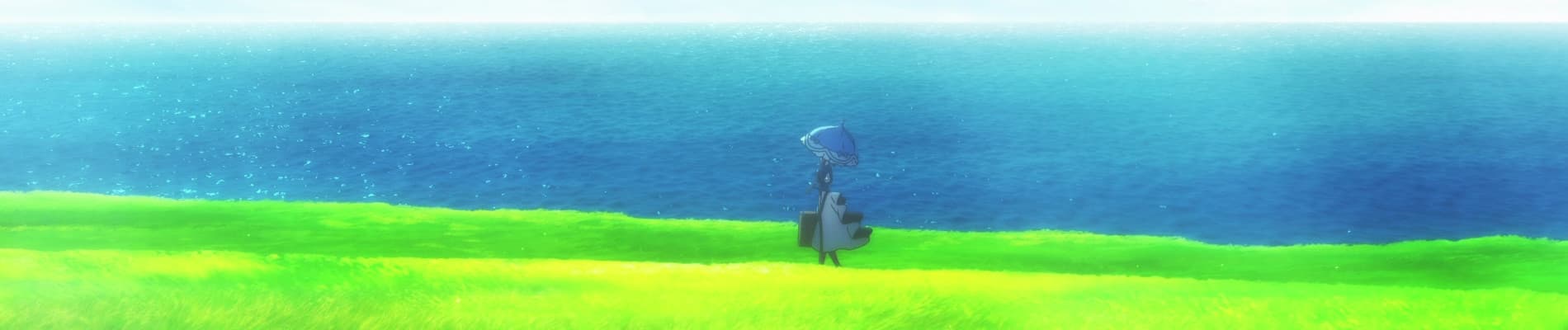
Violet Evergarden took me by surprise by posing the premise of the series at the end of the first episode: Violet wishes to know what "I love you" means and hopes to find her answer through becoming an Auto Memory Doll.
This is a topic that I will delve into later, as the question's intimate nature is significantly more subjective to answer in comparison to some more well-known and generally agreed upon categories such as the ones listed below.
Some comments, prior to the numerical ratings themselves:
Onto the categories:
Animation: 10/10. It's a perfect mix between Ghibli aesthetics and a clean, easy on the eyes finish. There isn't a single ugly character or background in this whole series. The nature scenes, cities, night skies, snowstorms, and sunrises are to die for. If I had a high resolution folder of images from the series I'd consider making of them wallpapers.
Characters: 7/10. They're flawed, they're real, simple when they need to be. There isn't a particular character that I would label as detestable, they're all incredibly well-designed, and each one has their own charm. I like being able to see how Violet can impact them with her sincerity. I wouldn't say that all of the characters are incredibly memorable, and there were some off moments where I couldn't understand the interactions between them (such as Cattleya's quip at the President towards the end). I found myself getting a bit more attached to Violet's clients than the supporting cast, and for that I feel compelled to deduct points.
World Building: 8/10. The countries, regions, and cities all have cool names. The tragic nature of Violet's backstory, being directly tied to the way the world is built and expanded upon, helps make the reality of war and post-war life much more impactful to a viewer. If there were a whole map I could follow along when some history is being explained then the score would be higher. If I could learn more history about the world then it would be perfect. Of course, this is nothing more than just nitpicking on my behalf; I have to admit that within the context of the series's premise, the geographical layout and borders of the countries aren't significant. I'm just an absolute world-building enthusiast and can really appreciate when geopolitical factors are expounded upon.
OST: 6/10. Not particularly impactful, but it isn't awful to hear. Some pieces are very nice--- I remember enjoying the violin that played when Leon and Violet were stargazing. OSTs only get rated above an 8/10 if they make me shed a tear. This OST didn't make me cry.
Character Design: 10/10. A character's color palette, clothing choice, hairstyle and even their accessories greatly reflect their characterization and personality. Take the President's disheveled look and kind eyes, for example: they show the viewer his caring and laid-back nature. Violet initially looks introspective, empty; and Luculia looks kind, genuine, hurt. Maria looks as tender as Aidan described her to be. Another notable example of the incredible character design include Cattleya's outfit and accessories. They demand that she is the center of attention and that she stands out, and this she does, given that she is so requested and was the CH Postal Company's poster child.
Overall, in spite of the myriad positive aspects and commendable attributes this series has, I feel that it has done its purpose in being watched once. I can't really see myself rewatching the series again for the sake of hedonistic enjoyment in the future; I now know what Violet's searching for, the journey she went through, and the conclusion she reached. The series isn't particularly addicting by itself. It certainly is a gateway into indulging series that deal with philosophical themes / question the human condition, though.
__
Violet's quest throughout the course of the anime struck incredibly close to home--- as I'm sure it did for countless other people out there--- because questioning what love really is happens to be a natural consequence of experiencing great grief and/or confusion.
(After all, this is the question raised that tied me into continuing the series. I wanted to see if Violet eventually does learn what "I love you" means, and if my own definition of "I love you" changed because of her experiences.)
With that being said, I decided to write down what I defined love as prior to watching episode 2 and beyond. After this section, you can find how I made modifications to my definition, expanded upon it, and correlated it to Violet's findings / actions based on her journey.
Proceed with caution.
When I had just finished the first episode:
As time has passed, I've become both an NBA YoungBoy Certified Heartbreaker and an NBA YoungBoy Certified Heartbreakee. There is no easy way around this reality which has helped to shape me into the person I am today. This is still a pill I've struggled to swallow; I know I have caused great pain unto people I would have laid my life down for, and they caused great pain to me as well. I've loved so deeply and so honestly with everything I've ever had and that which I didn't possess--- sometimes I even came to wonder if all I was ever born to do was love and nurture. This aformentioned prospect terrified me. I've seen...so much, experienced so much, and lost so much...time and time again I've come to ask myself what love is as a consequence. I've had people ask me, on more than one occasion, how I could allow myself to love again after all the betrayal, neglect, manipulation, and deception I was involved in.
I've been called stupid, I've been called bold, I've been called hopeless and I've been called brave.
Throughout the years, I've come up with answers such as "love is a promise ", "love is sacrifice ", "love is trust ", "love is selflessness ", "love is loyalty ", and "love is putting the needs of another above your own ". I wouldn't say that these definitions are incorrect with respect to the meaning I will establish below; I would instead say it is more accurate to infer that my definition becomes more precise as I gain more information and can adapt the meaning of the phrase, word, emotion, whatever, to my own experiences. With every modification to love's definition I feel like I've just circled around the essence of what it truly means to love someone. As of right now, then, what does "I love you" entail to me?:
I believed that love is a choice.
Hold on--- I know this sounds shallow and perhaps a bit incomplete. I'll debrief you before I explain why, exactly, I believed love is a choice.
Many of the platonic and romantic relationships I got into in the past were with people that had abysmal communication skills. As a consequence, I would often times be unaware of whether or not I was doing something wrong or if I was being too much. I was also often idolized and objectified, I guess. There existed this immaculate and do-no-wrong version of me which was never real inside the heads of these people, so when I allowed myself to be weak, upset, angry, and show traces of emotions that can be interpreted as negative around them, they would take their frustrations and disappointment out on me. I would never paint myself as a perfect person; I am aware of the fact that I cannot, and will never, please everyone. This doesn't bother me at all. I am only human, and only human; this is a fact that people in the past had a hard time stomaching, I guess. Because of these past experiences, I believe:
Love is when you choose to stay with someone and see the best in them after they irritate you, anger you, confuse you, and hurt your feelings. Love is acknowledging that someone has insecurities they struggle with, issues that they have yet to settle--- and still choosing to see the best in this person, recognizing their individuality, and acknowledging that you're willing to be there for through thick, thin, and everything in between .
When I love someone, like my friends for example, I choose to develop fondness for them because of everything they are and everything they aren't. Of course, this includes accepting the parts of them that might irritate me or upset me every so often. Especially because of what I've lived through, I refuse to paint a portrait of perfection out of anyone--- I would always rather see someone as a flawed and genuine human being than as an entity or a deity to worship, praising something as faux as it is 'flawless'.
I've come to learn time and time again that you cannot control or suppress that which you feel for someone no matter how hard you try to do so. You cannot control how you feel, but you can choose what you do with those feelings and how you act upon them. For example: person A can unwittingly develop feelings for person B. Person A can choose to pursue them and allow themselves honesty about the situation. Person A can also choose to ignore their feelings, pretend they don't exist, and mask the ache with something to distract them.
(In either scenario, it is safe to say that the way you feel can affect what you do, and that what you do can, in turn, affect the way you will feel.)
I could, therefore, make the argument that in the former situation person A chooses to plant the seed of a blooming love. Person A is allowing themselves to love in making the choice to practice honesty with themselves and be vulnerable.
After I finished the series:
When you love someone so deeply that you lose your sense of self, you attach your worth and purpose to that person's existence. Having been on both the receiving and giving end of that prior statement is a thousand times worse than it sounds. Seeing Violet tremble on screen, telling Gilbert that her life only had purpose because she received his orders rang terribly close to a younger and fragile Katherine that believed love was her only lifeline. In a time long past, I felt that life had no meaning without the company of some people I cherished. I felt I had no purpose if I wasn't to exist in my ex-partners' eyes and be everything he wanted me to be and more.
Time and time again my heart would collapse on itself as my stomach turned inside out; and, fortunately, time and time again I would recover. Violet might not have been able to forget and forgo her Major's existence completely, but she did go through a grieving process and eventually came to accept everything that happened as she learned to live a life that could bring her happiness.
Something Gilbert's mother told Violet in the last episode stuck with me. Attempting to comfort a crying Violet, she mused that those we love will forever live on as a piece of us. We can choose to carry the tenderness and memory of another with us in our hearts as we go about our lives even if the individual is a part of that life no longer.
There is a premise of that statement that I disagree with:
I know it is possible to stop loving someone because, well, I've done it myself. I feel that I don't carry those I used to love with me because I am not a nostalgic person and I would always prefer counting my current blessings over mulling the past. Does my lack of taking my ex-friends, my ex-lovers, and my ex-'you-were-so-important-to-me's alongside me for the rest of my journey mean my love wasn't real? Of course not. My approach to grief and dealing with the past isn't any less legitimate than Violet's, for example, just because it isn't sentimental.
(This live and let go approach is more of a consequence of my pragmatism than anything else, truly. I find peace in it.)
Violet Evergarden explored so many different types of love throughout her journey. She explored storge with Cattleya, Iris, Erica, the President, and more by allowing herself to form strong bonds with the people around her. She explored ludus with Ann, tending to her and indulging the child so that she'd know she was cared for even if her mother was ill. Violet consoled and advised Princess Charlotte on how she should act with Prince Damian, even going so far as to pull strings to allow the pair to be honest with each other about their emotions, personalities, and shared future. Through this, she got to witness the development of blooming romantic love firsthand. She came to understand fillial love by learning about, and sympathizing, with the Marlborough siblings' situation. She even got to vicariously experience both eros and agape through writing Aidan's letters for Maria and his parents respectively. She gave shape and came to understand her pragma for Gilbert by choosing to accept him as a part of her forever, demonstrated by her love for the brooch that matches his eyes. Most important for Violet's character development, she experienced philautia by choosing to assert herself and embracing living, not because of anyone's orders but because she wanted to carry on knowing that the tenderness Gilbert treated her with would always be by her side. Violet Evergarden learned that "I Love You" is so much more than a simple sentence with just one explanation or connotation. I suppose I did as well. *
For Fuck's sake--- Violet's limbs were blown off and all she could think about was getting her Major to safety, nevermind her blood loss or her own condition. By the way, I believe that the parallel between how she lost her arms the first time while defending Gilbert versus how she lost her arms the second time while fighting for her country / dismantling the bomb was beautiful. In both instances she acted out of love, but the Violet from the first episode could've never reached the lengths and demonstration of conscious love that our Violet came to embody.
Now, this begs the question that no one's been waiting for me to answer... how did my perception on the meaning of "I love you" change?
Well, prior to watching this series, and as a consequence of having felt misunderstood in many close relationships in the past, I felt that knowing someone deeply and entirely was a necessary prerequisite for loving them. After finishing it, though, I came to a realization: although Violet did not know all of Gilbert's secrets and didn't see herself as his equal, she certainly loved him. Would this caveat, perhaps, extend to less dire circumstances? When does someone realize that they've fallen in love? Perhaps my thinking shouldn't be so rigid and I should allow my definitions to be more flexible.
Love is many things for me. I show people I love them by showing them that I care about their well being, doing things for them without expecting their praise, comforting them, trusting them, and being willing to be honest.
Perhaps love is less about the abstraction, the "what does it mean?" , the introspection, the carefully dedicated time... and is more about the lengths you're willing to reach for another person, given that when I love someone I will trek heaven and hell to ensure that we can arrive at the point where they know that my affection is unwavering. People have different ways of demonstrating this aforementioned state, too: some write poems, others write songs, others erect statues or elaborate paintings. Some people design puzzles or make cute programs, others buy simple gifts, others are open to physical touch, and others still tease.
I am certain that there are a million different ways you can show someone that they're on your mind and in your heart. Maybe to love someone is to show them you care for their well being very deeply and ensuring that they know they are appreciated. This feels a bit deeper than just acknowledging someone's worst alongside their best and understanding them. In hindsight, I feel that you can acknowledge that people have good and bad sides by, I don't know, practicing empathy I suppose.
I feel like this is what I might have been missing all along --- for months, I had been under the impression that love could perhaps be boxed and that certain criteria had to be met in order to establish the legitimacy of the state, feeling, whatever you call it. Now I can't help but wonder if love is what you can do for someone above all else. Writing this, I find myself hoping that those I love know how much they mean to me. (And, of course, I still wouldn't change anything about them in order to make them more "perfected" versions of themselves in my eyes. I choose to still love someone for what they are, warts and all.)
Aftermath
I would say that this anime impacted the way I think, the way I feel, and the way I will choose to approach intangible and stuffy human emotions in the future. I will never in my life regret having caved into my friend's adamant recommendation of such a touching story. I feel very privileged to be able to reach these conclusions and extrapolate insights based on such abstract concepts, and I especially appreciate you, dearest reader, for even making it this far. In the spirit of this review, don't forget to show someone special that you love them, even if you don't say it explicitly. Trust me when I tell you that I know from the bottom of my heart how embarrassing a bold proclamation of affection can be. It's mortifying to be that vulnerable, right? Even still, some discomforts or moments of anxiety are certainly worth the payoff--- that is to say that perhaps seeing the smile painted on someone's face or hearing laughter ring in their voice is better to experience than any apprehension that could be holding you back.
Thank you, and take care. Drink water, try to get some sleep, and humor those you care about.
31 out of 32 users liked this review