Castle in the Sky
a review by Wilza
a review by Wilza
####This review contains spoilers.
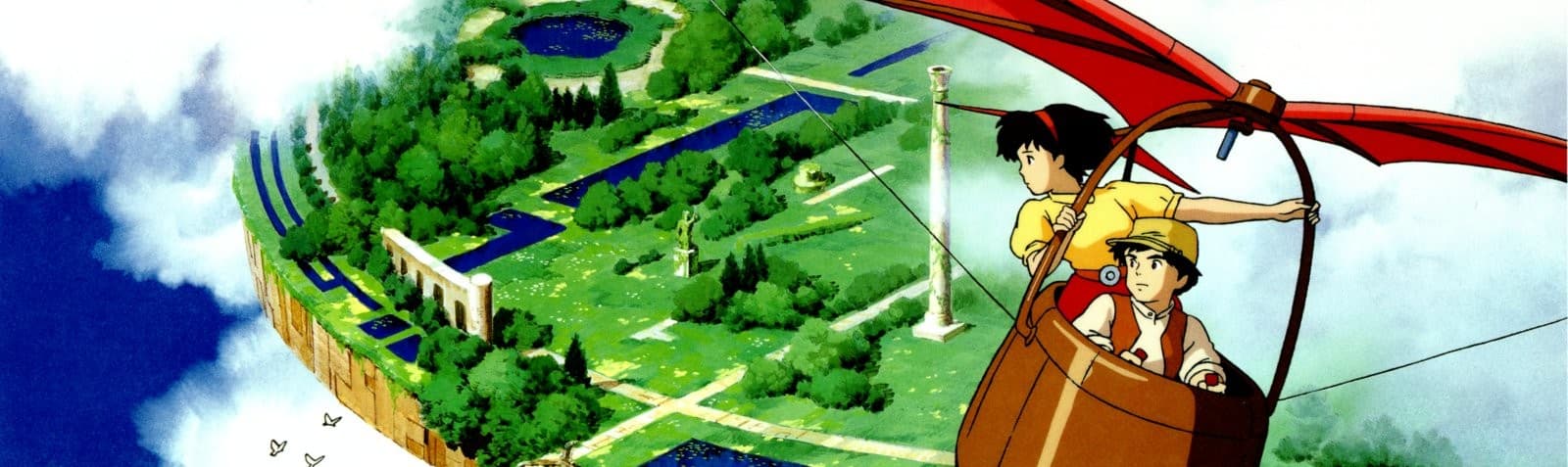
Soaring through the air in a lookout glider, Pazu and Sheeta are scanning the skies for a military gunship, the Goliath, when the enormous aircraft bursts through the clouds and attacks the mothership they are tied to. To their left, they see an enormous swirling cloud, whisked furiously by impossibly high winds blowing in the opposite direction to its surroundings. Suddenly, the tether breaks and Pazu sees no option but to fly their glider into the storm. Lightning crackles around them like furious snakes, but Pazu holds steady. Ahead of him, he sees a vision, his late father and his airship – Pazu’s connection to the skies and to the mysterious city of Laputa his father had told him stories of. And, before any harm can be done to the pair, they emerge from the black clouds into the eye of the storm. In it, a castle in the sky, built around an enormous tree.

This moment, when we see the Castle for the first time, can only be described as magical. And it is magical moments like these that leave lasting impacts on viewers, and that come to define the work of Miyazaki. Moments such as when the Laputan robot gently offers Sheeta a flower are why Laputa: The Castle in the Sky has left such an impression on audiences. Miyazaki imbues his work with passion and wonder in a universally loveable way. In my eyes, this is why The Castle in the Sky remains a constant touchstone more than three decades after its release. Despite the progress Miyazaki would make as both a director and storyteller in the years that would follow, and despite this not being the strongest of the Ghibli films, The Castle in the Sky proved that this fledging studio was worth its salt and continues to hold a place in our hearts.
To see how The Castle in the Sky fits into the Miyazaki canon, we have to go back eight years before its release. In the late 70s, Miyazaki was working for Nippon Animation. The studio was known for its work as part of the World Masterpiece Theatre (although nowadays it's perhaps better known for Hunter x Hunter). So, in 1978 Miyazaki was given his first chance to direct (well… unless you count his work on Lupin the 3rd, for which he co-directed most of the series with Ghibli cofounder Isao Takahata). The job was an adaptation of a 1970 post-apocalyptic novel written by Alexander Key called The Incredible Tide. Miyazaki aged down Key’s young adult novel into a story for kids, called Future Boy Conan. And Miyazaki’s opinions about storytelling already show here as he polished Key’s pessimistic and bleak story into something much more optimistic.
Future Boy Conan is important for the development of The Castle in the Sky in that the latter is unquestionably a refinement of the former. Simply looking at images of Future Boy Conan and the similarities are obvious. Lanna in particular, who is discovered by Conan after she escapes her abduction, is very obviously Sheeta. It also features a crew of pirates who Conan joins in hopes of saving Lanna from the clutches of a greedy militaristic enemy. And Future Boy Conan, much like Laputa, is coloured by themes of naturalism and environmentalism, stemming from the source material itself, but I think furthered echoed by Miyazaki.

Miyazaki is a perfectionist through and through, so it should be no surprise that given the opportunity and full creative control, he returns to a past project to perfect it. Abstracting the story from the source material that inspired it, Miyazaki injects his inspirations into the work. The town at the start of the film is based on his travels to Wales in 1984, where he witnessed, with admiration, the spirit of the UK miner’s strike. The town's population were inspired by what he saw of the strikers who “battled to save their way of life.”
And, of course, Miyazaki tears the seafaring Future Boy Conan from the ocean and launches it into the sky. His carefully designed aircraft are effective storytelling devices, quickly conveying information to the audience about their airborne passengers. The armour-clad Goliath is ugly, it’s gun turrets appear as wart-like protrusions on its muddy-brown camo body (but what, exactly, the camouflage paint aims to blend in with is unclear). There’s no doubt that The Goliath belongs to the bad guys. Conversely, Pazu and Sheeta discover Laputa for themselves aboard an unpowered glider as opposed to one of Dola’s ornithopters, a symbolic showing of their acceptance of the forces of nature. Throughout the film, flight is emphasised as a calling transcendent of morality, both good people and bad people are called to the sky. But there is no mistaking Miyazaki’s message. As Pazu and Sheeta recite the spell of destruction, bringing the destruction of Laputa’s world-threatening underbelly, we watch as the remains of Laputa and the enormous roots of the tree float higher into the sky.
The result of filling this story with Miyazaki’s passion is a much more personal, and, I think, consequentially a much more magical movie. And this magic left a mark on the world. Castle in the Sky immediately proved itself as central to the steampunk genre and directly influenced anime that would follow, most notably Hideki Anno’s 1990 anime Nadia: The Secret of Blue Water. Elsewhere, its mark can be seen in the airships of Final Fantasy and Mario, and even in Pixar’s films, such as Up and Wall-E. The robots even found their way into Minecraft with the iron golems.
Yet despite the enormous mark it left, Miyazaki is Miyazaki. So it just as unsurprising that he would return to many of the elements and themes of Castle in the Sky in his later works to improve them further. Most obviously Miyazaki’s love of flight is more expansively seen in Kiki’s Delivery Service and Porco Rosso. And I’d argue his exploration of environmentalism and militarism is more nuanced and honed in Princess Mononoke. Further, and throughout all of his stories, the way Miyazaki would go on to write villains quickly departs from the route taken with Muska. Rather than portray completely irredeemable characters, Miyazaki’s villains are more akin to the treatment received by Dola, reflecting a sympathetic streak in Miyazaki for his villains that developed out of work on Laputa.
In this regard, The Castle in the Sky quite soundly fits at the end of the beginning of his journey as a storyteller. As much as I enjoy this and Nausicaä (and the even earlier Castle of Cagliostro), I would find it difficult to argue they are his best films. And this is an amazing thing to be able to say because they are truly incredible films. Inspiring and full of magic. Miyazaki’s Magic. And there is no secret behind Miyazaki’s Magic. His animations would improve, and his stories would become stronger. But the magic was always there. Because the magic is him. He puts himself into his films, and they’re filled with life as a result.
17.5 out of 19 users liked this review
