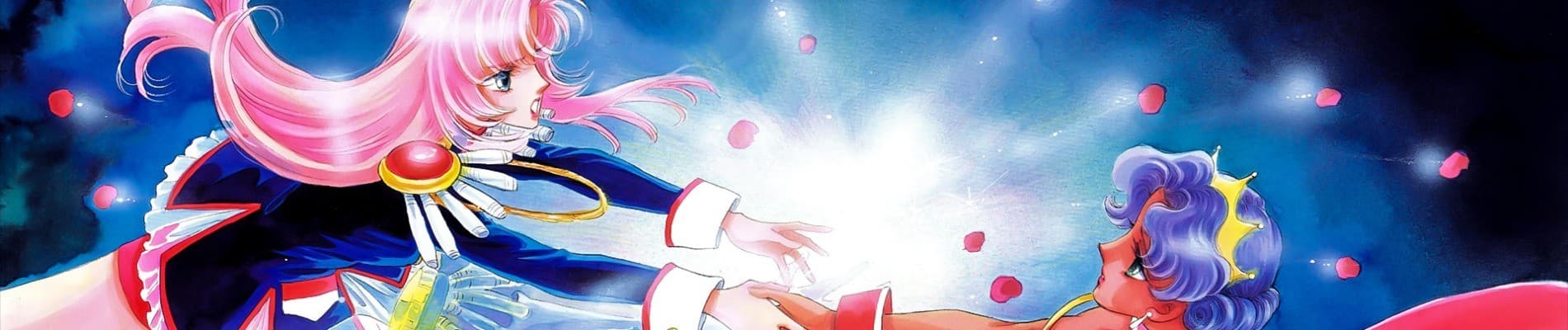
Revolutionary Girl Utena overflows with the use of literary devices seamlessly intertwined with storytelling most appropriate in the medium of animation, rife in beauty from creative writing and colorful production consistently organized throughout 39 episodes to fashion out one of the most engaging stories I've ever encountered, bombarding my insides with sensory pleasures and crowding my brain with incessant contemplation in attempts to connect the disjointed dots together as the tale unfolds. The visuals bellow its stunning quality from the very first episode alone, and I could go on about how lovely the aesthetics are. With technical expertise bringing forth shimmering style and a fulfillment of conceptual and thematic aims, Revolutionary Girl Utena makes for one of the greatest narratives tackling the tempestuous stages of youth in the pathways to maturation, and one of the greatest because of its decision to lay down a red carpet in reception for education, a contribution most influential in shaping the structure of the whole world and its residents as we see it.
Numerous stories all over the world feature main characters in their teenage years facing everyday life in school, trading romance, friendships, gossip, and experiences. In my knowledge, the coming-of-age genre is usually attached in educational institutions where characters go through new things simply because of their * role as students * on their way to the natural process of growing up. With that road to transition as the foundation, romcoms, mundane expeditions, mental health, fantasy plots, and so forth become the cornerstone to tell the message of the story.
Yet, as a man with a budding passion for learning, I'm baffled at the miniscule amount of concentrated deep delving on the role of education in the narratives of students in school, when it is highly evident that the institution itself also takes the role of primary molder of individual mindsets and therefore society as a whole.
Nelson Mandela says it perfectly, "Education is the most powerful weapon which you can use to change the world.” Taking the premise of "revolutionizing the world" through manifold battles encompassing the physical, mental, and spiritual, as individuals and as a collective, in the battleground of the school, I give my hats off to the author in hammering the significance of education into it.
Education is universal. This thought is mirrored by the rather grand scale--worldwide, if you may--established since the beginning episode of RGU. Going to school is a human right for a reason as mankind came in unison in acknowledging the nuclear potential found in an environment supported by a system purposed to inculcate and then cultivate essential learning of knowledge and values without discrimination unto every person in the world. It is universally appreciated as a human necessity, thus its reputation gradually became refined to be a stimuli for man's instinct: "When my child arrives at a certain age, I will let them go to school." It is not something to doubly think especially when one has enough resources to send one there, or to go there themselves no matter the age.
Of course, there are people who do not attend school since birth due to intentional decisions and/or unfortunate circumstances. They opt for homeschool if they can avail for such services, and there are those who do not go to any kind of school at all. But either way, everyone still receives education in some other manner, because although education is heavily inculcated in school premises, it doesn't stop in its confines. Still, school and education are two tightly linked existences which I will at times mean to interchange; I'll go over the rest of my reflection with that in mind.
Going back to the contributions of education in school, aside from knowledge being most accessible through teachers and libraries, it expands one's world due to the fact that there are plenty of people around you.
It's the most common mode in developing a sense of community with one another. As relational creatures, being surrounded with people and having to interact with them develops our own perspective as well, as we engage in cooperation and even division with them, all in the name of growth.
Education is simply life-changing. For better or for worse.
It is a sad truth that the educational curriculum taught in too many schools worldwide are still very traditional and restrictive to the creativity of students, that rather than allowing them to soar higher and roam freer in society by polished preparation, it rather diminishes their burning passion that can revitalize their own lives and society as well.
In my country alone, the system is very elitist, a remnant of Spanish and American colonization. Universities require too much units, individuality succumbs to conformity especially in Christian schools. The self is sacrificed for the sake of, really, no one. Although the lack of critical thinking training feeding ignorance benefits corrupt politicians, it still leads to unemployment and underemployment, which is prevalent in this country, contributing to the stagnancy and deterioration of the economy.
Another thing is that the left-behind get even more left behind, while the gifted are given more gifts. The overt favoritism distastefully adds to the horrible disparity and societal divide, so much that it's really hard to make yourself successful AND fulfilled due to the quality of education needing so much more improvement. So much time is given to unnecessary subjects, so little provided for specialization enhancement.
Truly, the system makes it hard to fully know ourselves, and there are unfortunate numbers who took their own lives because of the excessive stress. It feels like education is used to control people like puppets, making them afraid to expose their true selves.
I've babbled about education outside the series for long but the context itself is enough for my thoughts to run rampant, and it's beautiful like that. RGU also covers extensively the struggles against patriarchy, between society and youth, between adult and young, between man and woman. What they have in common is that they're established areas of division mankind has struggled against for so long, and still continue to do so today. Statements against prejudice and other forms of discrimination creating unfair domination for one over the other are shown throughout Revolutionary Girl Utena.
And it is a girl, a student, aged 14, that acts the role of a revolutionary figure...whether she liked it or not, battling against the god of the world--the principal of Ohtori Academy.
Student vs. Teacher is one thing, but Student vs. Principal is literally something else. Oh my Lord this protagonist-antagonist dynamic is a pinnacle of that relationship! A huge gap in status, in power, in age, in experience, yet striving to surmount against all odds which might take an eternity to catch up and a miracle to achieve is truly a revolution in its own right.
But really, Akio is merely a principal of a single school, not the playmaker of the whole educational system. The irony of one of his statements against Nanami really bit him back in the butt when he questioned what the eyes can see, for it only brings to light one's limited perception in their own, personal world where they endlessly wander the same path. The conclusion of the story where Akio failed another attempt to unite with Dios and continued to rely on Anthy by playing Prince and Princess inside the school was just masterful. Akio thought nothing changed and Utena's revolution was a failure because the school itself didn't change, but Anthy remarked that what Akio sees is only because he is too close-minded and absorbed with his fantasies. He himself is a student for eternity, one neither learning nor graduating.
Education is both springboard and track in learning about the truths of the world, and how one can react to such. Akio, in learning about its horrors, chose to live through a path of thorns, shedding away the Prince that he was, opting to become a corrupt principal instead. He is implied to have been manipulating children for ages in order to lead them to his school and through many versions of the Rose Bride system eventually make use of the swords of their hearts to open up the Rose Gate where light dwells. He baits them with the light of the truth and clads them in darkness. Not to mention using his own little sister as a sacrifice. Akio is basically a superpower official making use of education in twisted ways for his own personal gain, sacrificing the hope of the next generation. In his position, it is very easy to feed thoughts unto the sensitive minds of the young. And as a man at that, he is able to sweet talk women like they're swarming flies. He is the pinnacle of control, caging individual worlds on the palm of his hands.
Of course, common sense dictates that as principal, he holds more power than regular students. As an adult, he knows more, has experienced more, unlike the young. Yet why did Utena, very much opposite in terms of every trait, succeed in her personal revolution, and he didn't?
I can imagine learning the truth of the world is very much debilitating. I cannot blame Akio for showing a moment of weakness and allowing wicked to reign over him very self-awarely (Although blame is not placed, being unforgiveable is another thing). But in seeing the whole, he allowed what's important to him slip away from his grasp. That is, his sense of nobility, his innocent strength, that he so wished to have back.
Utena throughout the series after many supernatural battles presiding outside the essence of everyday life in school has, in the virtue of a student, learned many truths that go beyond the four walls of the classroom.
In the dueling grounds, Utena learned of the scope of what lies deep beneath the exterior of people around her.
The Student Council Saga introduced her to the deep desires of man and the extent they go to salve their own pain. The Black Rose Arc presents what exists under the surface, absorbing darkness and nourishing the roots of hatred and jealousy. Utena's innocence was mentioned a lot, and it was also pointed out that the same innocence has indeed harmed some people around her.
I'd like to think this is thanks to her ignorance; she still hasn't learned a lot about people yet as young as she is, with the help of the Prince persona keeping her strong too. As a Prince, she needs to learn about the weaknesses of people. But in the beginning, she still seems close-minded of it all, sticking only to her own set of moral codes. Still using the Sword of Dios inside Anthy's heart, there is still so much room for growth.
However, things changed in the Ohtori Akio Saga. Utena fought wielding the sword of her own heart channeled forth by her Rose Bride. Although Anthy was still needed in the process, it was a step further in actualizing her own strength. Making use of what she initially had along with what she's learned in school through her interactions with the Student Council members, Anthy, Akio and others, Utena gathered her own set of truths in her own limited world, and although straying due to Akio's seductiveness, still kept within her the true value of kinship. Instead of breaking worlds, she used it to save worlds, like a Prince.
Throughout the anime Utena questioned a lot of things about herself and her surroundings. She questioned her virtues as it was brutally tested by Akio. Touga, too, made her break her own sense of self for a moment. Yet precisely because of her genuine kindness in taking care of friendships, it allowed for good karma to befriend Utena as she gains strength and support from her friends, and of course, from within herself.
Granted, Utena doesn't know the horrors of the world unlike Akio, so she was able to tread on like she did. She resembled Dios, Akio before the whole witch incident. But there is one thing I believe which separated both. Utena isn't overwhelmingly altruistic. She knows her own boundaries, which is absolutely important in retaining our own sanity. From her life studies as she journeyed past loss and in the academy, she knows when to help others and when to help herself. "I hate people who don't take care of themselves," says Utena in the Black Rose Arc. It goes to show how self-regulation is make-or-break when experiencing maturity, for although Utena would eventually grow up like Akio and learn the awful truths of the world, her honed characteristics would safeguard her from falling over the edge.
So kids, it's okay to be yourself, and to indulge in your own individuality HEALTHILY. Repressing it would just give off the opposite effect, and maybe you'd just build up propelling force in doing what should not be done. It is not selfish to put oneself first before it's all too late. It's really a matter of timing.
Revolutionary Girl Utena is a story of setting one's self free from the birdcage of societal evils and unfair conditions, rising against the pressure proportionally increasing insofar as one grows older. The bars' manifestations number countless and form many shapes, making successful revolutions borderline miraculous. But to truly revolutionize the world is to grow up rightly. And as a student, it poetically entails utilizing what you've learned to aid self and others in accordance with virtue, for too much weight placed on one side of the scale would result in chaotic imbalance, that which is heavily clear in the Himemiya siblings: Akio as Dios gave too much for others and disregarded themselves, Anthy also sacrificed her whole being to put up with being a Rose Bride.
Going back to the birdcage manifestations placed upon people, sex is one thing. Here RGU very explicitly explores the struggle against patriarchal society. Just because one is born as a woman, they are immediately bombarded with traditional customs they need to uphold. It is very powerful how the characters marched a revolutionary parade against this. And lovely how homosexual themes are told with grace.
In the topic of setting oneself free, I would like to zoom in my personal favorite of the series, Himemiya Anthy. Bro she is just the object of not only the characters in the story, but the story itself. From the very start her mysterious exterior holding vapid expressions was incredibly off-putting, but at the same time, incredibly intriguing. She's literally the rose I as a fly am attracted to, not in the Princes like Touga and Akio people flock all around. But holy fuck did she just tick all the points that would make me so heavily curious in a character.
I was trying my best to put myself in her shoes, thinking she's human despite always having a smile on her face, who can feel things, and who has deep desires like the Student Council members and their significant others. Would anyone really like being in her position of the Rose Bride, endlessly used by her master's content? Umineko taught me to put myself in the character's shoes and actually internalize myself with what I know of them. Man, that was a really important skill to truly acquire, mastering empathy beyond reality, into fiction.
Overtime I just felt so much of her pain so clearly. But when the Tale of the Rose and her past as a witch only because he longed her brother to have peace so much, and how she continues to live in eternal pain, bro I fucking broke. The thought is already too horrifying, but seeing her suspended in the air amidst spikes and continuing to walk despite way past being worn out was just too much for me. She became a plaything for everyone, a doll meant to be controlled.
This went on for too long that the witch persona essentially became one she is most accustomed of wearing, even when, that really isn't who she is. She just had no choice but to go along with the Rose Bride system prepared by her brother because of the boundless love she has for him. She, too, wanted Dios to be saved, for Akio to be saved, and believed that this was the only way, even went so far as consummating with her own big brother to perhaps soothe his worries, as she is already numb to it all, thus using that numbness to at least make the people she loves feel good for themselves. In Akio's case, to continue allowing him to indulge in his Prince of the White Horse fantasies, to perhaps give him pleasure in making someone a Princess, too, since her little sister can only be an ordinary girl and cannot be his Princess. Perhaps that sense of oneness would give Akio the relief he needed as a vivid remnant of past warmth. Either way, Anthy continued to be controlled by Akio and by everyone else, except for Utena.
And so Himemiya Anthy acted along the role of the witch--content to endure and water flowers in a garden her whole life--in this elaborate play called Revolutionary Girl Utena until Tenjou Utena tore apart the script that was meant for her, opening up the coffin Anthy was placed in beyond the Rose Gate where the light that which is eternal, that which shines, that which is a power for miracles, that which grants the power to bring the world revolution is kept.
Who would have thought, that light was Anthy herself, sleeping inside her coffin until her Prince finally opens it up for her for she lost the strength and will to do so herself. Even when Utena was reaching out her hand and shouting for her name, Anthy still initially had so much lingering hesitation left in her. But how can one blame her? All her life, the Rose Bride within her is all she knows. She does not know Himemiya Anthy, a normal girl in a normal world yet.
For it is her own fate, born as a girl, to be a harbinger of apocalypse and nothing else. Zettai Unemi Mokushiroku is literally Anthy's lamentations. All she brings is pain for others, for in saving Dios, she neglected the countless other girls in the village. In partnering with Akio in this Rose Bride system, she brings inevitable pain upon the actors and actresses, most notably her champion and betrothed. She expressed intense self-deprecation as she opens up how Utena would not have experienced so much inner conflict where Anthy would not exist, explaining her earlier suicide attempt. She screamed "Forgive me!", indicating how much blame swirling around her already. She told her to run.
And so it would be better to keep being locked inside the coffin, never seeing the light of day again. A canny parallel to Utena's childhood escaping the harshness of life and seeking comfort inside the eternal stagnancy of the environment inside the coffin too.
But Anthy received Utena's hand. Despite the separation, Utena lent enough strength for Anthy to regain her own free will. Despite the academy itself not changing, and things continued normally, Utena's revolution was successful in that it allowed key persons a complete rethinking of their lives, and most of all, allowed Anthy to graduate from the coffin that is the school, from the coffin of Akio where he still lies. It is a beautiful depiction of the sequence of growth much like a domino effect.
Anthy herself was the light. The Tale of the Rose says that the Prince is the light of the world, and only girls are doomed to be witches were they to stop being princesses; but really, anyone can be Princes and Princesses. Heck, the distinction cemented on fairy tales upon fairy tales doesn't really matter, because we only have one role, and that is as human beings living in this world surrounded by other human beings. It is a constant giving and taking, of saving and asking for help, which are both brave and noble acts. Once one learns enough truths and sees the light, it is their turn now to be the light that shines around darkness.
Together, Utena and Anthy became the light and shined.
There really is still so much to tackle on. When it comes to symbolism, metaphor, allegory and imagery, I mentioned in the very first passage of this review how it was overflowing thereof. But the flood, rather than giving disarray upon the structure, rather nourished its roots with bountiful water.
The omnipresence of the rose: the Rose Garden, the Rose Crest, the colors of the rose, and how it relates to the world housing its residents of all varieties of creatures. The rose and its constituent subparts goes well with the symbolism of the uniform and fashion and how it represents the many parts of the self, either as a costume limited in the theater restricting one's true agency in the confines of outdated and unreasonable school rules, or as a badge of honor made of flesh and bones signifying who one truly is in life. In embracing the truth of the self, one needs to wear their true uniforms even in school, for it's never a crime to be who one is by birth. And society should be inclusive enough so as to accept the uniqueness humanity brings, and wise enough so as to realize that creativity flourishes the world.
The eternity present in pictures, as memories frozen in time, as memories themselves, also hold importance in telling the story of RGU. Looking at one's past and finding strength in it is essential in paving a path towards the future.
Nanami's metaphors are trophies of their own. I've extensively talked about her in my [[incomplete] Utena Synthesis write-up](https://docs.google.com/document/d/1TcdCd1unPbckcsWXaEO2zvww938c1jMPgatXp655F1M/edit?usp=sharing). But to basically serve a slice, Nanami is a key figure for family, blood, and continuity, and her episodes which one might deem as filler were heavily insightful and contributory in my growing understanding and love for the series.
The presence of animals is also given an entrance to the gold seat thanks to Nanami. The frog is the Prince and it swallows flies naturally, where flies are women. Frogs resemble the cage the corrupt Prince figure has on his hands. In the ending, where Chu-Chu escaped the embrace of a frog and went with Anthy in her journey to find Utena, it shows Anthy's escape from the clutches of the fantasy tale.
Nanami's dual atmosphere of unseriousness and seriousness also reflects the dual weapons she wields. The duality is everywhere in the series too.
Speaking of weapons, the sword within one's heart represents the strength they hold. It is their very own heart, their very own cores. Thus it was cool that Akio uses the Champion's sword--not his own--as a means to open up the Rose Gate.
The driveway and transportation in the form of vehicles such as cars and motors reflect adulthood. Think of the existence of age requirement in order to apply for a driver's license. Also think of the amount of responsibility which a driver holds every time they ride their vehicles. There is always a possibility to cause a car accident and harm lives. Additionally, the driver controls the pathway of the vehicle and its passengers, and the fact that it's always Akio racing through the night, engine throbbing the sound of the End of the World, augments his position as adult and controller. The "passenger's seat" also indicates partnership for couples. Utena in her Duel against Touga shown to be protecting Anthy against an onslaught of cars shows her rebellious nature in front of the path all takes, as if the cars are telling her to stay on the path laid for her and just be an ordinary girl and a mere princess, slave to patriarchy.
The formulaic and repetitive nature of Utena is something I've heard people complain, but it really fits well with the nature of life in school. Everyday life is repetitive, almost too recurrent. The fact that they utilized that aspect in order to transform mundane into something else creative resulted in a more evocative and engaging storytelling. Bro the shadow girls are very informative and helpful. Zettai Unmei Mokushiroku is something I chant everyday, so I do not mind the whole sequence before every Duel. The formula used in setting up Duels too were very much appropriate to me. In the end, these elements served well for achieving thematic aims.
What else, the separation of ordinary and special, the labelling of identities, I've touched upon on that Google Docs link. In the shadow girl plays, a UFO is seen many times to crash land on the Chairman's Residence. UFO, a mode of transportation for "space aliens" which is referenced a lot in Nanami's episodes. Space aliens experiencing pains from being unique and different from normative society. And the fact that they fall on the Chairman's Residence show that the school is supposed to be the home for the unique, the educators the givers of wisdom for mindset changes, only misconstrued by Akio as the acting chairman. But that was all he is, "acting" chairman. Not a true teacher. That Akio regards it as the pinnacle of the world--the End of the World--showing magnificent illusions show his stance on education, and the celestial power an educator holds in affecting change. Schools are individual worlds themselves, but there is always a world beyond that which one is familiar with, attained by graduation.
There is still so much to touch upon, and although I know I've talked too much already, I still fear going way past the "way past" haha. I would still love to solidify my thoughts on the Himemiya siblings as otherworldly beings capable of magic, or how it would work if they are merely ordinary creatures and all these fantasy shenanigans were elaborate metaphors in sight and in concept. Like I said, the level of engagement as I experienced RGU is insane, but that's for another time. My brain is just so happy to be worked to the bone like this.
Revolutionary Girl Utena is outstanding in carefully picking out foundational ideas and building Disney castles upon these individual blocks and fortifying each block to represent a whole-ass treasury room where thoughts are provoked and run rampant; creating a bountiful garden with disjointed roses that sprouted in different climates and environments yet allowing it to thrive as they're gathered on a single area; I reiterate once again my appreciation for utilizing education with so much depth; and entertaining the audience with the weird, with unhinged stylistic choices very much appropriate in this stage for revolution. All that, to create a story filled with heart, a message to children and adults alike to instill positive change within us as relational creatures all capable of bringing our own worlds revolution.
"Change is the end result of all true learning." - Leo Buscaglia
31.5 out of 33 users liked this review