Kino's Journey
a review by ZNote
a review by ZNote
During nearly every episode of Kino’s Journey, the young Kino travels to a new country with their motorrad Hermes and learns about the people there, as well as the rituals and customs of those people. Much like Kino, we are traveling along with them, likewise allowed to glimpse at another way of life. But the one immutable fact remains – whether in-universe as a traveler, or outside the bounds of the television screen as a viewer watching an anime, we are the outsider in the land. It is for that reason why even though the impression that we get of every country is a small fraction of their history, it often has such a resonance. After all, what better way to understand a country than see what the country offers freely to its visitors and what it decides to hide in the shadows, unseen by unfamiliar faces?
Kino’s first taste of the traveler’s way of life came from, of all places, a traveler to their own country. With the traveler introducing himself as Kino, we see the two of them go about the town and talk, with the young Kino slowly absorbing what it is that the older Kino has to say. As words are exchanged, the young Kino begins to gain a new awareness of not only the country they live in, but also who they are as a person. In only a couple of days, the outsider has affected Kino irrevocably, and it has become clear that the young Kino cannot simply go back to the way of life that they once so comfortably knew. Through travel, even though they were not the one who did the traveling this time, they have changed.
The outsider brings something that perhaps the native is not able to realize so easily – a new perspective. It is often only through the perspective of the outsider that we can accurately hold the mirror up to our own behaviors and tendencies, showing how odd, delightful, or cruel they can appear to everyone else who isn’t among us. When born and raised in a particular place, you are taught that place’s way of being. A product of their culture, you learn what it is that should be valued, what should be sacrificed, who the ally is, who the enemy is, and what it means to live, among other things.
The unsung quality of such an upbringing is not only the specific customs that should be honored, but also the rigidity with which those customs are to be challenged or be self-reflected. This operates at both the larger societal level and the smaller, more self-contained levels. It not only determines what the laws of a country or city may be and whether the offender should be incarcerated, but also determines whether someone should be kicked out of their family for something as inconsequential as the gender of whom they love. It indoctrinates and inspires on so many layers of the person through the act of teaching it and the consequences that follow as a result.
But the outsider challenges both a country or society’s tolerance and rigidity in a different manner. The introduction of a new person or a new idea carries with it both the exciting possibility of change, as well as the potential damage of what change may occur. The question then becomes to what extent should the outsider be welcomed, how much should their perception of the world be allowed to shape the foundation of the country’s individuals, the community, or the country as a whole? Because of the fickle nature of how society functions, and the inherent motivations of the outsider that may not be so readily obvious, there is no single, universal correct answer to that question. The outsider may indeed be sincere when they claim that they’re just visiting for a little while, or they may simply claim that while making sure you don’t notice their furious horde of raiders behind them. Some of history’s greatest monsters have been the outsider, while outsiders have also been instrumental in helping shape countries and societies into what they are. The only way to know what lies in store is to, if I may borrow a phrase, “allow things to take their course.”

When Kino adopts the traveler’s life for themselves, they inevitably carry that burden with them. By hitting the open road and allowing themselves to be at the mercies of not only the wilderness, but also the people they’ll encounter in and outside of countries, every encounter has the potential to be charitable or deadly. As such, every encounter requires Kino to take the time to evaluate to what extent the “outsider” should get involved, to be allowed to influence the events that may transpire.
Kino’s moral compass is not so simple that one could easily say when it will or won’t kick in. Therefore, Kino’s Journey fascinatingly shows the numerous ways it guides Kino along the voyages. There are indeed times where Kino gets more-directly involved in the country’s goings-on. Given their policy to only stay in a country for three days, there is no reason why Kino should help Nimya with her flying machine, as it clearly reflects that she is at odds with the entire country itself. Why run the risk of helping a town outcast if it only succeeds in creating more problems in the end with its failure? But here, Kino is propelled by curiosity to see the flying machine work, and, perhaps spurned by being bored to tears by the town leader’s spiel about agricultural boosting, longs to see something of intrigue occur before their eyes.

But there are other times where Kino’s decides to get uninvolved or maintain the status quo rather than seek a more-proactive interference. As Kino and Hermes ride on a long railway, they come across three men who are all working on it in some fashion, and each new worker unveils a larger understanding and revelation of the rail and the way in which all three are connected. The news is such that Kino could very well travel between the three men and deliver the news, but when juxtaposed against the story Kino tells of a place where people choose to do meaningless work, they decide to let the three men go about their business, unaware that the work they are doing might be just as devoid of meaning too, even if they cannot perceive it as such themselves.
And yet there are times where Kino doesn’t even have the agency to decide whether they get involved in a situation or not, or where their involvement leads to a consequence that couldn’t have been so clearly foreseen. On the immediate surface, it seems like Kino stopping to help some travelers on the road to warm up and eat so they don’t get hypothermia is perfectly noble. However, it’s only in helping them that Kino realizes that they were actually human traffickers, drawing their guns and looking to have Kino as their next prized commodity. Kino’s curiosity nearly led to their death.
But that might just be Kino’s ultimate binding thread, and the magnetism that steers their compass – curiosity. To be an outsider forever is to always be simply passing through, and to sustain that lifestyle for any length of time requires a curious appetite, to always be receptive—if not occasionally repulsed as well—by the things you see and the people you meet. With the entire world as their playground, Kino and Hermes are fortunate to be able to see so many places and explore so many ways in which the world can function or unveil itself. It comes with dangers to be sure, but the desire never goes away. That wanderlust feeds a curiosity too fundamentally unquenchable, hence why Kino would always choose to avoid settling down in any single place for too long. Why stay in one unmoving place when you can be the one who moves from place to place, bask in it all for a brief time, and then move on to the next place afterwards?
Depending on how you want to interpret that, Kino’s fear of settling down means having to necessarily miss out on what makes the world work. And the best way to see the world work is to become the permanent outsider, to always see the various country’s cultures and lifestyles through a window. Sometimes, that window is wide open, sometimes it’s ajar, sometimes it’s translucent, and other times, it is shut tightly. But you’re never going to know unless you roll up to it and get a closer look for yourself. The world does not stop moving, but by being the outsider, one can catch the tiniest glimpses of what time may look like frozen for one crystalline moment. What does the country you visit have to show you? Or, to put it another way, what does the country you visit choose to show you?
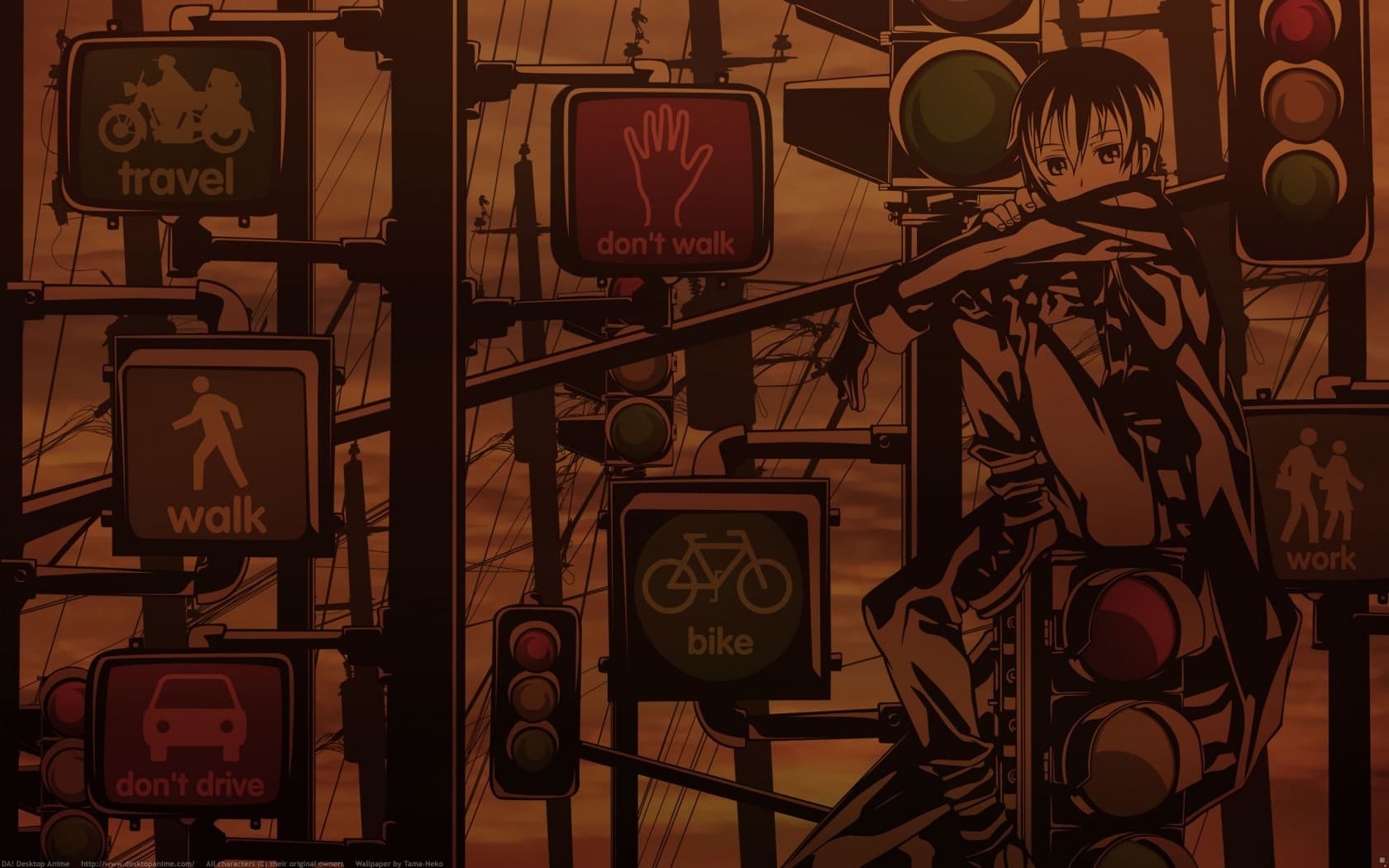
And shown through its sepia-tone-esque visual styling and impeccably-masterful sound directing, every country visited presents itself like an exhibit in a museum. This adaptation, directed by Nakamura Ryuutarou, treats its material with the seriousness its ruminations demand. In presenting each country as is, and in the ensuing follow-ups as Kino leaves for their next adventure, the series does not cast overt judgment on each place. The viewer is encouraged to contemplate rather than be told overtly what is or what isn't, what should be or what not should be. As outsiders in the story, we glimpse what would easily be alternative versions of mankind, and to gauge the extent to which those versions find their way into our lives both individually and societally. And the final question as Kino speeds away is always thus: what will we find next?
__________
Kino’s Journey allows us to take the role of the outsider and see outside-looking-in just how odd yet mesmerizing the world can be. Sometimes, that world is ugly, and at other times, it’s simply marvelous. While the central tenet and main interpretation of the show might be that it is precisely because the world is not beautiful, therefore it is beautiful, I’m actually going to offer something else instead – the world simply is. I cannot say for certain whether that is for better or worse, but if Kino’s Journey has anything to teach, it’s that the world out there is indeed quite big, and whether you’re looking for something or not, go out there. Only by going out there can you see how the world itself is. Who knows what you’ll find? Just be mindful that when you do, you’ll be the outsider, so go with care.

41.5 out of 43 users liked this review
