Homunculus

***
#
Introduction
Disclaimer: There are no major spoilers in this review. The reading experience will not be affected by the minor spoilers from the first two volumes that I will bring up. Any additional spoilers will be hidden in spoiler tags. It's a bit of a long review so bear with me.What does it mean to be human? Aren't we human beings such fascinating creatures? We like to think that we're continuously changing and evolving. In reality, we are merely frail beings that, when faced with danger, conceal our true selves beneath a false persona. The reality that you live in is the one that you make for yourself, but also one that others before you have put in place for you. Every one of us has parts of ourselves that are concealed behind a false reality, be it due to trauma, personal traits, or even differing opinions. Homunculus is a manga that delves further into these subjects. It is a manga that captures the essence of how fake society and individuals are, as well as the similarities and differences between members of various societies. It tells the story of the main character Nakoshi, a man who lives in a car parked between a fairly upscale hotel and a homeless park. He appears to be on a mission to discover who he is and what it means to be a human. By undergoing a surgery known as trepanation, he is given the opportunity to make some money. A small hole is drilled into the skull on the forehead during a trepanation, which is supposed to awaken your senses. Nakoshi seizes the chance, but after the procedure, he learns that he has gained a strange ability that allows him to see humans as monsters, aliens, robots, etc. Nakoshi is soon to discover that these "Homunculus" are much more than that, and they are closely intertwined to what it means to be human.

***
#
The Good
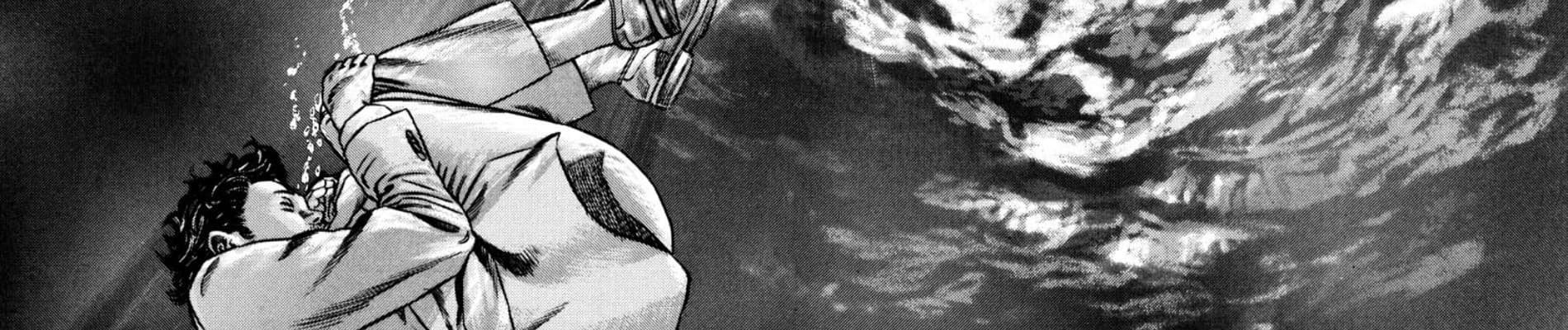
Homunculus stands out in terms of execution since every element the mangaka used to create this manga, such as the story, the characters, and the artwork, serves to emphasize a specific theme. This theme is what I refer to as two sides of the same coin. The good and the bad, the positive and the negative, the light and the dark, the lies and the truth, reality and fantasy, the inner and outer... The list goes on. The polar opposite nature of these two sides has no relevenace to the context of this theme. Simply acknowledging that there is a second side to everything is all that readers need to do. So how exactly does the mangaka emphasize this theme? Let's begin with the artwork. Homunculus has outstanding, top-tier artwork throughout the entire manga. Although I can't think of anything particularly distinctive in Hideo sensei's art style, he makes up for it with his mastery of complex visual cues. Hideo sensei enjoys presenting both inner and exterior perspectives. In numerous panels, he depicts various perspectives, including the interior and exterior of cars as well as an aerial view of the entire scene.

He is delving quite deeply into the theme at that point, but it doesn't stop there. He also emphasizes the outward and inward appearance of humans. He often used full black shading in panels to represent the characters' inner appearance (real selves), rather than a combination of white and black coloration. He subtly indicated in the manga's later volumes that this wasn't something he does at random. In this manga, there is no spoon-feeding. You must always keep an open mind and make an effort to pay attention to and comprehend every single detail.

Whilst we're on the topic of inner and outside appearance, allow me to veer off course and discuss how the plot itself relates to the theme. The mysterious man at the center of this story lives in a car parked between two societies: the rich and the poor - two very different sides of the same coin. It's up to us, the reader, to figure out which side he represents. This contributed in part to the earliest stages of Homunculus's engaging nature. As the plot develops, the true essence of the main character also does, and you come to understand that not only are there multiple sides to every coin, there are numerous coins. In the greater scheme of things, the rich and the poor are but one aspect. What about the truth and the lies? What about reality and fantasy? There were tons of options for how to proceed with this tale. At this point, the narrative's versatility and scope were already enormous, yet the Homunculus themselves remain the key plot device. I won't go into great depth on what Homunculus are because there are many different interpretations of them in the manga. In essence, it's a reflection of your genuine self; not the one that others perceive, but the one that you are on the inside.

Hideo sensei is also skilled in the art of misleading. There were so many times when I thought I had the plot figured out, only for the next volume to completely turn the situation around. Layers upon layers of false or misleading information are used to confuse the reader, not just one or two plot twists. Occasionally, the plot will develop as if it is revealing the reality of the situation, only to eventually reveal that it was all a fantasy. In other words, it included a lot of the typical psychological manga elements. But unlike other manga in this genre, I believe Homunculus did a decent job of describing or pointing the reader in the right direction as to what is actually happening. Some manga, such as Freesia, have many components that the reader is free to interpret however they please, but in this particular manga, the majority of the elements are supported by evidence that is buried inside the plot itself. Was this an effective approach for a manga in this genre? Well, it had a positive outcome for the majority of the volumes, but it fell short in the last 2 or so volumes (I will explain why later on). Overall, I do think that a lot of the justification is included in the manga itself.
Spoiler, click to view
For example: Nanako's artstyle, in which she begins with a full black background and gradually erases sections from here and there to get at the final drawing, can be compared to Hideo sensei's use of full black shading on the characters to show their true selves. I say this because Nanako herself did it because she had the ability to perceive individuals for who they really were (or at the time it was believed so). Even the existence of the Homunculus is justified because of Nakoshi's senses. The narrative first led us to believe that Nakoshi was only perceiving things as a result of the hole in his head. But Hideo sensei was only deceiving us in this way (multiple times in fact). By the time I got to the conclusion, I could claim with absolute certainty that the homunculus aren't real and that Nakoshi's trepanation did not grant him any new skills beyond those he already has. Let's also not overlook the fact that Hideo sensei provided a justification for Nakoshi eating his own semen. He is a self-obsessed man trying to find himself using his enhanced senses because no one else would. Plastic surgery changed his appearance on the outside, but on the inside he remained the same ugly man. Nakoshi is one of the most complex characters in animanga, and I could talk about why for days, but I'm afraid I don't have the time or the energy. I'm willing to have a direct discussion though, so if you're down for it, drop me a dm or something
Very little was left to the reader's imagination. Additionally, this manga has a finished feel to it. It didn't end in a way that left the reader baffled and unsure of what had actually happened. The conclusion is pretty clear and, in my opinion, only has one true interpretation. The narrative also delves into issues like self-obsession, a quest for the truth, peer pressure, parental influence, the state of society, the true nature of the wealthy and the poor, etc.

Although I had mixed feelings about most of the characters, it didn't really matter. This is due to the fact that most, if not all, of the characters serve as story devices to highlight the theme or reveal the protagonist's actual nature or his backstory. The paneling is excellent; there are several intriguing widespread panels. Although not to the same degree as Junji Ito's work, the majority of them convey an eerie, horrific feeling. And I believe that this manga's biggest strength was how quick it was to read. Do not be misled by the amount of chapters; this is a very quick read. I personally found that I could read a volume (each volume has roughly 230+ pages) of Homunculus in no more than 15 minutes, whereas the last time I checked, it took me almost an hour to read a volume of any other manga. Only the last volume took some time; I believe it was around three times as long as a regular volume.

***
#
The Bad
Although Homunculus is fairly well done and superior to other manga in terms of technique, it does have a fair amount of flaws. First of all, the early volumes had poor pacing. The shoddy introduction made it take a long time for me to become interested. Even when things got interesting, there was never a feeling of unease or thrill because new mysteries always emerged when the events of earlier volumes were explained. The read is made less enjoyable by the story's ongoing lack of clarity about its direction. And as I've already said, I have mixed feelings regarding the characters. You'll experience a lot of emptiness throughout the manga as a result of these reasons. Nakoshi was a wonderfully well-written character, and the side characters did a fantastic job at building him up, but I need to consider the bigger picture in this case - you, the reader, will undoubtedly despise him. He is among the most despicable and repulsive people you will ever see on the inside. One could argue that the fact that Nakoshi is repulsive underlines the manga's emphasis on realism, and I absolutely concur. However, I personally found that I had little emotional connection to the narrative and the characters, and just had to mention it (for the readers that prefer enjoyability over execution).

The plot is also inconsistent. I would say that volumes 8–11 marked the peak. The ending was severely rushed. Many characters with homunculi were introduced, although their relationship to Nakoshi and sometimes even the homunculi themselves was never revealed. It seems as though Hideo sensei completely changed how he approached the manga. He carefully incorporated the justifications for various manga themes into the plot throughout the course of the first 10 or so volumes. However, in the latter volumes, it appears as though he simply gave up on that and adopted a fan-service strategy that relies on shock value. Meaning that he didn't want to stick to the outstanding writing and techniques he had up until this point, but rather wanted to make the story in a way that confused the reader. Really, it's a shame because this made the events that led to the conclusion so predictable. I must admit that the revelations for Nakoshi in the later volumes were a little lackluster. I thought volumes 5 and 6 were a little underwhelming as well since, once again, I don't understand how those events are connected to Nakoshi's true character. Given that this is a psychological manga, it's possible that I didn't fully understand all that happened in these two volumes, but given how many other things I've understood, I highly doubt that's the case. Those two volumes felt edgy merely for the sake of being seinen. This leads me to my final point. It is overly edgy.
Spoiler, click to view
There is rape (but not just any rape, the special sort), other sexual acts, and the mangaka even went so far as to include scenes where Nakoshi has sex with a gender-bent version of himself due to his self-obsession. Was that really necessary? I don't see how it would change or develop the plot because every aspect of Nakoshi was already apparent by that point.
***
#
The Conclusion
I like to think that psychological manga is as entertaining as the reader makes it out to be. The enjoyment of the manga may be hampered if the reader doesn't comprehend the overarching plot or the minute details. That also holds true for Homonculus. If it wasn't already evident, this manga is well made but not all that entertaining. It was a small price to pay, but it still leaves a huge gap that is noticeable. When I read it the 2nd time knowing what was going to happen, I found that I enjoyed it more because I could pay attention to the minute details rather than being as
air quotes "shocked" or "baffled" as the mangaka meant the reader to be in the latter volumes. However, I still believe it is worthwhile to read. I've already provided a number of reasons, spanning from the theme to how it ties to the complexity of the protagonist's character. Despite being entirely fictional, Homunculus actually excelled at being realistic when it comes to the psychological aspect and how it depicted humans. The main takeaway in this manga, in my opinion, is that there are unpleasant or undesirable aspects of life, and we should deal with them rather than ignoring them or putting up fake images as a countermeasure. At the end of the day, that is what it means to be human. It is absolutely up to you whether you choose to read Homunculus or not because this is not simply another regular manga. You have to put in an extra effort to understand it thoroughly, so be prepared to do so. I appreciate your perseverance if you read all the way to the end of this review. Thanks for reading! As for my overall opinion on this manga: What can I say except that