One Outs
a review by Rework7288
a review by Rework7288
I really, really enjoyed the first half of this manga. Sports manga are hit-or-miss for me, but I love tense, psychological gambling manga (think Akagi, not Kakegurui), and the first hundred chapters or so really deliver on that front. But at roughly the two-thirds mark, the emphasis of the series changes. From that point on, the plot spins out of control, and the series loses a lot of what made it great. There was an arc towards the end that made me think the series might be finding its legs again, but ultimately it failed to fulfill that hope, and the ending was indefensibly rushed.
The basic premise of the story is that Tokuchi is a brilliant pitcher, despite his lack of athletic ability, because of his incredible talent at reading and manipulating his opponents. This talent lets him turn an 80mph fastball, and no ability to throw breaking pitches, into an undefeated record in "One Outs"—a one-at-bat gambling game played between a pitcher and batter. A veteran slugger named Kojima persuades him to play for the Lycaons, a perennially bad team. Tokuchi negotiates an unusual contract (called the "One Outs" contract) with the Lycaons' owner, Saikawa: $50,000 for every out while he's pitching, but -$500,000 for every run, with a multiplier clause that allows Saikawa to increase the stakes in key games.
This contract gives rise to almost all of the tension and conflict in the first half of the story. We quickly learn that Saikawa has no interest in the Lycaons' performance as a team. He cares only about maximizing their profits, because he has a secret contract to sell the team for 10x that season's profits. And Tokuchi racks up millions of dollars in his first handful of games, which would ruin that plan. So rather than use Tokuchi's talents to the team's advantage, Saikawa (acting through the manager) tries to ensure that the team loses, or at least that runs are scored against the team while Tokuchi is pitching.
This leads to some fantastic moments early on in which Tokuchi is (for example) forced to pitch every inning of a tripleheader, or switched in only when the bases are loaded, or even targeted by dirty tricks on and off the baseball diamond. This conflict between the player and his own team's owner lets Tokuchi's almost supernatural strength as a pitcher and gamesman coexist with genuine tension and difficulty for the team. And as Tokuchi leads the team through those struggles, his aloof demeanor thaws slightly, his teammates begin to trust him, and the team starts to develop into a real contender for the league championship.
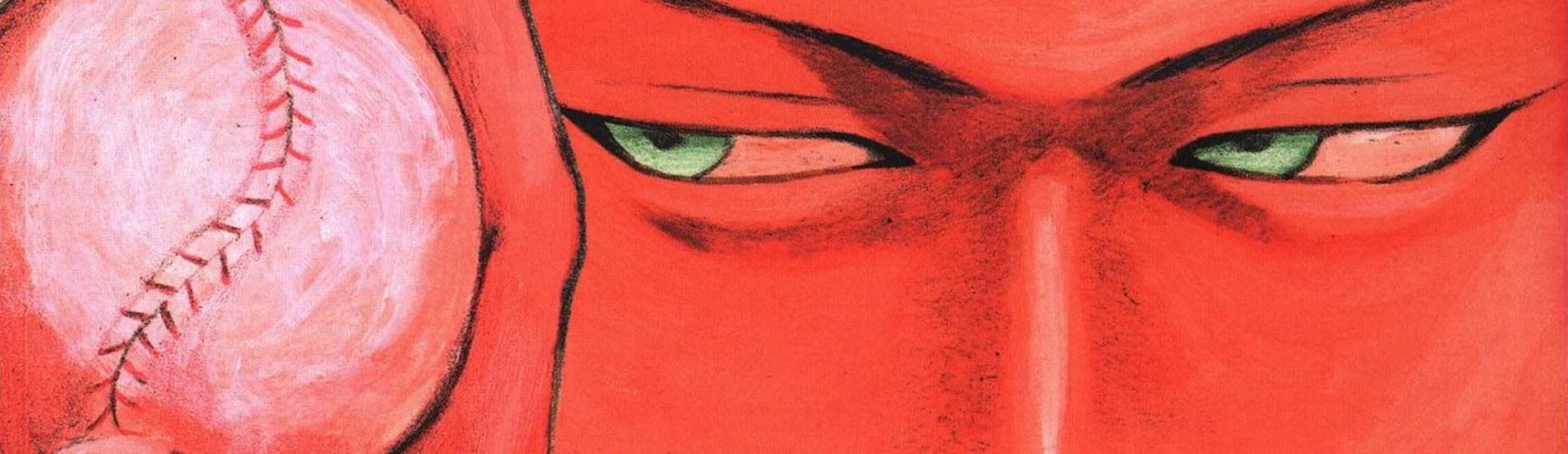
So for about the first half to two-thirds of the series, it was giving me everything I wanted in a sports manga. Tokuchi is a strong character who can stand the emphasis the series places on him. (In a lot of ways, including his appearance, he reminds me of Yoichi Hiruma, my favorite character from Eyeshield 21.) His development from an icy and aloof asshole into an icy and aloof asshole who cares about the team and has its respect is fun to watch—especially the growing bond of trust between him and his catcher, Ideguchi. The series is at its strongest, in fact, when Tokuchi is backed into a corner, his own abilities are stretched to their limits, and his mind games give his teammates an opportunity to use their own strengths for the first time.
Unfortunately, a little after the halfway point, the shortcomings of this premise start to show. The premise has two major weaknesses that eventually start to hamper the series.
First, there is only so much that you can do with a pitcher who has one pitch. As I said, the idea was that Tokuchi has no real athletic ability but is able to strike out excellent batters with nothing but a slow fastball because of his ability to read his opponent and get inside their head. But as increasingly good batters go up against him, this would begin to be (a) implausible, because at some point reflexes and visual acuity alone should be good enough to hit an 80mph fastball, and (b) boring, because each at-bat would go essentially the same way. So to address that issue, Tokuchi's skills are retconned a little bit. I won't go into the details, but what it boils down to is that Tokuchi is preternaturally accurate and has two subtly-different pitches that he can choose between at the moment he releases the ball. Okay, that's fine—better, in fact, since it makes the story feel a bit more plausible. But as the series advances, and the conflicts broaden from "let's not allow any runs while I'm pitching" to "let's win the game" and so on, the physical component of Tokuchi's pitching gradually replaces the psychological component. By the end of the series, the one-on-one psychological battle that got me hooked has totally vanished.
Second, the nature of Tokuchi's contract makes his earnings spiral out of control, robbing the conflicts of much of their tension. (What follows contains spoilers of roughly the first half of the series.)
In fact, this ultimately interferes with the plot, leading the series to completely neglect its strongest points, overturning some of its core themes, and ruining much of Tokuchi's character development. (What follows contains spoilers of the first 70–80% of the series.)
At this point the series goes totally off the rails. It turns out that Tokuchi—who, I will remind you, appears to have developed a genuine bond with his teammates—was engaged in a triple-cross, working with a private equity company to drive down the value of the Lycaons and force a sale only to betray them and buy it for himself at a bargain-basement price. This fact is revealed in a phone conversation between him and his teammates while they are together at practice and he is in bed with a blonde supermodel, which should give you some idea of how remorseful he feels about the whole thing.
Then there is a new antagonist introduced who appears to be trying to cause a merger of Japan's two baseball leagues. This subplot fizzles out almost immediately, but he continues to be the antagonist of the rest of the series.
Then Tokuchi completely overhauls the team's salary scheme, replacing it with a "you only get paid if we win, and only based on your individual performance" model. From this point onwards, the sense of camaraderie that had been built up during the first half of the series, the idea of shared striving, is totally out the window. I think the idea is to give Tokuchi's talents as a psychological manipulator a broader scope, but all it really does is make the Lycaons' final arc deeply unpleasant to read. The message ultimately sent by that arc is that the Lycaons had hidden strength that could only be unlocked once they stopped caring about the team as a whole and started focusing on making money. It's not a fun arc.
As the series lumbered on towards its conclusion, I still had some goodwill towards Tokuchi and his teammates, and I still wanted to see them achieve their goals. But the finale was a letdown, too. At about Chapter 155, it became obvious that the ending was going to be incredibly rushed. And it was.
Ultimately, the direction One Outs goes during the second half of the series suggests that the author didn't understand his own protagonist, or at least didn't care about doing him justice. Tokuchi is distant, cold-blooded, and unreadable, but he also has a sense of whimsy and honor. At the beginning of the series, he chooses to treat Kojima as having won their "One Outs" match, and therefore chooses to join the Lycaons, because he is moved by Kojima's determination. He chooses to make Kojima's championship dream his own. The Tokuchi who does these things in the first half of the series is not the Tokuchi of the second half.
If you are able to appreciate the first 60% of this series for what it is, and accept it as the brilliant but incomplete story of an unconventional pitcher leading his team to victory through mind games and psychological warfare, you will really love One Outs. If, like me, you cannot do that, then I do not think you will like One Outs, and I can't recommend it to you.
9 out of 10 users liked this review
