#
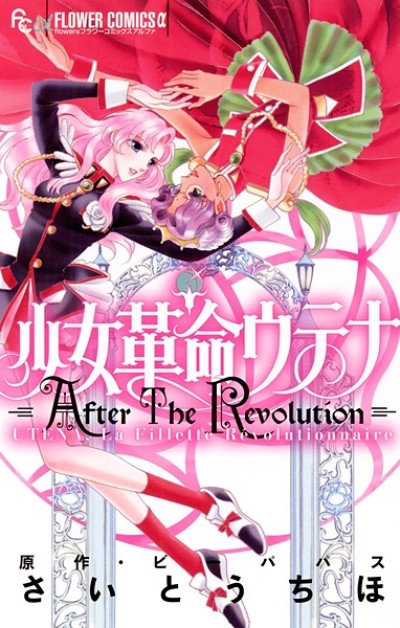
20 years after the release of 'Revolutionary Girl Utena', 'After the Revolution' was released, presenting stories surrounding the main cast of the original series, 20 years later. What is interesting to note is despite being a sequel to a popular title (and of top of that receiving an official translation, I even found and bought it at my local bookstore), I rarely see anyone talk about it. I was only able to find a small number English websites regarding this manga (one being a negative review and the other more positive). Furthermore, the stats on AniList reveal that not many people have read it.

As to why this is, I do have some theories, but that is for later in the review. For now, onto the review of 'Revolutionary Girl Utena: After the Revolution'.
#
The 'revolution' the characters must face in their respective stories is essentially one final bit of character development, one last hurdle they must overcome. The revolution appears to them as they face another dilemma, and usually this involves looking back at the past and growing from it. It is here where Utena returns to play out a new role, as the prince replacing Dios, appearing at the moment of revolution for each of the characters and pushing them towards it.
The first story centres around Kiryuu Touga and Saionji Kyouichi. Here, the story first establishes the two meeting at an art auction. The two have their banter as usual, but they are soon invited back to the academy by an all too familar letter. And so, the duo find themselves back at the academy, where the manga and anime took place many years ago.

The two find themselves at odds again, facing each other’s conflicting beliefs. It then moves onto the two reminiscing on their memories, and afterwards reaching a breaking point in the opposing values, the two duel once more for the 'power to revolutionise the world'. It is here where they resolve the conflict and using the power they obtain access to the painting of 'Revolution'.
Whilst it was nice to see the two again, I could not help but feel this story was rushed. It quickly goes from establishing their new 'occupations' (if you can call it that), them going back to the academy, looking back at an old memory, having a duel, and finally taking the painting. All this crammed within one chapter made it feel overly compressed. This becomes even more blatant when you take into account the whole reason why the conflict between Kiryuu and Saionji was never properly resolved. The theme of 'revolution' was central to this story, but unlike the anime I did not feel as drawn to it, mostly because of the rushed development. For me, this was the weakest story out of the three.

The next story draws attention to Arisugawa Juri, who even after all of these years she is still fencing. Takatsuki Shiori also plays a key role in this story, as Juri still has feelings for her. The conflict Juri must overcome in this story is her lingering affection for Shirori, as well as her past with Tsuchiya Ruka. This in turn made for a more captivating story than the previous entry, dealing with the intrinsic troubles Juri is facing, lingering after all those years. Although it was still held back by the tight time constraints, it was upheld by the engrossing character development as well as the symbolism present in the story, a key technique used all throughout the anime.

The final story is a bit of an interesting one, to put it one way. It delves into both Kaoru Miki and Kaoru Kozue, unveiling the relationship between the two. This time, however, it looks upon their bond in an incestuous light. Although this kind of relationship was hinted somewhat in the other media in the series, I was not expecting it to be as blatant here. Typically, I do not like incest as a theme, but it does have the potential to raise some interesting questions and provide an intriguing story, which can be seen in this short story, to some extent at the very least. This dynamic between the two presents a forbidden relationship, an arduous hurdle for the two. That said, if you are completely averse to the theme of incest, I can see you not enjoying this story at all. Their incestuous relationship is not the only focus of this story though, as the motif of the piano and the piece Miki has been desperately attempting to complete makes a return. Although it was not as central as it was in the anime, it was still enthralling to see it once again, that like the other characters in this manga, they could never truly leave the past behind, until they met Utena once again.

Initially I was confused as to why when the characters met Utena once more, they were very clear in stating that they do not know her at all, which was very odd given how the anime ended. Although she did disappear, it was not as though they all forgot about her, Anthy is determined to find her after the conclusion of the anime. Then after some searching around I found out that this was a sequel to the manga, not the anime. For those who may be unaware, the anime and manga diverge in their plots at some point in the story and even from the beginning there were minor differences. Thus, whilst both end with Utena disappearing, the manga and anime have very different endings, the key detail of the manga's ending is that everyone (but Anthy if I remember correctly) forgets about Utena. Despite that, it could be considered a sequel to the anime somewhat as what pans out in the stories could still apply to the anime's iteration, save for the fact that no one remembers Utena.
Overall, whilst it was certainly intriguing to explore the world of 'Revolutionary Girl Utena' once more many years in the future I could not help but feel it lacked the same feeling that the original anime had. Where the anime repeatedly drew me in with its fascinating themes and characters, the manga felt average in comparison. It was by no means bad, but just failed to draw me in as much as the anime did. Perhaps I am comparing it to the wrong thing though, if I read the manga I may have a completely different opinion on it. I do appreciate being able to see the cast once more, but they were not as strong as they were as when I watched the anime.

#

#
As for why this sequel is not as well known, that is either a result of little marketing or it being more of a sequel to the manga, which is less popular in comparison to the anime. Also, this sequel does not add too much to the series' lore, rather it just ties up the final conflict members of the cast were facing.
Hopefully you were able to get something out of this review. If would like to send me feedback on my reviews, please post a comment on this thread or feel free to send me a message.

19.5 out of 24 users liked this review
