
####This review contains spoilers.
More than 500,000 Japanese civilians died during the war. Some estimates place it as high as 800,000. That is a staggering number, essentially impossible to comprehend. More than half a million people reduced to a statistic without a face. Grave of the Fireflies is the story of two of those many thousands. A story and thus a face to the civilians that died during America’s deadly firebombing raids, that lost their homes, their parents, their siblings. A face to people who were left behind by their country and people in the name of war.

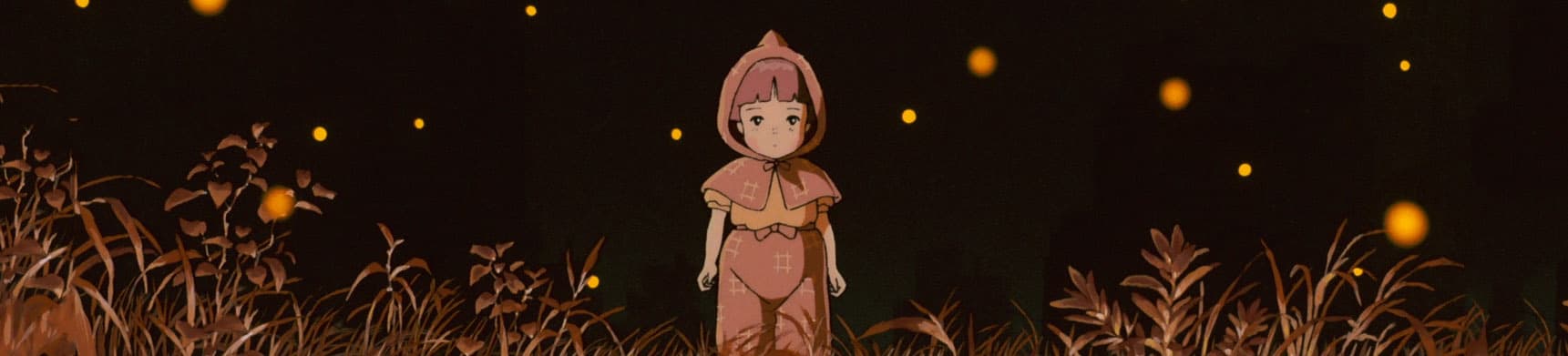
Isao Takahata's 1988 film Grave of the Fireflies is about Seita and Setsuko, two children, and how they survived the firebombing of Kobe. And how they failed to survive the last months of the war that followed. The story is semi-autobiographical, an adaptation of a short story written by Akiyuki Nosaka.
Much like the film, Nosaka’s adoptive father didn’t survive the bombing, and thus he and his younger sister were left to fend for themselves. However, Nosaka’s life story is, in a way, bleaker than the one he wrote, as he openly admits that Seita was much kinder than he ever was. Where Seita gave food to Setsuko despite his own hunger, Nosaka ate only to be riddled with remorse after.
Nosaka’s younger sister, Keiko, died of malnutrition in the months after the bombing. While Nosaka would, of course, survive the war, he wrote the short story to deal with his guilt as a survivor and the blame he placed on himself for her death. In my eyes, this is why Grave of the Fireflies begins and ends with Seita’s death, playing out like a double suicide, with the two being bound by love in both life and death.
With this in mind, I think it is easier to understand why the children run away from their aunt. It is essentially an avoidable action that results in their death and this is precisely the point of the film in many ways. Their deaths shouldn’t have happened and Seita is (at least in part – it's hard to deny the negligence of the aunt) to blame. Because Nosaka thinks he was to blame.
For some, issue may be taken with how the Grave of the Fireflies places the Japanese as victims of the war or at least suggests that the common people were deceived by the Imperial leaders. As a Western audience consuming a film that was explicitly made for young Japanese people, this assumption can feel jarring. But I don’t follow this train of thought myself.
Because despite what Japan did during the war, the Japanese people were victims. America’s firebombing campaign was devastating, more destructive than either of the atomic bombings. Major Curtis LeMay, the mastermind behind the operations, has openly admitted that America would have been tried for war crimes for the campaign had they lost the war. Estimates place the Japanese civilian deaths that resulted from these firebombings at 300,000, many more were injured and millions of Japanese were left without homes. Roughly half of Tokyo was destroyed. A bit more than half of Kobe was too. And there were many other cities attacked. Grave of the Fireflies does not shy away from depicting the reality of these attacks. The shots of the children’s mother before she dies are rough.

And whether ill-equipped or apathetic, the fact of the matter was that even more people died because Imperial Japan diverted resources to fuel the war. And this is the message the film portrays through the children’s aunt, who comes to embody Imperial Japan. She demands endurance and sacrifice be made in the name of the war effort. She takes their saved supplies and the rice gained from selling their mother’s kimono and gives it to her husband and daughter who – we are infantilisingly told – are contributing to the war.
Meanwhile, the military itself, which is supposedly fighting for Japan, is out of sight. The children’s father is absent and unable to care for them. And in spite of whatever the military is fighting for, people are dying at home. In this regard, Seita’s admiration of the navy shouldn’t be misunderstood as the film’s admiration for it. In reality, his idolisation of militarism plays as a dramatic irony because we know that Japan loses the war and that their father never returns to save them.
It’s these two characters that play any role of a villain in the film, not the Americans. War and neglect are the evils of the story, and arguing that Imperial Japan did horrible things during the war – to Americans or otherwise – misses the point of the film. It’s made to remind young Japanese people just over 40 years after the war of its horror, and it should continue to remind us of that. And this is not to suggest we should look past the atrocities of Imperial Japan, I just reject the idea that the film has any responsibility to show this or deal with it.
Grave of the Fireflies is a uniquely bleak Ghibli film, a grim and tragic anomaly compared to the rest of the catalogue. Unlike Miyazaki’s works which tend to be guided by his desire to make films that “tell children ‘it's good to be alive,’” and are liberally filled with his optimistic view of people, Takahata paints his film with hopelessness. Every bright moment of joy in the film is scarred by the grim reality that the protagonists are trying to ignore. We are not left to enjoy the fun day at the beach, as it is interrupted by the discovery of a dead body and is hauntingly ended with Setsuko’s line “But I’ll get hungry if I swim,” which shatters any hope that her childlike innocence could be preserved.
Studio Ghibli wouldn’t really make a film like Grave of the Fireflies until The Wind Rises in 2013, which similarly focuses on the war and is marred by guilt and tragedy. But even then it is not nearly as soul-crushing or misery-inducing as Grave of the Fireflies. Grave of the Fireflies is a film that left me staggering around my house openly sobbing, something no Studio Ghibli film has strived to do since.
But it still looks and feels like Ghibli. It’s absolutely stunning, the backgrounds are spectacular, even when they are of the post-apocalyptic landscape of the ruined Kobe. The cave and the lake are a fittingly delightful refuge from the world and act as a terrifyingly perfect stage for the slow encroachment of Setsuko’s death.

The final shots of the lake, as the music of a record plays over the water, are nothing short of beautiful, and are an incredible way to conclude the film as you sit there shell-shocked. The movie cuts this beauty short, however, for us to return to the train station and Seita’s death. And it’s this – the film’s ability to move between beauty and bleakness – that is central to what makes it such an unforgettable anime, constantly reminding us that beauty can be short-lived and that fireflies can die much too soon.