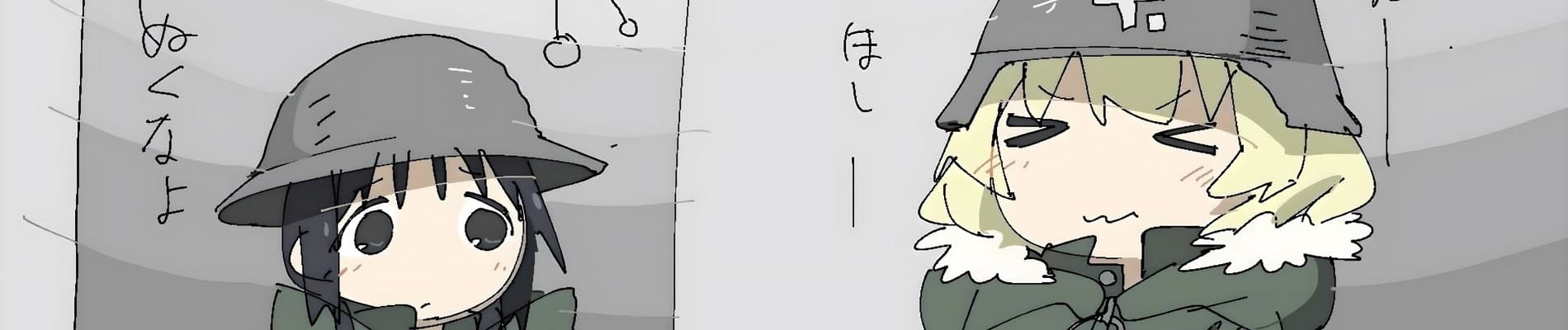


Girls' Last Tour is a post-apocalyptic slice of life, a story of the survival of two young girls, Chiito and Yuuri, as far as they know potentially some of the last people on Earth. It exists off of an inherently antithetical premise, done before more conventionally, but here almost as a subversion of its very concept. Cute Girls Doing Cute Things, but faced not with midterms or social anxiety, but their own inevitable extinction. Chiito the mechanic, the analytic, journaling and worrying for the two of them, Yuuri the illiterate, ravenous meathead, existing to eat and sleep, an instant comedic pair. The two travel through the decay of the old world, searching for presumed shelter somewhere far above, where the last vestiges of humanity might be hidden. There are no vast threats, there are no apocalyptic aftershocks, just the empty, decomposing body of all that came before, the sum of all human experience. They scavenge for resources, they cook rations, they drive, and they spend the rest of their time deconstructing the corpse of reality, discussing the fundamental elements of religion, war, art, literacy, simply out of curiosity.
To start, the technical side is excellent. TKmiz has a very wavy, sketchy sort of art style, applied to make the world feel truly black and white and inescapably industrial. Under close scrutiny, it can look simplistic, but it often combines to create vast interlocking detail, sometimes even combining between frames. There's a real sense of scale in almost any environment portrayed, as if everything is far beyond the scope of understanding of our characters, and perhaps that's okay. Sometimes a page of the manga is framed to carry a single feeling across every panel on it in its composition, extending the mesh wires or endless metropolis structures beyond view to truly let the reader sink into the world. Its a contemplative manga, drawn and structured contemplatively.
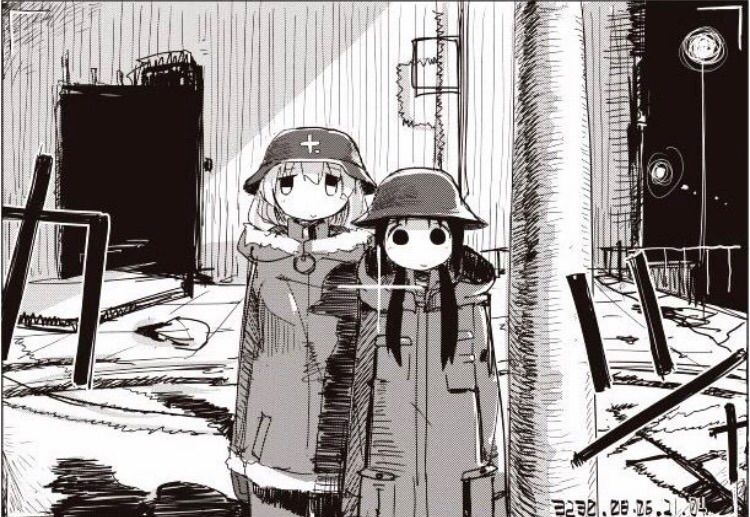
The characters are simplistic and often predictable, usually with a single goal or defining characteristic, almost always serving to broaden the shadow of hopelessness that stretches across the world they inhabit. Chii and Yuuri are likeable, very comfortably designed, and maybe most importantly very fun to watch. They are almost always having fun, entertaining themselves to distract from the grim reality, relishing in the mundane (and maybe sometimes not so mundane) leftovers of whatever civilization or time period that used to be. They make a great tandem in concept and in practice, the pragmatism of Chii invariably undercut by Yuuri's lackadaisical idiot wisdom, providing ever-so-slight conflict and difference in interpretation on every topic. The core concept of a CGDCT in a hopeless wasteland probably wouldn't work if its core characters weren't fun and light in spite of the circumstances, and Girls' Last Tour does that well...
...And instead has every side character perpetuate the hopelessness and inevitability of existence instead. There are not many of them, and they don't stay in the story long, but they all exist to fail. These are mini melancholies, met not with tears but with a release, a sense of freedom from the obligations of their self-assigned pursuits. Failure or not, they learn to recontextualize their defeat into the death of society, and find peace within it, a microcosm of the core development the main characters undergo.
Thematically, hopelessness is the order of the day. Everyone exists to find meaning in the ashes, whether that be society's or their own. Sometimes that ostensible meaning is food, sometimes it is death, but it's always there, the driving force behind every individual. Girls' Last Tour is really at its core a search for meaning, maybe for the writer as much as the characters. In that way, reading it feels not like picking up a piece of light fiction, but more like a classical piece of literature, existing in a Dostoyevskian capacity, to answer an overarching question on life or society. As The Brothers Karamazov exists to answer "Does God Exist?", Girls' Last Tour stands to answer, absent God and civilization, "What Does Man Live For?"
I won't get into spoilers in fact on what that answer is, but I will spoil by comparison. To me, Girls' Last Tour is almost exactly a secular version of Tolstoy's classic Novella, the Death of Ivan Ilych, where a low-level Russian magistrate bumps his hip while changing the curtains and subsequently dies of cancer. He struggles against his death, fearing the unknown, until he reconciles his death with his faith, and suddenly, his perspective is flipped. Death is not a terror, but a freedom, a consummation, a joyous catharsis. The imagery surrounding the ending of Girls' Last Tour mirrors that of Ivan Ilych strongly, traveling through a suffocating, narrow passage after being stripped of everything that formerly defined them on the way to the end. Except here, the key to catharsis was not faith, but the human bonds we make. When all else is gone, the memories and connections humans make with each other cannot be stripped away. That is TKmiz's answer, that is what man strives for, not books, not food, not death, not war, not peace, but the intangible interpersonal relationships that make us more than simply agents of human entropy.
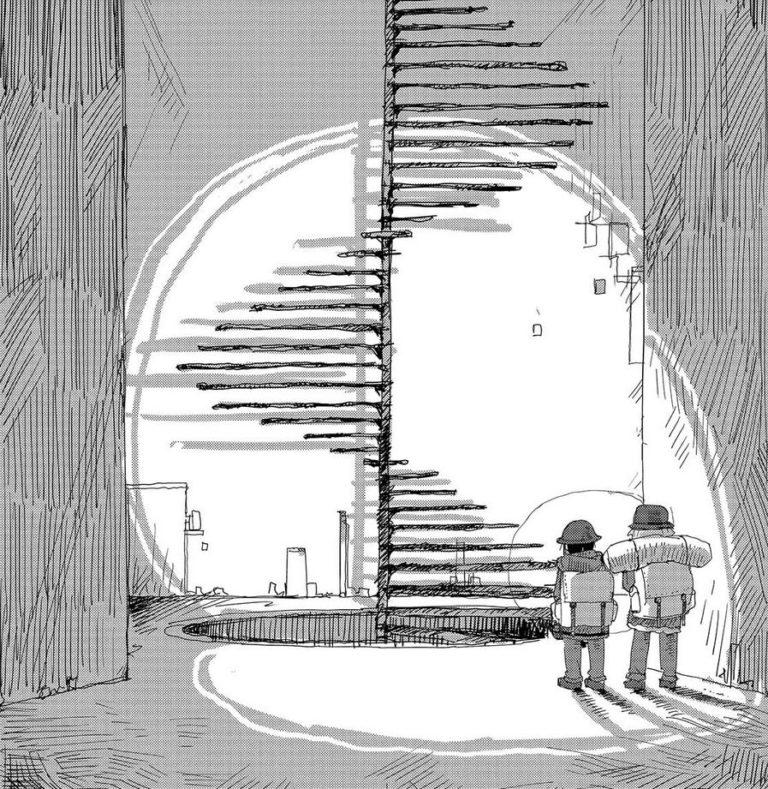
I don't know if their answer is any more correct than Tolstoy's, but I find it no less profound.