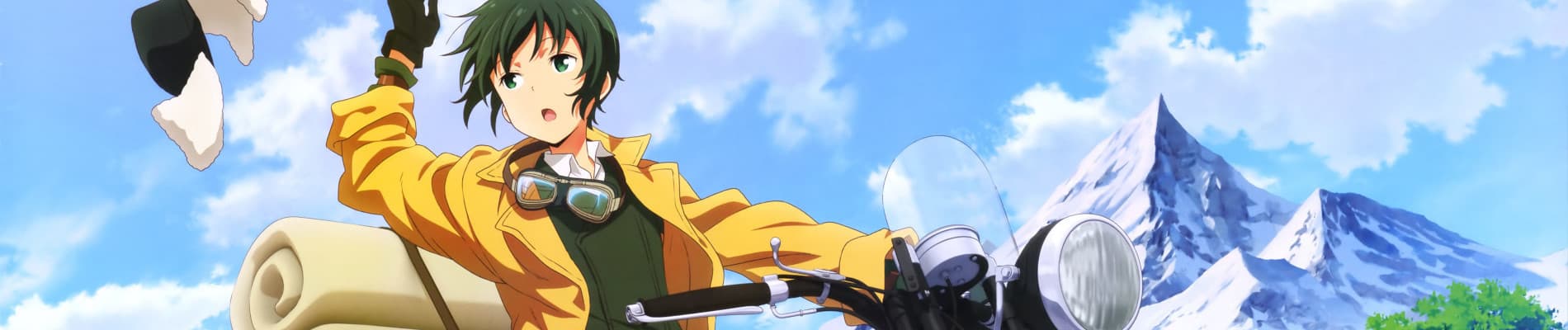
I love Kino's Journey—it's one of my favorite series, apart from maybe Made in Abyss. The story is simple, with Kino as the traveler, Hermes as their ride and companion (pronounced air-em-es: don't get it wrong!), and the world as their road of exploration, leading to countries (or lands) with unique cultures. What I don't love, however, is how the series's story gets applied, with this version distorting many of its basic principles (specifically its characters). If your first experience of Kino's Journey is from this version (and not from the 2003 anime or light novel), you likely have some image of the story and characters which skews from the original base (e.g. seeing Kino as a gun-weiling traveler who can resolve some of the world's problems, as opposed to a traveler who likes to explore the world and understand people's lives while sometimes being forced to resort to violence).
In this review, I'll try to outline the series and this version of Kino's Journey, highlight a number of its shortcomings while contrasting it to the 2003 anime, and conclude with details on why the review matters. I will also mention some criticisms I hear of this version which I personally don't agree with, but still think are worth mentioning.
Kino's Journey is a series that began in the 2000s with the light novel by Keiichi Shigusawa. For me, it was the first light novel I read, though I've only read some of the volumes (between three and four, in which I skipped the first one). The series got its major adaptation with the 2003 anime, which primarily covered the first volume, but did include parts of stories from other volumes, such as volume 3, chapter 5 (The Country that Forbids Discrimination | -True Blue Sky-) where Kino ponders the color of the sky and what it means for traveling. The adaptation was directed by Ryuutarou Nakamura, who also directed works like Serial Experiments Lain, though I personally don't care so much about who is involved in production (unless it's someone like Susumu Hirasawa). Anyway, fast forward some movie and manga adaptations and we arrive at the present 2017 anime adaptation.
The first time I watched Kino's Journey was when I was in my room with one window blind closed and another open. I was watching the 2003 version and was in the middle of the second episode ("A Tale of Feeding Off Others —I Want to Live.—") when I thought to myself, "Kino is probably going to be one of my favorite characters", which turned out to be true (yay). The time I watched the 2017 version was when I was on vacation and staying at a hotel. I thought something was "off" about it, but I still liked it, so I gave it 3/5 stars and moved on... until it came back to me.
I initially found the story choice to be weird. Episodes 1, 2, 3, 11, and 12 plus partially 4, 6, and 9 (second country with the points system) all feature some elements of violence/action. While Kino's Journey as a series does use violence in its stories (come on, where else are these scenes coming from?), they're usually spread out through the chapters; yet this version has a lot of them bundled into one. It's not even the excessive action which is necessarily problematic: Kino, in general, takes a much more active role in this version, acting as a kind of savior for some countries (see episodes 2, 3, 12, and partially 4). But wait, a contradiction! In some episodes, Kino's role is very minimal, or practically not there (see episodes 4, 6, and partially 7, 9)!
Well, the common reason (and the one I agree with) has to do with how the episodes were adapted. Apparently the producers ran a poll asking fans to vote for the stories they wanted to see adapted, in which they selected the ones with the most votes (we all love democracy, but watch 2003's episode 5, "Land of Majority Rule —Ourselfish—"). This is problematic, since while Kino's Journey is episodic in its storytelling, the stories themselves are not unordered. In the 2003 anime's episode of the colosseum, for example, we got to watch Kino for five episodes prior, watching their experiences and personality come to play on the semi-dull colored screen. So, by episode six, when Kino
The adaptation of the colosseum episode also highlights a distinction I think the 2003 anime gets right, which this version lazily ignores, but one some people who are very critical of this version surprisingly defend. Apart from the previously mentioned choice of episodes, this version of Kino's Journey seems to be much more faithful towards the light novel. This sounds like a good thing at first (faithful does sound like a good word)—after all, you'll get a more consistent story. The issue I personally take with faithfulness here is that being faithful also means copying its flaws, and copying what's meant for one medium in another. In this version, for example, Kino practically 1-hit K.O.s her enemies, instantly defeating them, and also doesn't spend much time exploring the country. In contrast, in the 2003 version, Kino gets to see first-hands the state of the country and the king, which influences her decision at the end to
While I hear a lot of criticism for the story, one point I often hear praise for is the art and animation: "it looks great!" I don't blame anyone for thinking so, given the 2003 anime doesn't look great to many people. However, I would like to raise a "why" to this, as I think art and animation, to some degrees, is misunderstood.
When tasked to design a system (here, art and animation), consistency is often prioritized over extravagance. That's not to say either version is one of the two, but to say that, given the choice between an ugly but leaning consistent design and a beautiful yet inconsistent design, consistently will likely win. It would be weird to have a character wear a hat for 20 episodes then not wear it afterwards for no reason. It may be a controversial opinion of mine (and one that may be fair to critique), but I honestly find the art and animation problematic in this version from how much it differs. Kino has like 5-6 different eye / theme colors throughout the anime, some scenes do not blend well (e.g. the sheep with the fire), and, more annoyingly, it flips between "normal" and CGI animation. Sometimes Kino gets on to Hermes like a sketch, and other times like a block. It's as if they're in two different dimensions (or maybe 12, given the eye colors)!
Another anime which adopts a similar art and animation choice is Boogiepop Phantom, which uses it to paint an environment oozing in horror. It's not an accident, as we can tell by the last episode, yet it heavily contributes to how viewers interpret the story. Similar, the 2003 anime of Kino's Journey uses it, to some capacity, to influence our perception of the story. A perfect scene which encapsulates this feeling is the adults episode with Kino's backstory. After riding Hermes out of the country, we, the viewer, are unlocked the world, after being stuck in the country for so long. Behold:
Still looks bad? :(
Anyway, here's the 2017 equivalent, with more scenes to show the difference in art:
Does it look pretty? Sure! But is it consistent? Not so much. In just those five images (there are really 7-8 instances of this here), we basically have five different color palettes of Kino, which means five different kinds of Kino to interpret (note that by color palette, I don't mean that all anime should only use one set of colors; I mean that their colors should be consistent with the theme, which images 1, 3, and 5 don't really do well; a base set of colors, kind of). It's kind of like in some anime where they'll either cover the eyes by making it dark/hard to see to imply some deep shift in mood or will change their eye color (usually to red) to signal some transformation. Is this really Kino's Journey, or Kino's Journies? Are we dealing with the yellow Kino that's willing to
This review has primarily been a brain dump of me trying to put into words my issues with the current Kino's Journey. For avid fans of this version, this review likely means little—and that's a good thing. You shouldn't let one experience like mine tell you how to like your stories. But for people who are more on the fence when it comes to the series, I would highly recommend watching the 2003 version of Kino's Journey, as its framing of Kino is much more accurate than what this version paints. If you still want to watch this, at the very least, watch the 2003 version before it so you don't mistake Kino's actions.
This is my first review! I wrote this in about half a day, since I didn't want to try and express it in a note.
I wrote this in CotEditor—a simple plain-text editor. Markdown editors, from my experience, are not very good, with Typora and AniList's built-in one being prime examples for me. Cot is interesting, since it's still text, but you can see the syntax (but not the applied syntax), so it's somewhat decent to write in (I swear, this is not a promotion).
I primarily write mini-reviews in the notes field of entries on my list, so check it out if you want to see my thoughts on other series. :)
18 out of 23 users liked this review
