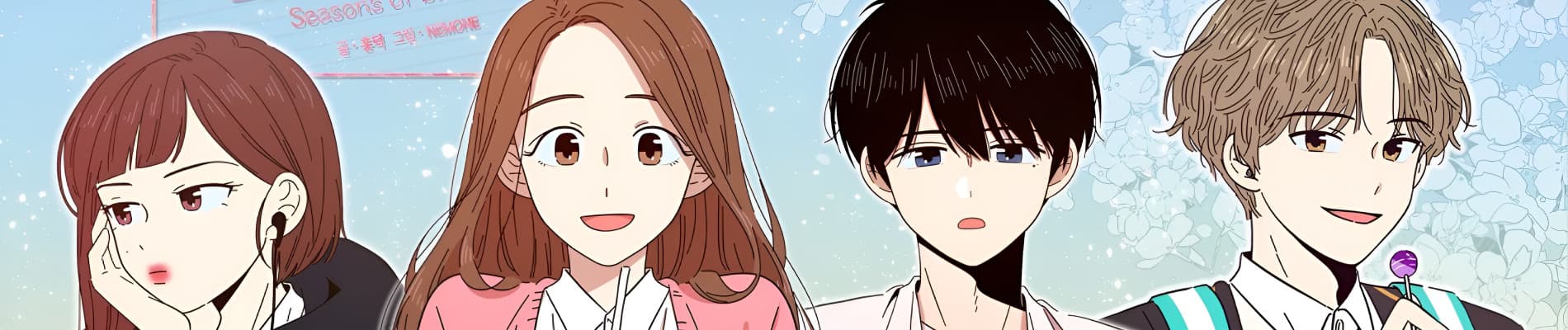
Seasons of Blossom is an excellently told story that explores both the beauty and hardships that come with young adulthood. Each season of the story stars a different protagonist with a new central theme, and a seasonal motif to go alongside their story.Within this review, I will be looking at 3 aspects of this webcomic. The artwork, the characters, and the story. This review will include spoilers. I will avoid talking in-depth about specific story events, but I will have to touch upon the themes that each season covers in order to summarize them. As of writing this, the story is not complete, and I will update this review when it finishes.
Also, if my review somehow manages to convince you to read the webcomic, please bear in mind that it covers topics such as suicide, self harm, depression, and bullying. If you are sensitive to these topics, I would hold off on reading it until you’re more comfortable, but ultimately, it is up to your personal discretion.
Artwork 10/10Seasons of Blossom’s art style is very crisp and clean. The colors are vivid, yet they are not distracting, and honestly, the style really helped immerse me into the story and maintain my engagement. The art style can seem a bit simple with the lack of heavy shading, but don’t let that simplicity fool you, as there are quite a lot of details put into the artwork.
One very small detail I particularly really love is the fact that each season is assigned a color, with Bomi’s flower (spring) being pink, Hamin’s flower (summer) being green, Gaeul’s flower (autumn) being orange, and Dongchae’s flower (winter) being grey. The webcomic’s logo will change colors to match the seasonal color, and the flashback sequences will use the main season’s color in the background, instead of the classic flashback black that most comics opt for. This usage of color also helps immerse the viewer into the sensation that comes with each season. The bubbly new beginnings of spring, the bittersweet heat of summer, the bright change of autumn, and the harsh cold of winter.
When I first started the comic, I found the way the creators of the webcomic drew and coloured eyes to be particularly unique and expressive. They say that eyes are the window to the soul, and Seasons of Blossom takes that literally. For background characters that the main cast is not particularly familiar with, eyes won’t be drawn. This could, just simply be a shortcut to save time, as webcomic artists often have to take shortcuts to meet deadlines. However, there are a few instances where it truly feels like it is not just a mere coincidence. One of them involves the main character of the first season, Bomi, and her love interest, Jinyeong. Initially, before Jinyeong overhears that Bomi likes him, he doesn’t see her eyes when they bump into each other. It is only after he hears about her feelings, that her existence becomes significant in his world, and he begins to notice her face every time he looks at her. On the contrary, there is a character within the story who is deeply struggling in his life, and his eyes are almost never seen, because he never opens up to the audience, nor himself. With the few times that we DO see his eyes, we can only see one of them, giving the reader a sense that something is missing, or that he is deeply hurt and broken.
Webcomics created for the mobile scroll format can experience particular limitations that comics published as books do not face. One of those limitations is the fact that you lose out on overall page layout and paneling. Webcomics tend to only display 2-3 panels on the screen at once while the reader scrolls, which is far fewer than the panels that can be fit onto two pages of a book, and as a result, the webcomic artists lose freedom in paneling and page layout. Despite the limitations, I’ve noticed on multiple occasions that Seasons of Blossom’s paneling includes references to past scenes, whether it be to mirror a scene or character, or to contrast them entirely. Usually, these are quite spread apart though, so it can be difficult to notice unless you’re rereading the comic, but I would particularly point towards the contrast and similarities between the scenes that Hamin is in, versus the scenes that Dongchae is in. They parallel each other quite a lot, and that emphasizes the similarities of their situations. Honestly, the fact that the webcomic does this makes the artwork score go from a 9/10 to a 10/10, because I admire when webcomics work past the limitations of their medium.
Characters 10/10
I often find that stories with ensemble casts can be a bit of a risk. There are a lot of difficulties in balancing screen time and development between everyone. However, Seasons of Blossom avoids this by intricately linking each character with another, in some way. Whether they are childhood friends, siblings, former classmates, a friend’s friend, the friend of a bully…The types of relationships a character has with another immediately helps characterize them, and allow for opportunities for past characters to naturally show up within the story. I cannot go too in depth with the relationships because of the fact that I would need to delve deeply into story spoilers, but it is one thing to keep an eye on when reading for the first time, because you will be amazed at how each character influences the lives of another in various ways, just by existing. One particularly meaningful relationship to keep an eye on is
Spoiler, click to viewclick to hide
the way that Hamin's life was able to impact Gaeul through Somang, even though Hamin and Gaeul had never even met before. The protagonists, Bomi, Hamin, Gaeul, and Dongchae are all far more similar than they initially may seem on the surface.
Spoiler, click to viewclick to hide
They all share the same kinds of trauma that come with youth, their differences being the fact that some characters got chances to heal, while other characters grew too tired of the hurt. With each main character, you think — “oh, if only they had this one person in their lives, they could’ve been happier,” or the exact opposite, that “if this person was not in their lives, things would’ve been far worse.” The story encourages you to ask these “if only” kinds of questions, but settles you back into the reality of their world very quickly, reminding you that you cannot change the past, and that sometimes it’s okay to accept the way things happened and to move forward regardless. A small detail I really enjoy is the consistency in background characters, too. For example, Jinyeong and Jaemin’s respective friend groups may consist of side characters who do not get as much spotlight as the main cast, but their characterization is very strong because of the fact that they consistently appear and their designs are recognizable. And when a particular side character steps out beyond the sidelines to become a main character, it feels natural because the audience was already familiar with said character.
If you ever think, “Oh, I’m sad this season is ending, because I won’t get to see the main cast…” you’ll be completely surprised by the fact that past characters will constantly reappear. So if you really enjoyed the romance between Jinyeong and Bomi in season 1, don’t drop the comic after finishing Bomi’s flower, because they both appear quite a lot throughout the rest of the story, with their relationship still growing constantly. In fact, I feel that the main cast of the first season — Bomi, Jinyeong, Jaemin, and Seonhui — are the “true” main characters in the entire story, because each one of them individually can represent a season as well, and they receive development and spotlight as within that specific season, too. Bomi is of course spring, Jaemin is summer, Seonhui is autumn, and Jinyeong is winter. It is nice to have a big cast of characters, but it is also equally as nice to have these 4 characters that the reader is able to consistently come back to.
Story 10/10
This section will lightly discuss the themes of each season, and thus will cover light spoilers.
Bomi's Flower:
Spoiler, click to viewclick to hide
On that topic of Bomi and Jinyeong’s relationship, I initially started this webcomic for the same reasons other people did when it was released on webtoon — the romance. The first season, Bomi’s flower, is a very lighthearted romance that’ll give you that same bubbly feeling that a lighthearted shoujo romance manga will. The topics it covers are far more lighthearted than the later seasons to reflect upon the sweetness of spring, such as romance and friendship. It does lightly touch upon bullying, too, but not as indepthly as later seasons.
I’m personally a huge sucker for a classic tall girl x short guy trope, and Bomi and Jinyeong’s relationship provides the fluffiest and sweetest content with that trope. The drama within the first season is typical for a romance, yet without it, I think the resolution and ending of the first season would be nowhere near as impactful. There is a slight love triangle, but the approach to its writing and the resolution makes it feel satisfying and it was never frustrating to watch unfold. This season is a favorite for many because of Jinyeong and Bomi, and understandably so, because they are very fun to watch together. Hamin's Flower:
Spoiler, click to viewclick to hide
The second season delves into the story of Jaemin’s older brother, Hamin. It covers topics of suicide, depression, and high parental expectations, while also having a romance plot — hence the bittersweetness of summer. This season without fail makes me ugly sob uncontrollably, tears and snot running down my face, crying loudly enough that my family gets concerned…It’s a heavy story, but Nemone and Hongduck’s approach to writing these topics is so delicate and careful. This season was really impactful to me, completely shifting my outlook on life, and it makes me disappointed when I hear that people drop the story after the first season, because I truly think Hamin’s Flower tells a very important story. Gaeul's Flower:
Spoiler, click to viewclick to hide
The third season delves into the story of Gaeul. It covers topics of depression, bullying, and self harm. There is, once again, a romance plot as well, that is fun to watch, because Subin (Gaeul’s love interest) gets flustered constantly by her. This season feels empowering to read, and watching the characters change, grow, and move on from the past is incredibly satisfying. It fits the everchanging season of autumn perfectly. Dongchae's Flower:
Spoiler, click to viewclick to hide
The fourth and final season, Dongchae’s flower — winter — delves into all of the heavy topics mentioned before while dialing back the romance by quite a bit. This season truly feels like a harsh cold wind that you can feel deep within your bones. The tension is high, things just seem to be slowly unraveling and falling apart…and while this season isn’t finished yet, I have high hopes that as the winter comes to a close, that the warmth of spring will come to embrace every character, and heal every conflict. These are all very simple summaries of each season though, and I did not include side plots because at that point, I’d just write out the entire story into the review. Some side plots are quite interesting to watch unfold and it would be better for you to explore them on your own.
Final Thoughts
Seasons of Blossom’s approaches to the subject matter it covers is truly so cathartic to witness. The writers clearly know how to write these heavier topics in a delicate, tasteful manner. Stories covering topics such as suicide and bullying can sometimes end up intentionally or unintentionally blaming the victim, but Seasons of Blossom never puts the blame on the victim. Instead, it emphasizes the importance of being kind to those around you. It reminds you that you never truly know the hardships someone else is going through unless they tell you, and it’s important that you keep an open hand out to help anyone who might be struggling. It understands that healing from trauma is a long and difficult process, and it isn’t something that happens overnight. It has truly been one of the most impactful pieces of media I have ever consumed, and I hope that many more people can experience its beauty.