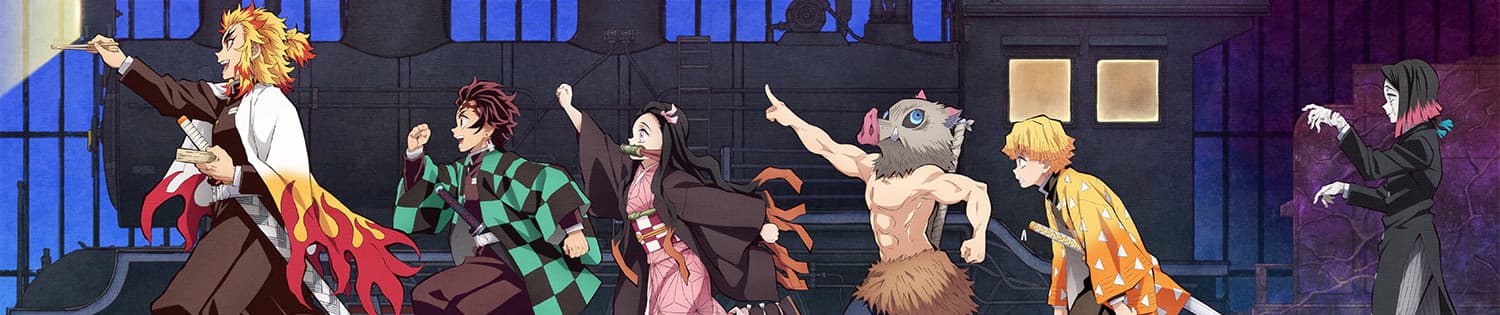
Demon Slayer is a series of little depth and many flaws, but looking gorgeous and inspiring intense emotional responses is not one of them; and that is exactly why Demon Slayer - The Movie: Mugen Train is so damn good - it's 117 minutes of oscillating non-stop between action and emotion in a masterful way, and often mixing the two to great effect.
The movie follows our main trio (and the ever-adorable Nezuko) as they embark on their latest adventure: To investigate a series of mysterious disappearances onboard the 'Infinity Train', alongside an elite member of the Demon Slayer Corps - The Flame Hashira, Rengoku Kyoujurou. It is, as per usual, a simple premise - and it is, as per usual, executed incredibly well.
But before I talk about any of the content, I think it's worth talking about something else that I really like about the movie: The fact that it is a movie. One of my main complaints for Season 1 was how mediocre the first half felt, and that was due in part to the pacing, which felt incredibly slow until the Mount Natagumo arc - here, though, I think the fact that we only have around 2 hours to work with helps even out the less exciting parts (which are far better this time around) with the action-packed parts really well. Unfortunately though, Ufotable didn't seem to agree with me when they made the 7 episode ~~cash grab~~ remake of the arc for television before Season 2 aired, but that's a topic for another review.
The movie picks up right where the show left off, as our lovable trio board the Infinity Train to meet with their new ally - however, things soon go wrong when all four are plunged into a deep slumber and begin seeing dreams from which they would never want to wake from.
Tanjiro is shown a dream where he is given back his former life - his mother and siblings are all alive, he isn't a demon slayer, Nezuko hasn't been turned into a demon, and the past few years of his life were all a dream. Soon after, though, he begins to realise that something is wrong - and in an incredibly heart wrenching scene (which is also sort of hilarious when you rewatch it, that baby falling on his face is really funny on repeat viewings) he is forced to abandon his family, yet again without being able to say goodbye, for the sake of his friends.
Rengoku's dream is the other one I want to spend a little time talking about, as it's actually a point of the movie that's written quite intelligently - unlike the main trio's dreams, which are full of their greatest fantasies, Rengoku's dream is... Sad. His father, the former Flame Hashira, hates him and thinks nought of his accomplishments, and his brother Senjurou is still saddened by his sorry state. This highlights the differences between the younger characters and himself - though he's upset by the state of his life, he has learned to embrace it, and is a man who's greatest joy is to do the best he can for those around him. So, his dream is not an impossible fantasy - it's just an ordinary day he spends speaking to and spending time with his brother. I also think this is a reflection of what happy dream Tanjiro would see if he were to see another one after he left his family in the last one - he has now fully accepted that they can never come back, and is moving forward despite his pain, much like Rengoku. Like I said earlier, this series isn't always written thoughtfully - but when it is, I'm perfectly willing to commend it. This scene does, though, end in an even funnier way than Tanjiro's, and I'm not sure this was intentional either: As Rengoku stops the assassin attempting to take him out in his dream (who looks like a child), he grabs and lifts her by the throat, and when Tanjiro wakes up he completely ignores it - it's fucking hilarious as he tries to wake the others while Rengoku is brutally murdering what looks like a 12 year old girl.
As everyone wakes up, they go to confront the demon behind the disappearances and their dreams - and, surprisingly, Tanjiro is able to take him out with ease after it shows him dreams of his family blaming him for their deaths, which then triggers a much darker side of our lovable protagonist we haven't seen before. We don't have much time to dwell on this though, as the demon begins to reform his body, and becomes the ultimate horror: A CGI model! More specifically, he has apparently merged with the train - much to Inosuke's delight, as he had tried to fight the train earlier - and our gang now has to find a way of stopping him. A few gorgeously animated fight scenes later, Lower Moon Demon Enmu has been defeated, but the danger isn't yet over - as the group are recovering, a new villain emerges from the shadows, almost killing Tanjiro within a split second if not for Rengoku's intervention.
This new foe is Upper Moon Demon Number 3, Akaza - a worrying appearance, as we know from Season 1 that no Demon Slayer has been able to kill an Upper Moon in centuries. What ensues is a fight that takes this movie from the level of the average Demon Slayer episode but 5 times as long to one of the best animated movies I've ever seen - because it's finally time for Ufotable to flex their strongest suit.
Unfortunately, though, no amount of beautiful animation is able to save the Flame Hashira, who almost manages to take out Akaza with him - as the movie reaches its end, we're treated to an emotional conversation between Tanjiro and his dying mentor, leaving all eyes and noses in the audience leaky.
I would say that the recap of the movie above pretty much explains everything that works about it, so now I'll go over my main issue with the film: Namely, the villains. Enmu, unfortunately, is incredibly boring - his sole motivation is that murder makes him horny, and that's not particularly interesting. Akaza, on the other hand, is a lot more fun - though we don't know anything much about him yet, we get the impression that he's someone who loves the thrill of a fight and who actually respects strong opponents he can duel. He's also hot. The problem with him, though, is that he comes out of nowhere - he is in no way connected to anything that happened in the movie before his appearance, and I think it makes his presence a little confusing. What makes this problem worse is that in Season 2, we find out that he only found Tanjiro and the others by coincidence - I think this actually had a really simple fix, as it could have easily been the case that Enmu, in some way, had called upon his superior for help.
Ultimately, though, I think the movie is still outstanding - all of the strengths of the first season are present, heightened, and have been put into a much more well-paced viewing experience, and most of my criticisms have been adressed. The idea of "Perfecting Simplicity" the first season evokes is still very much present, but has been developed in a satisfying way - I think that anyone who enjoyed the first season will appreciate this movie as a worthy continuation.
47.5 out of 52 users liked this review
