

Sousou no Frieren is the kind of story where simplicity is everything. This, after all, is the core of the entire Iyashikei genre, whose work is included, where its translation and meaning is to provide a kind of “cure for the soul” or relief/relaxation, works that end up focusing more on the mundane and its unique atmosphere. .
For some people, I believe that this type of story is not very pleasant, after all, they are not works in which the protagonist has something to fight in search of his desire to achieve something, nor is it something that answers all the questions he raises, as usually happens. in classic design works.
Sousou no Frieren, Girls Last Tour, Yotsuba To, and other works of the Iyashikei genre, are of a specific kind of plot whose objective is exactly the simplicity of everything that is exaggerated within the classic design. They are made to be simpler, but obviously in a way that still pleases the reader, and that he is fulfilled when consuming such a work.
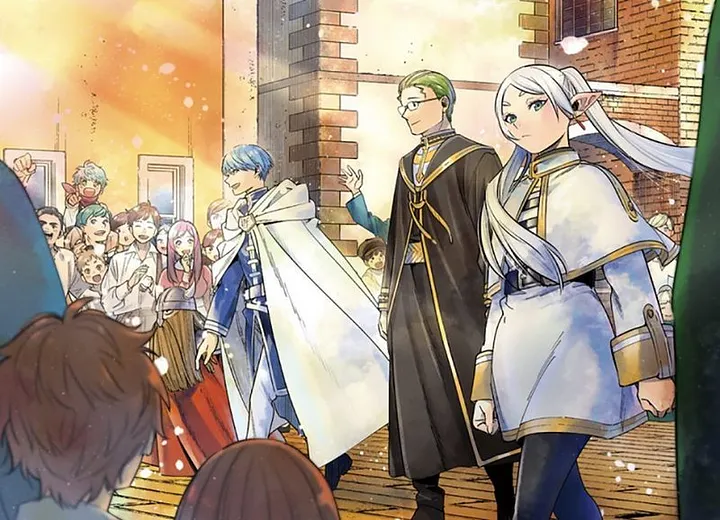
Frieren's story begins with a group of characters that make up the "Group of the Hero". A typical RPG group that you can find anywhere and in any era, be it games, books, series or movies; We have the Priest, the Dwarf, the Hero and a Mage.
For a usual Fantasy world, derived from RPG Mesa or the old Final Fantasy, these are the 4 typical characters who set out to defeat the evil and vile Demon King that torments the world. The existence of this as well as the misleading premise of an adventure in a fantasy world against the Demon King should be seen as a convention of the RPG genre.
After all, to judge how Cliche depends on how this convention will be used, among other issues.
However, Frieren starts by surprising us with the “break in expectation”, or in this case with the break with the typical usual convention. A group of heroes setting out to defeat the Demon King. Here the story already begins after such events, after all the adventure, conflicts, relationships, everything has already been progressed.
The story starts after the prime of life for each of those group members, or at least most of them, and so what will they do now?
Our protagonist, Frieren, the group's mage and an Elf, will be our eyes during this post-journey journey. The girl is practically immortal, having lived so long that she is unaware of her own concept of death, at least by natural means.
Even if the peak of her companions' lives is a 10-year adventure to go against the Demon King, that time for her is short and tiny compared to the scope of her life. But the same is not true of her friends, who are merely human.
Frieren is oblivious to the concept of time, not only is she ignorant and brutish about emotions without being able to understand them very well.
Before the group disbands, a promise is made to reunite after 50 years, a suggestion made by Frieren.

It is somewhat usual for works whose story is made through simplicity, subtle details and that could go unnoticed in a less attentive reading, even if it is as obvious as it is now.
Notice how Frieren doesn't understand the reason for Hammiel's sigh (in some translations laugh). She acts like this from the beginning of the story already doing her characterization and character reveal to the audience, so it's clear from the first look that Frieren didn't consider 50 years to be too long.
It's as if she said "We'll meet here in a week". Himmel understands this and realizing that this trait hasn't changed during her 10 year adventure with them, that she still can't understand that 50 years isn't just too long, how any one of them could be dead in that time.
Just after a few pages of the chapter, we see the promise of 50 years being fulfilled.

But time forgives no one but the elves in the world of Sousou No Frieren. So the trigger for the whole story and the key point for Frieren's character; The Death of Himmel.
The regret of not enjoying the time with her friends before time took her away from it. Regret for wasted time, and understanding the importance of ties. After all Himmel valued Frieren, after all for him her friend was something precious, someone who spent 10 years by her side. Himmel understood the value of experience and the gift. Frieren, on the other hand, doesn't understand this because she has a long life, so she didn't value his friend as he should and cries in regret.

From here Frieren decides that she will embark on a journey to learn to understand what life means to the humans around her. In the end those 10 years of Adventure, which Frieren called tiny compared to her life, just “one hundredth”, completely changed her life, and we go from here on a journey to find meaning in human life.

And when I say Nilism, I am referring to a radically skeptical and, above all, pessimistic view of interpretations of reality, which annihilates values and convictions.
Even if Nietz's words and philosophies are different, it is this commonly known definition that I am referring to.
With the kind of questions we might encounter during Frieren's journey; Ties, Life, Death, Forgetfulness, Regret, Moving Forward, Religion, Personal Growth, etc. It is common in this type of work, and therefore in Frieren, for some of these questions to go unanswered.
Frieren is still being released and even so I believe without a doubt that the end of the work will be open. Most of the questions raised by the work will be answered, but several other questions will not, leaving a trace after the end, which will pass the task of answering them to the viewer after the end. Things are already being done even at the present moment.
Although it seemed that the work ended with a question mark, an “open” ending does not mean that the work stopped halfway, leaving everything undefined.
All questions must be answered, and that will determine what kind of Frieren story was for you. If you understand the questions and your answer is positive, that even despite our short time we must take advantage, do the best for those around us, etc. So it is certainly a positive ending, but the opposite is also possible, a nihilistic ending, where this perception is a clear notion of the issues of the work, life and death, ends up highlighting the lack of meaning in life.

As much as the work seeks to answer your questions, and in a relatively positive way, encouraging life, most of them are not a statement, it's just a character's point of view, which never REALLY comes true, it's something that goes from interpretation . Leaving this duality of hope and nihilism about life. The work is about understanding human life, but everyone can have the perception they want from the elements of the narrative.
Frieren is the type of story, as well as another of its kind, where the writer typically leaves us with the task of finishing the last piece of work, of answering the questions left.
Here, both Frieren and the other characters, both those who appear and those who remain on the journey with her, end up dealing with external conflicts with family, society, the environment, but the emphasis always falls on her internal battles, with your own thoughts, feelings, conscious or unconscious.
Despite the fights against monsters, demons, and some random quests, the emphasis of the story is on the intimate side of each of those characters. How Frieren, Fern, Stark and each of the other characters closely relate to the events, and by that I don't mean to specify the fight against the monsters itself, but rather all the SoL events that occur during the journey, this whole arc of going up to the challenge and overcome it, which usually ends with some philosophy, idea of life or spiritual restoration on the part of the characters.

About the protagonist. Frieren is not an inert character, but is relatively passive and reactive. In other words, she is a somewhat passive protagonist of the story, which defines the scope of her character. And naturally this type of character for being passive is compensated with a great internal struggle (which is not her case) or the dramatic events that surround her.
Despite subtle changes to Frieren, her character arc is categorized as Static, at least at this point in the story. Since the Static Arc is one where the character will have little internal conflict and won't significantly change as a person — although at times they may change their perspective, learn different skills, or gain a different role. The protagonist didn't overcome a great deal of inner resistance or anything, he simply gained a new skill set or took on a new position.
he changes wrought by a Flat Arc will be most evident in the cast and world around the character. Characters in Flat Arcs are often the catalysts for change in the story world around them, triggering prominent growth arcs in those of other characters.
Even Hammiel is also part of the Static arc and the greatest proof of this is his importance in the work and the changes caused by his actions, including his occasional death as a trigger for Frieren's change.

In a typical story, events are usually expressed with the principle of causality. That is, how a cause creates an effect, how that effect turns into a cause that triggers yet another effect. Those stories that normally use this principle, use the principle of chance and thus give meaning to life. This chance gives meaning to life.
However, there is the opposite of this, which turns out to be the case with Frieren and many other works. Coincidence. When we replace chance with coincidence, that's when we place the emphasis on the random collision of things in the universe, which breaks the chain of chance and leads to fragmentation and meaninglessness.
Coincidence is the conductor of Frieren's fictional world, despite some moments of chance, here is where actions trigger events that no longer cause effects, which ends up fragmenting the story and transforming it into an episodic story.

For those who are more demanding about what to consume, don't worry, as long as you don't dislike Slice of Life, which is the heart of the work, there's nothing to fear.
Although the episodic sequence can be uncomfortable, the structure of the work is very clear and objective. Consistent within its own plot, with its well-established elements, it wasn't even hard for me to recognize them.
For those who are more demanding about what to consume, don't worry, as long as you don't dislike Slice of Life, which is the heart of the work, there's nothing to fear.
Although the episodic sequence can be uncomfortable, the structure of the work is very clear and objective. Consistent within its own plot, with its well-established elements, it wasn't even hard for me to recognize them.
The plot of Sousou no Frieren, as already mentioned, is a work that values simplicity, and this is the style of plot that the work decided to adopt, as well as several others of the same genre. That's why I say that within the plot itself, the work is extremely consistent. Just because it's simple doesn't detract from the power of being a well-told story.
I may even not have commented on the usual configuration of each chapter, as well as the flashbacks, because I thought it wouldn't be necessary. But for a special mention here at the end, it's great how this element connects with the work's own message about memories and how precious they are. Frieren always remembering his past and the way the past contrasts with the present and directs everything to the future, is something beautiful and genius on the part of the writing.
And I think it's amazing the way Hammiel is built throughout the story, he's a character who dies in the first chapter, but is present throughout the rest of the story.

Thanking Eisen and Heiter, whom they consider parents, was only possible due to the change that Hammiel provided in his former teammates.
It is a character that is not familiar to us, but even so, we know a lot about him as if we really know him, apart from the fact that his existence and recurring presence throughout the work is linked to the theme that oblivion, death and memory, since dead people fear be forgotten, but Hammiel lives from his companions and that by his influence on others and others, in an endless cycle keeping his spirit alive, Stark and Fern never knew him, but Himmel changed the lives of young people forever indirectly and the same thing will happen in the next generations due to this change. It is an absurd metalanguage that he ends up having with the work.
Sousou no Frieren is a story that searches for the meaning of human life and its questions, from worldly mannerisms, religion to life and death. Being the last along with time what else the work tries to understand and decipher. And with his characters, we go together to self-discover the essence of life.
Despite the apparent melancholic atmosphere, it is a heart-warming work, full of joys and sadness, tears and smiles, just like life.
