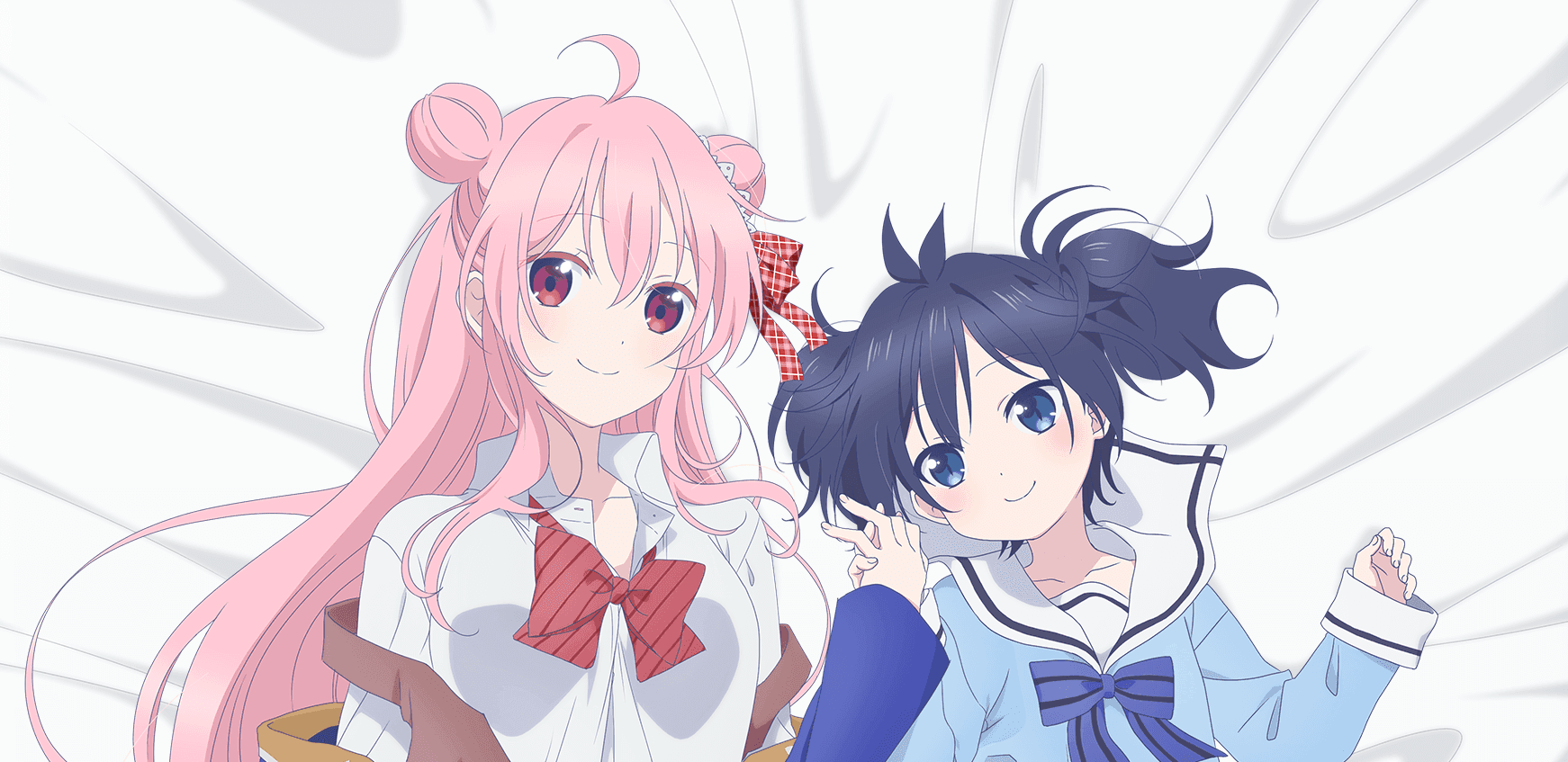


Happy Sugar Life is a highly divisive show. Depending on who you ask, you'll likely receive numerous and varied answers at what the show is. An entertaining trashfire, yandere schlock a la Future Diary, compelling psychodrama, an affront to common morality, all are common and accepted answers (and I posit that you will learn much about how one views media through their interpretation). Chances are, if you've seen Happy Sugar Life, you stand at one polar end of the spectrum or the other. Yet, I would argue, this need not be the case. At its core, it really only asks two questions of the viewer: come with an impartial frame of mind, and strap in. With that being said, lets return to that core question, to which I would ask you the reader to strap in, cuz I have a lot to say on this. What exactly is HSL?
Happy Sugar Life is a psychological drama chronicling the story of Satou Matsuzaka, a popular and motivated teenage girl... who has recently fallen in love with a child, the boisterous and innocent Shio Koube, an elementary school girl who has fallen into Satou's care through mysterious means. On the other hand, it is a masterful romantic tragedy, and I would argue probably the only good yandere plot, putting it in a very interesting and attractive position. Happy Sugar Life is one of my favorite classes of story, an unbelievable and utterly audacious concept that should never work, elevated entirely through its execution. I must admit, I have somewhat buried the lede, as Happy Sugar Life is without question one of my favorite shows regardless of media type, and consistently holds up on rewatch. I often ask myself how this could be, but the answer is fairly straight forwards: godly pacing, and an ability to enter into characters' mindstates that rivals the best of any psychological media.
Happy Sugar Life exists in an exaggerated reality, where loonies are far and away the norm and every character is hiding significant and perhaps psychotic damage. And this is completely okay. If HSL marketed itself as a piece of realist fiction, there would be glaring tonal and consistency issues, but it does not hold itself as such. One of the show's finest qualities is an understanding of what it is, on most every level. Animation, tone, voice acting, writing, HSL knows it is toeing the thin line between unhinged and compelling at most every level. Consequently, it does an excellent job of balancing between the two, not committing the sin most yandere media subscribe to in overplaying their hands, and not taking itself too seriously that it can't provide levity in its content or presentation.

The presentation and aesthetic are extremely strong, especially for the work of a first-time studio. As said, it understands what it is, and what it can do. As such, it relies not on over-the-top, knockout visuals or art style, but the more subtle aspects of its visuals. HSL is constantly playing with its saturation for the sake of contrast, purposely oversweetening when Satou is with Shio, engulfing the viewer in the sickly sugary atmosphere of the Happy Sugar Life. This pale, saccharine visage is the canvas on which HSL paints its psychological imagery, most prevalently through the eyes of its characters. I'll come out and say it off the top, I am a sucker for cool eyes, and HSL loves to play with eyes. Most often they have a piercing sheen to them, viscerally popping out from their understated background, creating tension all on their own. HSL is often marketed as horror, but it doesn't really hit that mark generally, nor do I think it is trying to. But I do think there are few things as innately unsettling as the gaze of Satou's Aunt. Even past that, its just a tour de force for eyes. Swirls, landscapes, bloody streaks, pale abysses, they say the eyes are the windows of the soul, and I think few pieces of media take that to heart as well as HSL.

I'm not done talking about the visuals, and I'm not sure I'll ever be. HSL thrives with a brand of psychological visual metaphor, attempting to place the viewer directly in the mind space of the character, seeing how they see reality, feeling intensely how otherwise innocuous decisions affect them. The atmosphere HSL lives in is so visually rich and imaginative, every emotion a character undergoes you can just drink up and bask in the glow. HSL presents to the audience untempered perspectives, character viewpoints unfiltered through the shaping hand of an overarching moral grounding. It is a commitment to the characters that I find incredibly endearing and honest, if often totally insane. But that's what makes it fun.

And that fun is what yandere enjoyers often bank their enjoyment on, as reason is generally not within the character archetype's purview. However, Satou Matsuzaka is a different class of yandere, and the only one I've seen with some level of nuance. She is not unreasonable, and often is extremely logical and goal driven. Despite her reputation as a violent pink hair yandere, I would argue that she's almost a deconstruction of the archetype, a thoughtful and decisive character that will only use violence if absolutely necessary, often times keeping it together far more than she is succumbing to her impulses. When she kills someone, you understand completely why it had to be done, and hell honestly I tend to agree with her. Her brain makes sense in a way that yandere brains typically aren't required to, allowing her to perform higher function and varied means to securing what she holds dear. This is exemplified in an almost comical scene in concept, where she is presented at work with a second yandere, who only has eyes for Satou. A challenge which she answers definitively, picking her apart and manipulating her with aplomb, showing keen understanding of her own inherent weaknesses and urges. I'm almost convinced she's the only yandere ever made that actually has the capacity to think, and consequently is easily the most interesting version of the archetype ever presented, as it gives her the ability to express an intelligible sense of personal conflict.

Most would classify the rest of the character under the catchall categories of "crazy" or "normal", but in a world where crazy is the new normal, it is not quite so simple. Taiyou is often hard done by this in my opinion, because he is simply an excellent walking tragedy. His perspective is visually usually the butt of a joke, or the tip of the lance of psychosis, but underneath that surface he is the only character that actively recognizes his abnormal behavior and wishes to return to normalcy. His story is the fall of a relatively normal guy into a neverending spiral of desperation, which unfortunately could not quite come to fruition given the plot constraints of the show (my really single core complaint on it). The manga gives him more room to grow, with truly insidious implications. Past Taiyou are the princess and pauper pair of Asahi and Shouko, a homeless boy drunk on the light of the moon and a naive high school girl, caught up in a plot she should never have been privy to. I dislike Shouko more than most, but its not on merits of her character, and both are more than adequate expressions of the writer's intent.

Now, the element that really elevates the characters is the voice acting, across the board some of the best I think you could ask for. At the very least, everyone bought in 100%. HanaKana gives an unusually understated performance as the lead, bringing a gravitas and manipulation to Satou that is really welcome. Kikuko Inoue laces every one of the Aunt's lines with a dollop of intoxicating venom, nailing the exact tone the character needed to bring. The inimitable Misaki Kuno gives an excellent and vulnerable performance as Shio, who is just about the most adorable thing you could imagine, a character that needed her presence to really justify herself as the object of every other major character in the show. But most impressive of all, Natsuki Hanae, the voice of Tanjiro himself, gives an utterly unhinged and broken performance as Taiyou. Its insane, its leaning right over the edge, but the palpable danger and tension it brings is so effective, so intense, that it manages to stay on the right side. In summation: I love just about every VA performance in the show.
I could type almost all day on the merits of HSL's presentation, but how is it's plot? In construction somewhat shaky, to be honest. The cops are ineffective, there's someone new that is abjectly crazy out of the blue around every corner, the show asks you to buy into the world and not ask many questions, but it is saved in large part by its pacing. HSL understands very well how to create and maintain momentum by slowly doling out information, leaving a question always dangling out in front of you, stringing you along until, before you know it, you're at the end of an episode, and you have to know what happens next. Up until the final stretch, it is all thrills no frills, providing in my opinion one of the most consistently tense and entrancing progressions out there. Now once it hits the final two episodes, it starts to fall apart just a bit, but that's really not the fault of the show as it is timing.
On the other hand though, the thematic content is great. At its core HSL is a love story, and it lives up to that billing faithfully, with a romance centering on cycles of abuse and mutual understanding. Its not particularly deep, but it is consistent and there is progression across the board, even if it leaves all of Shio's character work until just about the very end. I do think the anime ending mucks things up quite a lot, but that's a bit of an in-depth issue. On its face, the battle of love philosophies between Satou's fulfillment in Shio and the Aunt's love as poison is quite compelling, and there's more than enough meat on the bone to keep interest for a brisk twelve episode season. I will say however, if you can't stand to find a way to empathize with Satou and at least understand her worldview, you will have a difficult time reconciling societal morals with Satou's actions. But that's not what this is about, Satou doesn't need to be absolved in the court of public opinion, the more prevalent question is whether her actions live up to her own personal morals, her own strict internal code.
Now lets get to issues. As I said, big one, the last run. Context needs to be established, because at the point the show was made, the ending had not been written. From what I understand the show likely took a sort of outline from Kagisora, and used really the proto-progression there to get to where they, and really everyone, knows that this story has to end. And in abstract, I love it. Its melancholic, its a strong redemption, it cuts most of the loose plot threads, and it lays the groundwork for the Happy Sugar Life to exist in perpetuity, which I find very interesting. The only issue is that it has to absolute butcher the pacing and speed through events to reach that ending, throwing into 1-2 episodes what ended up becoming a full volume in the manga. Still, I would argue given the circumstances, that is very forgivable. The real problem lies in how the ending is characterized, which stands in direct opposition to the eventual end of the manga, creating a bit of an issue in interpretation. It seems, the director wanted Satou to come to a sort of revelation regarding what it meant to love, and move away from the romance the show had established up to that point. The manga ending does not do this, and there is no pseudo-motherly revelation, Satou's love is contextualized in an entirely different, and somewhat more interesting, fashion. For this reason, while I used to enjoy the show more, I can't hold it above the manga anymore, and for a purer statement of Kagisora's intent I have to recommend the manga over this. In the grand scheme of things though, as said, this is a relatively small and contextual issue.
I mean what can I say except I love this show. If given enough time and enough will, I think I could keep writing for days. I would be loathe to leave out the absolute banger quality of the OP from this review, or Episode 8 as my pick for best piece of TV in any form wholesale, but I think I should leave it at that lest I go on ad infinitum. I think the show is often hard done by people that refuse to buy in to its premise, or that fail to let go of their moral grounding in interpreting it, but its truly top notch TV. The only person that will get in the way of enjoying the ride is yourself.
