It's about time I'm dedicating myself to write a review on anilist, about a series that belongs to my favorite anime franchise Psycho-Pass.
During the last two weeks I rewatched the third season of it, and completed it with the anime movie "PSYCHO-PASS 3: FIRST INSPECTOR", which I'll integrate in my assessment and rating of the overall season and this review, regarding the fact that it basically represents the final episodes of it.
I first saw season three around two and a half years ago and before my recent rewatch I remembered that I was unsatisfied with it and my overall critical view on different aspects. May it depended on changed and blurred memories, or was it through the movie First Inspector, that rounded and completed the open-end of the season, in either case I finished this particular season three, with a much more positive feeling and an impression of it as a considerable improvement on season two. How I come to this conclusion and to describe what are in my opinion the elements I consider the weak points as well as the strengths of the show, are aspects I'll tackle in this review.
One of those strengths, is something I want to mention before, because it will appear several times in the review, and this is my classification of season three as an excellent done sequel. I will elaborate this point especially under the category "characters".
-----
#Synopsis
A few years after the events in season two, a duo of two good old friends, in the person of Arata Shindou and Kei Mikhail Ignatov, joins the the Division 01 of the CID of the Public Safety Bureau as inspectors. During their first case and operation, they see themself confronted what seems at the surface like an ordinary accident, but soon they discover that there is more behind of it. In a new environment, they have to adapt and learn how to shoulder responsibility. Luckily, the childhood friends can rely on the other and they can share many burdens, but the extend of the criminal actions will put even their friendship to the test.
#Plot
Already with the plot, the third season of Psycho-Pass orientates itself on various main elements of the franchise, that are also unmistakable pillars of the plot in season one. Again a weakness of the Sybil System is exploited by the inviduals who serve as the antagonists of season three.
Spoiler, click to viewclick to hideIn this case it is Byfrost, a system itself that once was used as a Bug- and Erroridentification program for the Sybil System in its early days. In this system, that has a hierarchic structure, the congressmen at the top, gamble and play about events in the society, that they themself initally orchestrated through a gap in the system, and make prognosis about the developments of the events.
Similar to season one, Division 01 of the CID must solve individual crime cases that are connected together with a shared origin.
One aspect that bothered me concerning the plot was, that in my opinion the third case was too convoluted, there were too many twists and turns and with the large count of characters and the additional acting characters in the background, it was difficult to keep the track and overview of the story. The pacing of the events was enormously stretched, which extracted the dramatic and tension of the anime at this point.
What I prefered in contrary was the wide range of topics that where brought up through the individual cases from a financial scandal and corruption, over elections in the society of sybil to the debate about a district for immigrants.
Probably the best aspect about the plot in season three was the final, that is shown in Psycho Pass 3 FIRST INSPECTOR. The plot is is brought to a logical and satisfying ending, moreover it offered an outlook into the future of Psycho-Pass and introduced aspects that will probably play a role in further series. It completed storylines of individual characters and, in return, represented as well new beginnings, in the form of the resumption of storylines of other characters.
#Worldbuilding
The Worldbuilding was mostly not extended in season three of Psycho-Pass. Though there was one point that was occasionally thematized in this season, which were the Slums and abandoned districts as the central location in the story. The anime took its time to explain their existence, the daily-life of its habitants and its functions in a japan that is ruled by sybil. Spoiler, click to viewclick to hide It's roles as a sealed off and segregated room of social exclusion. To seperate the "good" and "bad" persons in the society and by that using those abandoned districts as anarchistic prisons, to shield of their side of it.
#Characters
Likewise to other Psycho-Pass productions, it were the characters that stood out for me particularly and they represent the aspect I prefered the most about this season. I always characterized it as a particular strength of Psycho-Pass to have a comprehensive examination of the characters, by giving them enough screen time, space to develop and appear, as well as to grant them extensive interactions between the each other and through that create unique dynamics and a good group atmosphere. Especially thanks to the deep-going evaluation fo the characters, one can identify, sympathize and relate to the different characters.
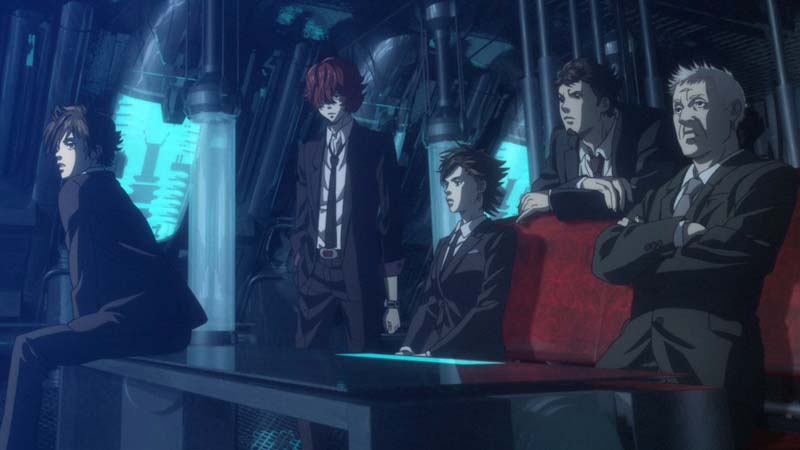
In season three we have an almost entirely new and changed constellation in division 01 of the CID.
Kei Mikhail Ignatov und Arata Shindou
Starting with the main characters Arata Shindou and Kei Mikhail Ignatov. Both have possibly from the start the best chemistry of all Psycho Pass duos of protagonists.
They are well balanced and complement each other good in terms of their characteristics and other points. They embody contrary traits on different fields. Arata is the cheerful, carefree and philanthropic part from both of them, while Ignatov is more reserved and distanced in his behaviour. What they share is their distinct sense of justice and the believe of humans as the last instance to decide what they judge as right or wrong and to take responsibility for that decision.
Spoiler, click to viewclick to hide
In terms of Arata Shindou there were smaller issues that bothered me a bit, first are his too obvious and strong similarities and shared characteristics with Akane Tsunemori. His bonding with enforcers, having a critical view on sybil and an individual view on justice in this society as well as having a Criminally Asymptomatic Constitution. That is simply too much to speak of a simple imitation. Furthemore his ability of mental tracing in addition with an extraordinary physically condition, were something I felt as overexaggerating.
Tenma Todoroki
The enforcer is on the outside a slightly different version of Tomomi Masaoka. What differs the two is their personal background and their characteristics. Todoroki is the son of a well-endowed and influential family and suffers from the fate of abandonment after the didn't turn out as they expected him to be. He also has a strong sense for justice, which he wouldn't admit publically and his inner passion for being a cop isn't as strong as the one Masaoka had. Apart from that he has a laid back character and the habit to come to the wrong conclusion because he instantly shouts the first thing that comes to his mind.
Kazumich Irie and Mao Kisaragi
The character of the enforcer Kazumichi Irie was probably my favorite addition in the series. Not only his character is extraordinary funny, but his personal packground it what mainly makes him interesting. With his socialisation and origin, as someone who who grew up in the slums, far away from the stabil society of Sybil he brings up an interesting perspective to the show and world of Psycho-Pass. Through his experiences and road of life, he portrays and offers a different view on Sybil and the shadow sides of the system.
Unfortunately Mao Kisaragi, was from the cast of characters the one that remained bland and superficial for most of the time. Near the end we discover more about her and her backstory but that wasn't enough, that she could leave a lasting impression on me.
Now I'll get to the previous mentioned point why I regard it as a brilliant sequel.
This has to do with the treatment of old, beloved and seasoned characters and their implemention in the story. In comparison to new characters, there are around as equally characters in the story from seasons before, who already went through experiences and developments, and are treasured and respected by the fans.
What now sets a good sequel apart from a bad or only mediocre sequel, is to integrate them in the story, without resulting in the extreme of either overshadowing the new characters by the old ones or diminishing the old ones by the new. In my view this season of Psycho-Pass managed this balance perfectly, which is why I hold it in such high regards.
The new introduced characters have their moments as well as the old ones. The former logically have more screentime, to have them porperly introduced to the viewer and to let them take the steps to also become fully established characters of the franchise. But this is done not by making them a simply just better versions of the old ones, but by giving them challenges to overcome, equip them with weaknesses and strengths to form a believable character.
Though the members of the old crew have less screentime, they nevertheless keep their old characteristics and strengths that resulted from many experiences throughtout the seasons.
To see the old team interact with the new one always made my Psycho-Pass heart jump higher and I loved to see the dynamics and situations between the Suppressing Action Department of the Ministry of Foreign Affairs and division 01 of the CID.
#Animation
The animation was good and appropriate for the year of 2019 when it was released. Its remarkable how fast one grown used to this level of animation, especially when I recently took a look in the episodes of the first season and I was surprised how far the animation quality improved since them.
A special mention deserve the many hand to hand combat scenes and fight choreographies in the anime. Psycho-Pass is surely unmatched in this category and they were always a pleasure to watch.
#Music
The music was typically for the anime, I loved the addition of soundtracks of the first season, as soon as characters from previous seasons had an appearance. Another aspect that I also appreciate is how for each season of Psycho-Pass, they modify and more or less change the main theme of season one, and use it as its main soundtrack for the current one.
A third season of Psycho-Pass that heavily orientates itself on elements that carry the franchise and that made it popular in the first place, and therefore is in my view a far more interesting season than the second one. Depending on individual taste, the similarities to aspects from the first season can be viewed as too strong. Though to its defend, it also tries to bring in new aspects, topics and characters to the series and world. In particularly in questions of characters and how to bring new and old characters into line in a sequel, this series is an ideal example.