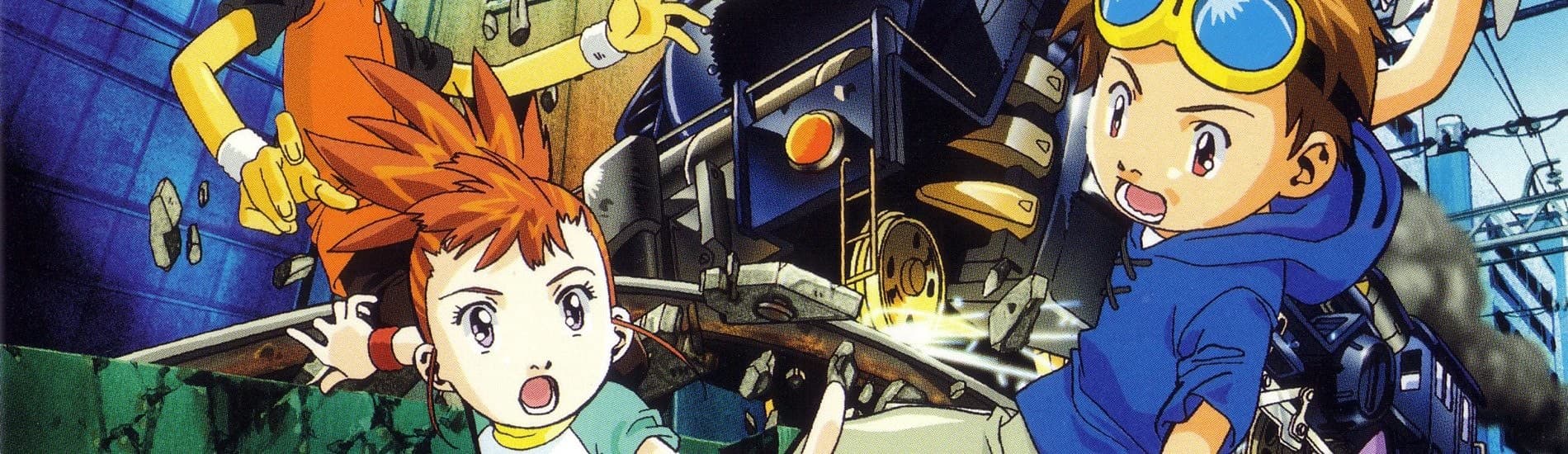
You probably recognize Digimon as one of the biggest media franchises in Japan. If you’ve spent a decent amount of time watching the anime that airs on American TV, and especially if you did so while growing up in the early 2000s, there’s a good chance you have fond memories of watching the Digi-Destined go on adventures with their digital pals, saving both the real world and the digital worlds from cosmic enemies that threatened all life on both planes of existence. You probably played the video games, collected the cards, maybe even competed against other fans for cash and glory... But what if one day, you found out that the franchise you’ve been obsessed with has been real all along? And to make matters even more insane, what if the digital world started leaking into ours? This is the situation that several ten year old children in a quiet, unassuming suburb have been dealing with. For an average fanboy named Takato, an ultra-responsible pacifist named Henry, and a ruthless champion named Rika, the fantasy world becomes all too real when they wind up pulling their own digimon partners into the real world. You might say this sounds like a dream come true, but as the rift between worlds becomes more and more unstable, the lives of our heroes and the people around them are about to be turned upside down forever.
When I was in my early teens, there was a huge culture war being fought between Pokemon and Digimon. Much like the days of Star Wars versus Star Trek, you were either on one side or the other, and if you liked both, then you probably kept that detail on the downlow. Personally, Pokemon was a hardcore obsession for me, which probably shouldn’t be surprising seeing how I’m on the spectrum and I have a dangerously addictive personality. Pokemon was my life, like few other obsessions ever have been, but I did watch Digimon too. I saw most of the first season, and I liked it just fine. I saw some of the second season, and... Well, I certainly saw some of it. I don’t know, I guess because I got into Pokemon first, Digimon didn’t really gel with me, because the story wasn’t about collecting Digimon? I dunno, I tend to love the first entity that sparks an obsession more than any other related entities that follow it. There’s also the fact that, while Digimon may have had superior animation, I liked the designs in Pokemon a lot more, as the human cast of Digimon looked too cartoony for me, and my first impression of Digimon themselves was that they looked like rejected Pokemon designs. Same with Monster Rancher, tbh.
I didn’t watch Tamers when it aired, rather, I wound up checking it out in the mid-2010s after a critic I followed gave it a stellar recommendation, and there wound up being a lot of things about it that absolutely floored me. The animation was more or less the same as I remembered... Digimon never felt like a particularly high budget franchise, but it never felt cheap either, and while they did sometimes take a page out of Pokemon’s book by using static images of characters firing off special effect long distance attacks to save money, the action scenes have always been way more dynamic than Pokemon’s, because Digimon in the anime fight each other using more than just their specialized attacks. They can punch, kick and slash without having to call out some name from their moveset. The battles were thus far more interesting, and yeah, you do kind of have to have a decent budget for that. Thankfully, Digimon has always been produced by Toei, who have been around since the sixties, and are no stranger to managing their budgets just enough to pull off well choreographed and intense fight scenes without having to compromise too much to compensate for them.
With Tamers, this is kicked up a notch in a few ways. First off, while the design aesthetic is largely the same, the characters do look slightly more realistic in terms of anatomy and wardrobe. Characters not only dress more like normal people than in previous seasons, they have more normal looking hairstyles as well,, with a pleasant enough color palette so as to not appear too generic. Sure, the fact that everyone still wears the same clothes day in and day out is a little immersion-breaking, but for an anime series based on a children’s toy and trading card franchise, Tamers swings closer to Beck than Yugioh on the “people who could feasibly cross your path on a normal day” scale. The real world also feels more believable... The first two seasons could get away with having more generic settings because they spent most of their runtime in the Digital world anyway, but in Tamers, you only get brief glimpses of the Digital world up until the halfway point of the series, so the human setting has to have a sense of weight and history to it... And it does. From the forests to the suburbs to the big city, it doesn’t take long for the viewer to develop a sense of familiarity to any area the characters interact in.
The digital world also has a ton of personality all its own, but that’s getting into spoilers. I also personally like the designs of the Digimon more, but maybe that’s because you’re not presented with like a dozen of them all at once? Unlike previous seasons, Tamers takes its time presenting the first few main Digimon to you, developing them and their Tamers individually to establish their role in the story and why they’re worth getting invested in... In my opinion, this is a far stronger approach than presenting the entire cast with one Digimon each right off the bat, leaving your first impressions of them heavily unbalanced. The designs of both the Tamers and their Digimon aren’t just gimmicks or toy blueprints, they tie into the personalities and identities of the characters themselves. For one relatively spoiler-free example, Takato is obsessed with Digimon, so it makes sense that the Digimon he designs and brings to life is kind of a rip-off of Agumon... And the fact that he wears goggles on his head is deliberately explained away as him mimicking Tai and Davis.
As far as the English dub is concerned, the acting is just as strong as it’s ever been, with the cast list reading like a who’s who of industry titans from the turn of the century, some of whom... Like Bob Papenbrook and Philece Sampler... Have sadly passed away. Actors who play the main few Digimon also went the extra mile of voicing all of their digivolutions as well, and while that might not sound like much, the great Steve Blum plays at least half a dozen characters here, and he is unrecognizable as every single form of Guilmon. Melissa Fahn... You know, fucking Ed from Cowboy Bebop? Gives the prickly Rika a slightly gravelley cadence which she’s able to play around with as she portrays her as a fierce tsundere in the early episodes, as well as a compassionate friend in the later episodes. Brian Beacock had his first anime role as Takato, and despite being in his thirties, he pulled off a crackly-voiced adolescent very convincingly. Bridget Hoffman probably had the toughest job of all in the role of Jeri, given all of her character’s eccentricities, and the gauntlet of emotional trauma she had to run through.
I don’t think it’s controversial to say that anime airing on American TV back in the day had a long, long history of censorship and rewrites, to a point that I don’t think any title was really safe from. Don’t get me wrong, Digimon wasn’t owned by 4Kids or anything, but neither was Cardcaptors, and look what happened to THAT property. Digimon Tamers was owned by Fox, and they made the kind of cuts you could expect at the time... Blood, obscure cultural references, stuff like that... But the only changes they made that actually hurt the series were some of the dialogue rewrites, which I’m pretty sure were done to simplify some pretty esoteric topics for the sake of younger audiences, but wound up either obscuring some important details about a character’s development, or outright turning a moment of forgiveness into a condemnation of a well meaning character who had made mistakes, but earned their redemption. I can’t get into more details because these moments occurred towards the end of the series, but suffice to say that other than those few solitary issues, it’s a pretty damn good dub.
So to say Digimon Tamers has a reputation would be putting it mildly. It’s one of the most unique entries in the Digimon franchise, as well as one of the most polarizing, for a variety of reasons, and to understand why, we need to take a step back to the creative mind behind the series, Chiaki Konaka. You may not know him by name, but once you see some of his more famous works lined up in front of you, it’s not hard to pinpoint what he’s all about. Konaka is an auteur who likes to use dark tones and trippy visuals to explore psychological themes often relating to identity and reality, which isn’t surprising once you hear that he’s also a massive fan of Evangeleon. Personally, I’m not a huge fan. I’ve seen a lot of titles from him that are popular, but that really didn’t grab me. My impression of him has always been that he treats his own themes and ideas with a higher level of priority than the characters and stories he’s supposed to be using to communicate them to us, which at least for me, makes it difficult to engage with his narratives enough to care what he’s trying to say.
Out of the anime he was heavily involved in, I thought Ghost Hound was kind of boring. I’ve already given you my full thoughts on Serial Experiments Lain and the original Hellsing TV series. I only recently found out that while he was involved with The Big O, the bulk of his involvement happened in the entire second half... Which seems obvious in retrospect... And good God almighty, I am only now learning that he was involved in Shadow Star Narutaru, including writing the script for the objectively putrid final two episodes. Oh, and he also very recently revealed himself to be a right wing conspiracy theorist nutjob, but that’s irrelevant to the discussion, so we’ll put that aside for later. For now, I have another pressing question to answer; If I dislike Chiaki Konaka so much, and I find his work to be boring, pretentious and sometimes downright incompetent, why is none of that true for Digimon Tamers? What is it about the third season of a childrens’ anime that was designed to sell toys that has me doing a complete 180 on him?
That’s a difficult question to answer, but I think the saving grace of Tamers is that it offered Konaka the perfect amount of freedom, as well as the perfect amount of restraint. When the subject of a third season of Digimon came up, nobody attached to the franchise really knew how to move forward, as the ending of season 2 had been nothing short of conclusive. Konaka already had some buzz behind him at this point, and while he hadn’t been one of the main minds behind the series prior to this, he had done some work for it off and on in the second season, and he’d written a couple of fan favorite episodes, so when he volunteered, Toei was happy to hand him the reins. Konata had ideas for the franchise, and to his credit, they were the kind of ideas you’d have for a franchise you genuinely love and feel inspired by... He wanted to explore the more dangerous and primal side of Digimon, paying attention to the conflict between their roles as friendly playmates and wild animals. He wanted to make Digivolution special again, as he felt it had become too commonplace in the second season, to the point that nothing really felt like a threat. Speaking of threats, he wanted to get rid of the element of reincarnation and make death permanent, to raise the stakes and the emotional gravity of each battle to new heights. Toei let him get away with all of this, and a lot more.
There were obviously rules he had to follow, as this WAS a children’s action series, but this turned out to be a blessing in disguise. I’ve always held to the belief that creativity shines the brightest in the shadow of adversity, because when you have rules and restrictions to follow, you pretty much have to find creative ways around them, and that philosophy perfectly describes one of the most important elements of Tamers; While the censors were bafflingly kind to Tamers, letting Konaka get away with some mature themes and downright terrifying imagery, they also had a few very odd mandates thrown in... They told Konaka they wanted him to find a way to include the video games and trading cards in the story, and I shouldn’t have to explain why that’s a ridiculous request, should I? That’s an unreasonable demand by any definition, but Konaka took that request and ran with it, conceiving Tamers as a meta-season where the entire franchise up until that point was completely fictional... Even by fictional standards. This upset a lot of people, and I can see why... Being told that the characters you’ve fallen in love with were never real even outside of the real world is a lot to take in.
Personally, I love stories like this, and I don’t think they get told nearly often enough. There’s a movie where Freddy Krueger comes to life and starts killing off his own director and actors... There’s a sequel to the Blair Witch Project that nobody on Earth likes other than me... There’s that one Ebiten OVA... I think that’s it. It’s pretty common these days for fictional characters to break the fourth wall, but to THIS degree? It’s honestly pretty rare. There’s a lot of places you can go with an idea like this, and while Tamers was too busy telling its own story to really explore the relationship between its own franchise and its fanbase, it also doesn’t NOT do that. The Digimon franchise isn’t just some cool thing all the human characters love, it’s something they all have their own unique relationship with that ties in with their personalities and backstories. Takato is the full-steam otaku who collects all the merch and dedicates his life to his fantasies. Henry’s time with the video game informs both his pacifism and why his beliefs went that way. Rika’s domination of the card game tournament scene gives her a level of control over her life while her Mother tries to force her into a modeling and beauty pageant career. For Jeri, Digimon is that weird thing she has to dive into if she wants to make friends with the other kids. I’m telling you, if you grew up with any multimedia children’s franchise, at least one of these should be relatable to you.
We can take this even further, because each character who receives their own Digimon... With two small exceptions that I won’t name for spoiler reasons... Each tamer has a unique dynamic with their partner that’s unlike any of the others, and this is partially because the characters themselves are all well written and distinct, especially compared to previous seasons. Don’t get me wrong, I don’t think the cast of either of the previous seasons were shallow or even boring... They were all fleshed out and developed, and it wasn’t hard to get to know them, but it was still pretty easy to divide them into archetypes, with most of their distinguishing qualities being attributable to said archetypes. The cast of Tamers is far more complex right off the bat, with the exception of a couple of forgettable side characters and one Mary Sue from the video games who makes some cameo appearances towards the end.
I know I’ve been talking about this show in a lot of vague ways, and that’s largely because it’s a heavily spoiler-filled show. Huge reveals and twists happen early and they happen often, and I can’t even talk about half of the characters who receive Digimon partners without spoiling way too much. All I can say is that, while I haven’t seen everything from the Digimon franchise, Tamers is by far the deepest, smartest and most mature title I have seen... But that brings up an interesting question regarding its audience. It’s easy for me, as a 37 year old critic, to give this show the green light, but it is ultimately a kids show... And would it be popular with kids? Is it even safe for kids? I’m gonna be honest, I don’t know. I’m not a parent, I don’t exactly have kids to show it too. It’s entirely possible that the themes are too mature for kids to appreciate, and maybe it could be considered too scary and potentially traumatizing for them. For a lot of kids it probably is. Maybe most kids are better off sticking with the first two seasons, and pretend the franchise never made that fateful vault over the fourth wall. But what about when I was a kid?
I’ve already mentioned how I didn’t watch Tamers during its initial airing on American TV, but I wasn't a child then, I was in my late teens. If I were a child, and someone showed Tamers to me... I think I would have absolutely loved it. Don’t get me wrong, I was not the bravest child when it came to scary media, but I have a pretty good memory for the kind of things that used to bother me, and I can’t think of any lines that Tamers crossed. I think I would have appreciated the more adult themes and darker, dramatic tones just fine, and here’s why; When I was really little, there were two Sonic the Hedgehog cartoons. In the self entitled “Sonic the Hedgehog,” or “Sonic Sat Am,” the story took place in a dystopian future where an evil, menacing Robotnik was using technology to turn animals into robots. In the other series, Adventures of Sonic the Hedgehog, Sonic just ran out, trolling Robotnik, and guzzling down chili dogs. I’m not going to pretend I didn’t watch a ton of stupid shit back then, but I still knew the difference between good Sonic and bad Sonic. I’ve rewatched several nostalgic shows from my childhood that left me cringing like I’d just been hit by lightning, but shows like Sonic? Batman the Animated Series? Samurai Jack? Pirates of Dark Water? They’ve all stuck with me into adulthood, and I believe Tamers would have joined them.
Hell, you could even make the argument that Tamers was legitimately ahead of its time when it came to presenting a sophisticated narrative. Chiaki Konaka got rid of the Town of Beginnings and made death permanent for various reasons, one of the most important being that he thought kids shouldn’t be sheltered from the concept of death. I’ve been rewatching Gravity Falls lately, and there’s an episode where the mayor of town, an elderly man who had previously joked about being excited to meet the grim reaper, dies offscreen, and the plot of the episode revolves around electing a new mayor, but here’s the thing... When I was a child, no kids show could have gotten away with that. Christ, even in my teen years, death was off-limits in any show kids were able to watch. Remember How the Teen Titans villain Deathstroke had his name changed to Slade? If that show came out today, I’m convinced they could have just called him Deathstroke. Media is evolving at a rapid pace, especially children’s media, and as modern cartoons begin to trust the intelligence of their audience more than ever before, it’s becoming increasingly clear just how ahead of its time Tamers was. It’s not a perfect show... It has some plot holes here and there, and of course it has its share of silliness, but for a TV series that was meant to sell toys? I don’t think it gets much better than this.
Digimon Tamers was released on DVD a few years ago, but has since gone out of print, although you can stream the series on Hulu. A few sequels have been released, including a 50 minute movie that’s not very good, and a 30 minute bonus episode that’s pretty fun if you turn your brain off. Chiaki Konaka also made waves when he recently released a new audio drama called Tamers 2020, where our heroes reunite to battle cancel culture, censorship, political correctness, and perhaps the most evil force in all of humanity, fact checkers. I couldn’t make this shit up if I tried.
Well, Chiaki Konaka may have put in a valiant effort for the title of “Creator who shat the hardest on their own work to prove how stupid and unsubtle right wing commentary is,” but Stephen Pastis still holds that honor, and despite Konaka’s best efforts, Digimon Tamers still holds up beautifully to this day. I haven’t seen every installment in the Digimon franchise... Honestly, I haven’t seen anything released after Tamers... But from what I have seen, Tamers is easily the best of the bunch. I can’t guarantee everyone will enjoy it as much as I did, especially among younger and more sensitive audiences, and I know some people find it boring when a story takes the scenic approach, taking its sweet time introducing it’s world and characters before finally diving into the plot, but personally? I love how dark and mature it is for a kid’s show, and I love slow burn stories that give you time to get interested in everything... Besides, even at its slowest moments, Tamers is never shy about delivering intense action, chilling twists and surprisingly effective humor. Whether you’re a fan of the Digimon franchise or not, Tamers is well worth your time, and I’d highly recommend checking it out.
I give Digimon Tamers an 8/10.
36.5 out of 40 users liked this review