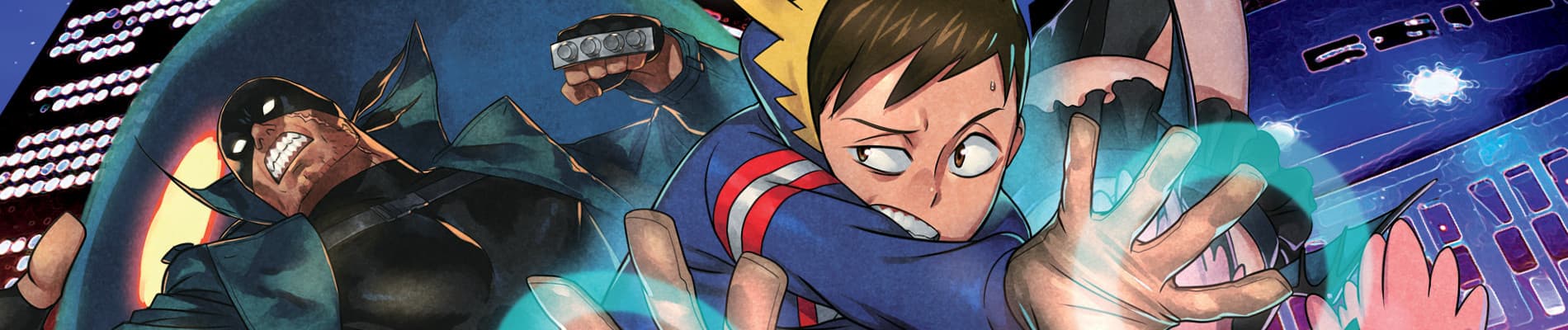
"I know I don't have a chance of going pro at this point. But still, if only for a second, I just wanna fly."
- Koichi, Chapter 2
My Hero Academia: Vigilantes is a prequel series that takes the core themes of My Hero Academia and looks at them from a new focal point. While using a pre-established setting and plot, Vigilantes manages to build its own identity surrounding the world of quirks and heroes. There are a couple of elements that will be hindered due to it originally being published alongside the main series, especially in regards to plot reveals that are reflected in My Hero Academia and possibly affecting how the series might feel when being read as a complete narrative.
Vigilantes starts with a strong and clear focus, taking the concerns of the main series and offering a new perspective; looking at a side of society which is often brushed over in the main series. By exploring society outside of the labels of 'heroes' and 'villains', we can focus on characters that don't easily fit into these labels. It promises and tries, even if not successfully, to be a series that is less afraid to question the world that has already been established. While it does end up having a similar attitude to the main series, the beginning of the series definitely marks itself as something new and refreshing.
Exploring an already established world comes with many restraints, from predetermined events to dealing with well-known characters, it can be difficult to create a plot that hooks readers in. By mixing in a number of new characters and being set in a time far enough removed that little is known about it, Vigilantes manages to maintain some tension throughout. Towards the end, as the narrative creeps closer to the story most readers will be familiar with, it begins to slip a little more into a status quo that it struggles to really interrogate as it would destabilise the world of My Hero Academia in a way that would make the main series feel too out of sync.
This unfortunately means that some developments are abandoned regardless of how important they initially seemed. This is a flaw that originates from how spread out the narrative becomes, trying to cover a lot of ground but not being given the necessary space to do so effectively. One of the most noticeable instances is that the darker tones and stylistic choices are lost by the end of the series. This doesn't mean that there needs to be an overbearing darkness to it (there is, after all, a problem with creators trying to make stories more 'serious' in order to appeal to a certain audience) but it does make the tone feel very inconsistent at times.
Instead of trying to push its limits as far as it can, Vigilantes ends up falling into the realm of predictability, even when predetermined plot points aren't considered. This is a shame because, at least for the start of its run, the series really tried to stand out.
The attempts to stand apart from My Hero Academia are demonstrated in two main ways. The first is through its focus on a different approach to hero culture. Where My Hero Academia starts off with rose-tinted glasses, Vigilantes begins with a more cynical view and this works well; setting up a contrast which is reflected in other aspects of the story. This means that the world is less glamorised, especially when concerned with heroes like Endeavour and Eraserhead, as we see them from an outsider's perspective. Unfortunately, by the end of the series, it struggles to commit to this and comes to resemble the attitude offered by the main series. This is a shame as, rather than developing as the series progresses, the tonal shift feels rather abrupt. Despite this, there are a number of strong emotional moments that shine through the tonal inconsistencies and Vigilantes is at its strongest when it is attempting to challenge the ideals of both characters and readers.
The second way that Vigilantes stands out is through its main character, Kouichi. With his more limited quirk adding restrictions to his activities, he acts as a conduit for the reader without the potentially off-putting naivety displayed by early Izuku. This avoids some of the pitfalls which make Izuku feel like a failed representation of the idea that "anyone can be a hero." Instead of being gifted power through intervention, Kouichi uses his limited skill set in interesting ways. His struggles end up feeling more tangible and, while this element of his character slowly gets lost, it is easy to get invested in his struggles.
The other important characters are quite an odd mix, some balancing each other out while others tend to be given more plot despite never being deeply developed. This is especially true with the main trio. Vigilantes could have been a little better balanced if it focused more on the student-mentor dynamic between Knuckleduster and Kouichi. Partly because both characters have unique interpretations of the world that complement each other well. It would also mean that the series committed a little more to its own characters, rather than it becoming distracted by already established heroes that the reader has already encountered.
Pop*Step, despite showing the potential for a lot of character development, finds herself falling into a repeating cycle that wears her character down over time. There is little resolution for her character or exploration of her psyche in any meaningful way. This is made worse by the over-sexualisation of her at times; it is shoehorned into the narrative and often beaten over the reader's heads to a point where it becomes frustrating. It could have opened a potential avenue for_ Vigilantes_ to explore that is in keeping with its approach to hero culture, but it quickly slammed the door shut in its own face.
An inevitable consequence of this being a spin-off series is that the original characters are often buried underneath returning characters. This is a shame because a couple of supporting characters are really well-handled and demonstrate interesting character growth that could have been utilised more. Even relying on the more sidelined heroes would be an improvement, rather than fleshing out characters that the reader will already have a good grasp of. That isn't to say that returning characters are handled poorly, it just feels as though they have been relied on too much to carry the story at times. The original side characters often allow for the exploration of ideas that are inaccessible to the main character, especially around redemption. The slow development allows their progress to feel believable, showing the reader how they have changed rather than simply declaring it. These characters show that, despite some having copy-and-pasted personalities, there was potential for more development.
The art style is engaging enough, especially with the use of shading; clearly marking it as being different from My Hero Academia without straying too far from its main style. The consistency in this, as well as character design, allows Vigilantes to seamlessly slot in without getting too lost in the noise. This meant that, when reading both series at the same time, it was very difficult to mix up or get confused. And, while it would have been nice to see some more experimental panelling later on, the art does its job well.
Overall, if you are a person who enjoys My Hero Academia, then Vigilantes will be a good series to pick up. In some areas, Vigilantes tackles its themes and characters in a way that is more successful than My Hero Academia but in others, it is less so. For me, this is an ideal balance for a spin-off; it should complement without directly overshadowing or regurgitating the main series. Despite this, there are a couple of issues that make it feel like it's wasting its potential at times and making it feel like a bit of a disappointment by its end.
14.5 out of 23 users liked this review