I try not to be too smug when talking about anime. Discussing media always works best when you keep an open mind to all perspectives, so if someone has an opinion I disagree with, I do my best to disagree politely and present my side of the argument fairly. I’m not always successful, but I always make the attempt. Today, though? I feel justified in being a bit of a smarmy jackass. So allow me to present a couple of quotes from my review of My Hero Academia’s fifth season, back when everyone was calling it the worst show in the world because it made a couple arcs 50% less bloody.
“All this is to say, don’t be surprised when My Hero Academia once again becomes the most beloved shonen on the planet heading into its final stretch. Because this show has far from run its course yet.”
“Season 5 may be a low point in its history, but the fact that its low point is still so damn high is a testament to why this show deserved to conquer the world in the first place. My Hero Academia is still good, and I’ll be happy to say “I told you so” when the final seasons blow everyone’s socks off and make them fall in love with it all over again.”
Ladies, gentlemen, and everyone in between, allow me to state, on record, that I FUCKING CALLED IT.
God, do you know how long I’ve been waiting to get that off my chest? I’ve suffered through years of mediocre actioners being worshipped as the new best thing ever, watched as bottom-of-the-barrel crap like Tokyo Revengers and Fire Force tricked everyone into liking them, listened to a flighty, tasteless fandom turn their backs on one of the modern era’s greatest shonen because their lizard brains couldn’t concentrate without a thousand particle effects popping off every second. But no more. No more do I have to carry the torch solo as I have for far too long. Because at long last, after two subpar seasons that still blow most of its contemporaries out of the water, the second anime I ever watched has clawed its way back to the front of the pack and forced everyone to remember why My Hero Academia remains one of anime’s greatest modern standard bearers. The king is back on top, and I look forward to apologies from everyone who ever doubted it deserved the crown.
Okay, maybe that’s a little harsh. It’s not like My Hero Academia has ever been a perfect show, despite its self-evident excellence. Even in this fantastic return to form, plenty of its old issues still carry over. There’s the stupid unnecessary title cards all the characters get every episode, like the show thinks we’re so stupid we’ll forget everyone’s name in the week’s time between episodes. There’s the comedy that never quite clicks as well as it needs to, often disrupting otherwise fantastic scenes. The cast has grown overstuffed enough to officially qualify as a problem, with some characters frustratingly underutilized and some given way too much attention (seriously, who thought Best Jeanist was interesting enough to take over the tertiary protagonist role this season?). And it has a bad habit of stopping at huge moments and pausing the action for unnecessary flashbacks that we didn’t need to understand how the characters got where they were. If you’re the kind of shonen-head who just wants to turn your brain off and enjoy a bunch of flashy fights, it’s no wonder you’d be seduced by the sakuga-laden likes of Demon Slayer and JJK, despite their far more glaring issues in the story department.
But if you’re someone who actually appreciates a good story as a backbone to all those fisticuffs? Then you already know why MHA stands head and shoulders above its competition. And after five seasons watching this pressure cooker of a society boil hotter and hotter, it’s finally time for the lid to pop.
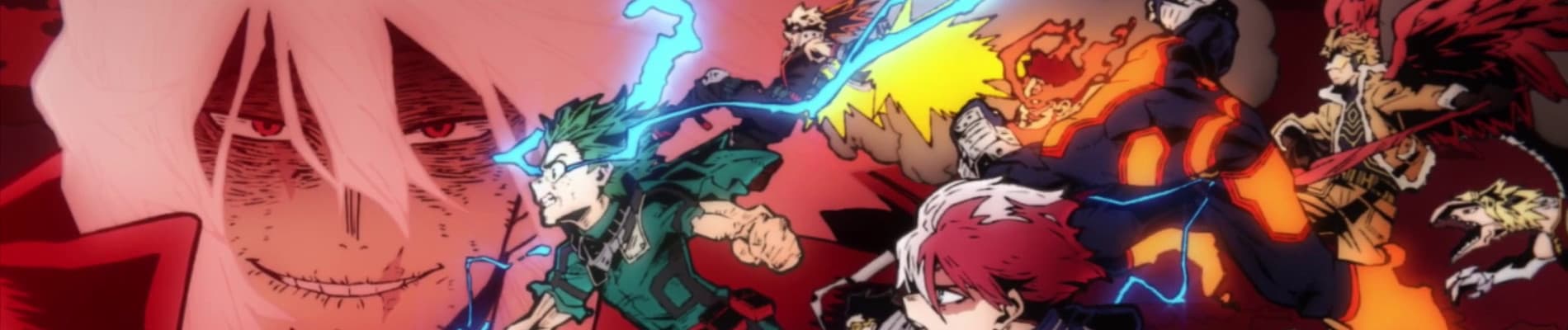
Season 6 is an explosion, plain and simple. It’s over a hundred episodes of peeling back the layers of hero society finally coming to a head and bringing the whole damn house of cards crashing down. The season’s first half is entirely taken up by a massive heroes vs villains war, a war in which everyone is pushed past their breaking point and forced to make climactic decisions about who they are and who they want to be. Characters die, self-actualize, rise to their ideas and shatter beneath them, on all sides of the conflict and sometimes all at the same time. If the All Might vs All For One battle back in season 3 was the end of My Hero Academia’s first act, then this barn-burner brawl is the climax to its second act. It’s the destruction of the status quo, an inflection point for all its characters, and as definitive a no-going-back mic drop as you can imagine. This is the end of the world as we know it, all the mistakes and hypocrisies of heroes past finally coming home to roost as Shigaraki puts his master plan into motion and the foundations of the earth itself tremble in response.
And once the rubble has finally settled, the season’s second half turns to tackle the aftermath. What happens when the world falls apart? What happens when everything people believed in turns out to be a lie? The heroes they put their trust in failed to protect them, and many revealed themselves to be little better than the villains they were supposed to be fighting. Fear and hatred compound, safety nets fails one after the other, and this society that once seemed so perfect reveals itself for the sham it always was. And Deku and his friends are caught right in the middle of the chaos, thrust far too soon into the role of the world’s hope for the future. They always wanted to be heroes: now, it’s time for them to come to terms with what that really means.
There’s a level of moral complexity to these developments that I don’t think any of us could have predicted. My Hero Academia started out as one of the most outwardly inspirational, optimistic stories on the market, but it’s proven itself more than capable of deconstructing its own premise. Heroism in MHA isn’t a static state of affairs; it’s a question that must be asked, re-asked, and asked again through the contradictions and imperfections of the real world. What does it mean to protect? To save? Where does the responsibility lie when we fall short? Is it ever too late to fix your mistakes and start over again? A lesser show might shy away from those questions, but MHA relishes in teasing out their intricacies. And it makes this season- especially the second half- some of the most captivating drama we’ve ever gotten from this genre. Watching the world come undone, and watching the heroes struggle to face the new task before them, results in not just some of MHA’s best moments, but some of the most hard-hitting resolutions in all of shonen history. The Deku/Shigaraki parallels! The return of You Say Run! Uraraka’s climactic speech re-cementing her as one of the all-time great shonen love interests! Payoff for not one, but two of the best goddamn redemption arcs this side of Zuko (and with Shigaraki, that number may climb to 3...)! Twice! Hawks! Lady Nagant! Season 6 is a portrait of a world falling apart, but it’s also a portrait of what rises from the ashes it left behind. As Deku himself says at one point, the world is far more complex than simple black and white, but that only makes it even more important to stand up for what really matters when the chips are down.
I’ve been watching My Hero Academia for a while. I started it back when there were just two seasons out and everyone was still riding high on the hype train. I’ve experienced its highs, its lows, its brilliance and its stupidity (Mineta has done nothing pervy this season and I am SO HAPPY YOU GUYS). I’ve been with this show for a long ass time. But no matter how its perception has shifted over the years, no matter how much anime I’ve consumed since then, I keep returning to the simple fact that MHA is really goddamn good. I don’t just like it because it was one of my firsts, or because of sunk cost fallacy, or anything like that; this genuinely IS one of the smartest, richest, most emotionally resonant works of shonen storytelling to ever appear in Jump’s pages. And watching so many of its threads come to a head in season 6 has only confirmed that it’s going to stand the test of time. I can’t count how many episodes left me weepy, how often I was left astonished at the courage and intelligence of Horikoshi’s writing. This isn’t one of those stories that squanders its potential along the way and leaves you indifferent by the end: this is a story that’s going to fulfil every last promise it made, pay off every last idea it set up, and bring it all together in a complete package that makes the entire show better in hindsight.
Because even in its slowest moments, this show was so much more than a mindless punch-em-up. This is a story all about the nature of heroism itself, and what it truly means to be a hero in a seemingly perfect world that actually has more cracks in its foundation than a log cabin built atop the San Andreas fault. This is a story about what happens when golden ideals run up against reality, how good intentions go awry and send an entire society down a path to ruin. This is a story about what drives villains to be villains in the first place, and why they deserve our understanding even in spite of their crimes. And it’s a story about how to rediscover and reforge hope, learning all over again what it means to make the world a better place. Unlike so many of its contemporaries, My Hero Academia actually has things to say about our modern world, ideas it wants to convey that run deeper than “just believe in yourself!” Demon Slayer can lavish as many pretty lights and spinning cameras as it wants atop its cardboard world and stick figure characters, but that momentary flash is nothing compared to this slow-burning tale of what it takes to rediscover heroism in a world that’s forgotten its true form.
Season 6 of My Hero Academia is phenomenal. It’s a lightning-bolt payoff to a story years in the making, sending it hurtling into its final act in as staggeringly brilliant fashion as I ever could have dreamed. It’s not just a new high water mark for this show, finally surpassing the bar set by season 3; it’s cemented this show’s status as one of anime’s all-time classics. When we look back on this period, it won’t be the vapid flashiness of Demon Slayer or the agonizing stupidity of Tokyo Revengers that stand the test of time. It’ll be the story of how a crybaby with green hair became the greatest hero... and how the entire world became the greatest hero right alongside him.
152 out of 203 users liked this review