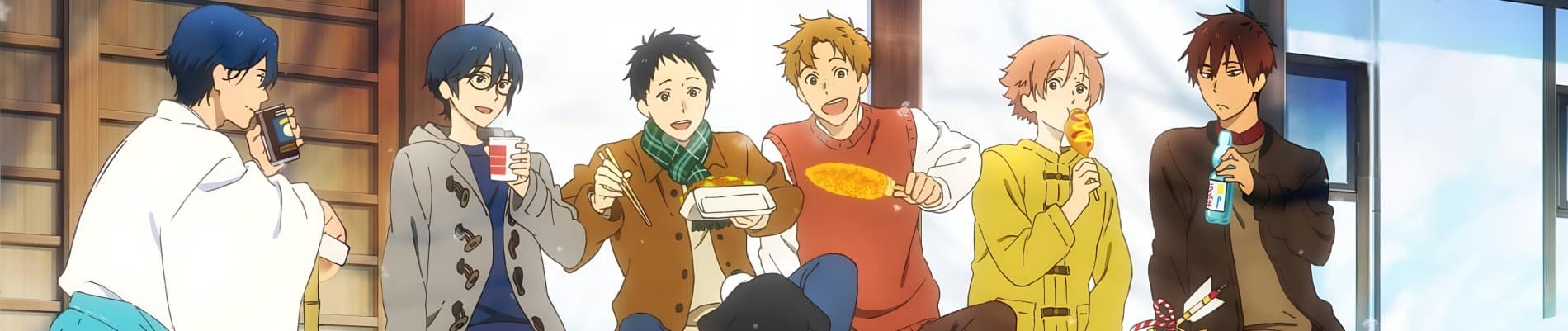

Tsurune is an oddity. It’s that one Kyoto Animation property that you've probably heard of, but haven’t seen yet since it gets lost in the wash of the studio’s higher melodramas or more-spirited slapstick and fantastical comedies, its ability to moe-dify art into something both visually and thematically beautiful, or Free! getting its umpteenth sequel. To say I was surprised with this property getting a season two was an understatement. As much as I, like most, love seeing Kyoto Animation come up with something new, I had to sincerely wonder where things were supposed to go. As a focused character study on Minato coming to terms with his own problems on the range and within himself, the thematic arc of the first season was well and truly closed.
But I was looking for the wrong thing. Tsurune was always sitting quietly within the studio’s bright output, always calmly drawing its breath to find its own ikiai, yet at the price of being outshined by both the studio’s predecessors and progeny. While they emoted, Tsurune ruminated. That contemplative element of being so in-tune with itself was perhaps needed more than we realize. Kyoto Animation is still, to an extent, living in the aftershock of 2019, and although Miss Kobayashi’s Dragon Maid S and Free! concluding perhaps helped assuage some initial worries, the new talent from their nurturing school had yet to be truly tested. Ironically, it was one of the studio’s most calming ventures that would prove just how much creative daring its new blood had. And thank goodness that it exists.


(Cuts like these with the metaphorical divide between outside vs. inside, exterior vs. interior, color contrasts with the hair and clothes, the fisheye-esque lens, or creative perspective within the space, show that even completely mundane moments can shimmer and breathe life into the everyday)
It would be one thing to point out the sheer technical excellence or general use of its tracking shots, or perhaps remark on the sound and music, which have always been two of the original Tsurune’s most-unsung triumphs of storytelling – the meditative nature of its timbre functions both as ambiance and character psychological profiling. But of particular importance is the presence of Yamamura Takuya, who although being at Kyoto Animation for some time and having done episode directing before, has only taken the full director’s chair thrice, all for Tsurune. Yet if the time between the two seasons is any indication, he has grown by such leaps and bounds for mood-setting and framing as to be a tour de force.
To call him an emerging figure to continue Yamada Naoko’s gentle flame-like legacy is not, I believe, too much of an exaggeration. Aside from the intentionally more-overt visual signs, such as mannerisms like hair-fiddling or episode six’s use of girl bonding over their mutual passion, he’s also created a production environment of fostering the talent that the studio has had to craft delicate pieces that allow quiet beauty throughout. It can be sensed in each twitch of the character’s finger, every time the group excitedly goes off to shoot, or when a tough conversation is had that requires tough love or a communal bath. Whether it be numerous new [key]( https://www.animenewsnetwork.com/encyclopedia/people.php?id=233372) animators [getting]( https://www.animenewsnetwork.com/encyclopedia/people.php?id=233940) their very [first]( https://www.animenewsnetwork.com/encyclopedia/people.php?id=233373) jobs in the production pipeline proper, or intermingling the new with Kyoto Animation’s more-seasoned veterans by using their sure hands and delicate attention to detail to put the finishing touches on emotional climaxes, the future of the studio is now, more assuredly than ever, in capable hands. As surely as Minato will pick up his bow, or Shuu’s younger sister Sae will quietly cheer him or Ryohei on, the time to draw the arrows AND the time to draw the arrows must come again. The Linking Shot, indeed.
(This cut specifically by Satou Tatsuya, responsible for some of KyoAni’s most mood-oriented and dramatically-striking moments like the running on the water in Violet Evergarden, perfectly represents the studio’s ideology. The arms and hands show that, no matter what future KyoAni has in store, its staff, both old and new, will approach it together in all its magic)
Tsurune season two, in that case, was the perfect specimen for this new dawning of studio talent – a relaxed atmosphere in-house with an equally-relaxed atmosphere in-text, having enough drama to set a predictable, but ceaselessly-satisfying trajectory with its expanding cast, both in number and in ever-evolving dynamics. As Nikaido mutters about how there’s no fun in watching a movie when you know the ending, his question is given a perfect response – “Depends on how they play out.” It’s that answer that Kyoto Animation so poignantly understands, and why even an endeavor from one of their ostensibly “lesser” franchises still soars through the air. They found their ikiai a long time ago.
I’m truly grateful that they share it with us.