Inu-Oh
a review by MattSweatshirT
a review by MattSweatshirT
“Taken from us and forgotten, this is our story.”
Simply living life is something it seems people have become more and more alienated from. Humanity has taken on such a severe self-importance that we make the mistake of trying to find some kind of meaning in our lives. Everything we do seems to be centered around trying to figure out some grand importance behind our miniscule existence. Something that makes us special in comparison to the rest of the world and universe. But this misses the point entirely. The beauty and importance to life is self-evident. Life is in itself an unimaginable coincidence–An impossible opportunity, and an experience to treasure. And the way to treasure it isn’t to prescribe any additional significance to things that only serves to distract from what is actually important, it is to live it. Don’t find meaning, it isn’t there; instead find yourself, and find your art.
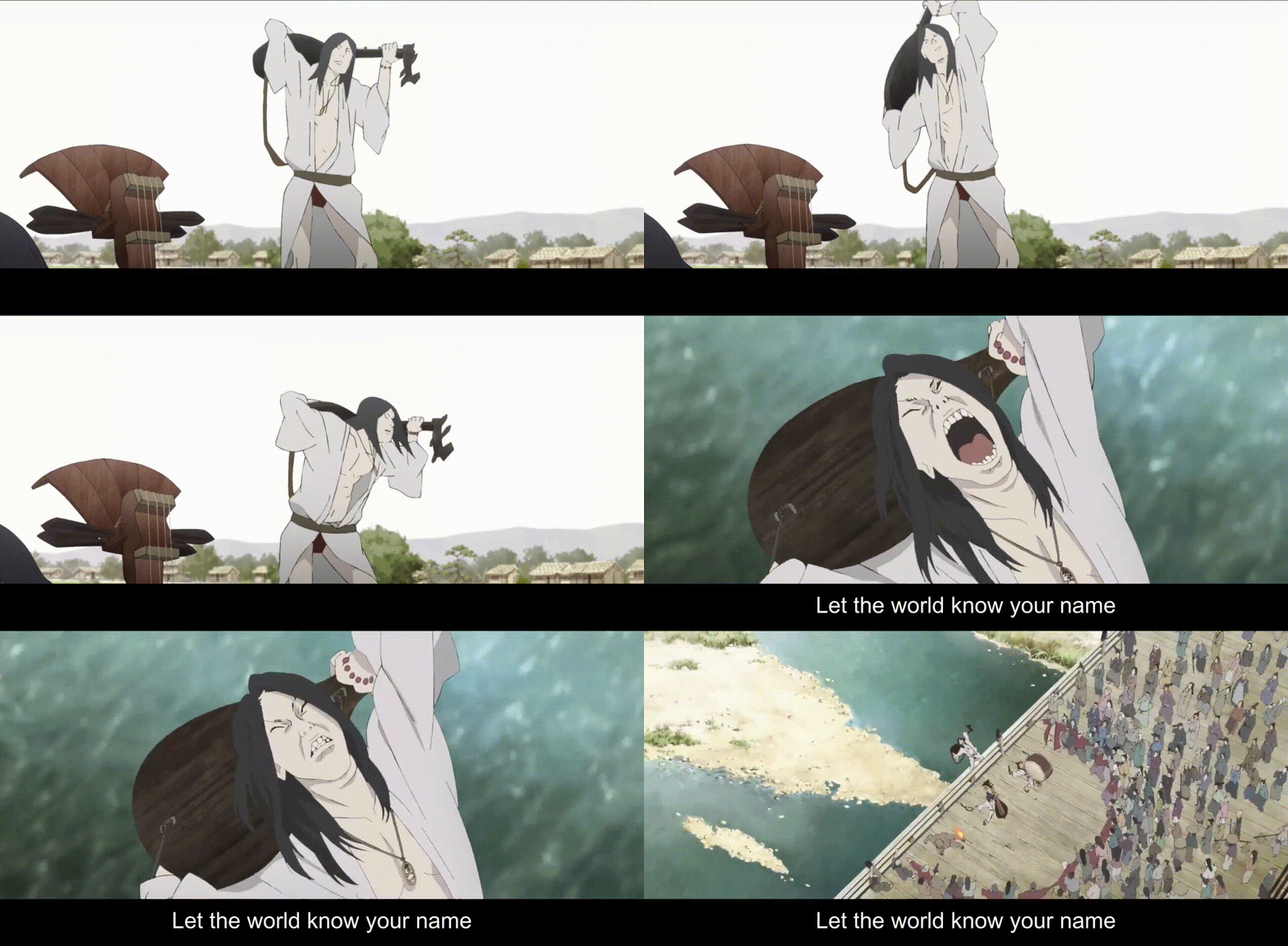
Masaaki Yuasa is probably the biggest name in the auteur side of the anime industry, especially in the Western fandom. His catalog of creatively driven projects that make the most of the medium they are within have gained him the notoriety he has today. In early 2020, he stepped down as president of the studio he helped found, Science Saru, and announced that he would essentially be retiring. He has since clarified that he isn’t actually done working in the anime industry entirely, but is just taking a break and seeing what happens from there. But Inu-Oh, his latest film, feels like the final celebratory work that comes at the end of any good creative’s career to synthesize all that has come prior–To bookend a life of creating art to express oneself, and to encourage all those that may carry on that torch going forward.
If the rest of Yuasa’s career is working on nothing but cash-grab Netflix productions that use A.I. generated art to churn out anime with little to no artistic value, well, I’d be pretty disappointed, but I couldn’t blame him too much. But in the meantime before A.I. has completely taken over the world, let’s keep talking about Inu-oh and how cool it is as essentially the antithesis to the current trend of producers trying to adapt everything possible all at once for monetary gain resulting in rushed, uninspired products.
Inu-oh is one half of Science Saru’s recent journey back in time through Japanese history–the other being Naoko Yamada’s take on The Heike Story. The Heike Story is originally a compilation of orally-passed-down accounts of the legendary reign of the Heike clan. Inu-oh is a fictionalized story about a lost piece of history regarding the storytellers who would go on to pass down those accounts and others that are now lost to time. Yamada’s adaptation serves largely to breathe new life into the restating of the messages behind the work and insist on the importance of continuing the tradition of passing it down. Yuasa’s film recontextualizes that tradition in a new, unique way. It celebrates the stories that haven’t been able to be passed down–the art and expression of the unheard. It also celebrates the telling of stories not only for the sake of them living on, but as a means of self-expression. In doing this, he really makes this film into his own in what feels like a more intimate way than he’s ever done before. What are his best works prior to this in my opinion are those that are TV adaptations of others’ stories–Tatami and Ping Pong. In an interview following the release of Inu-oh, he stated, “The film world and the TV world are completely different, with TV projects being much longer [...] This means I need a lot of people who work joyfully for me in order to work on what I need them to work on. On the other hand, movie making is something that is very personal, and for me, it’s better that I do most of the work” (interview here). This resulted in Inu-oh functioning as what feels like a personal statement on collaboration and the art-making process. And the film where he feels most himself is the story where he is telling us to try and be ourselves. Perhaps this wasn't even purposefully the message of the film in the first place and he used the process of creating it to actualize the ideas for himself in his own life.


As a production, Inu-oh pretty much follows suit with what we’ve come to expect from Yuasa and whatever team he works with. A shifting art style used to convey the specificity of each and every scene. Character designs by Taiyo Matsumoto, as Yuasa also worked with on Ping Pong, that have a distinct charm that seems to perfectly match Yuasa’s characterization and sense of humor. Gorgeous and intentional color design by Yuuko Kobari, who has done consistently stand-out work on projects such as Redline, Space Dandy, Texhnolyze, and Great Pretender. A fluidity to the animation that flows wonderfully to depict emotion. When asked about his use of the medium of animation, Yuasa stated that “space is very different from what you would capture with a camera or in a more intellectual fashion. It’s through emotion that space changes” (interview here). And in this film’s case, it's a wonder how constantly engaging it managed to be while broken apart by such lengthy musical numbers. What is unique about Inu-oh in his catalog is its ability to somehow capture such a unified aesthetic of its historical period while still retaining all the experimentation we’ve come to know and love from him. All-in-all, a joyful and inspiring form that expresses the film’s messages better than any script ever could.
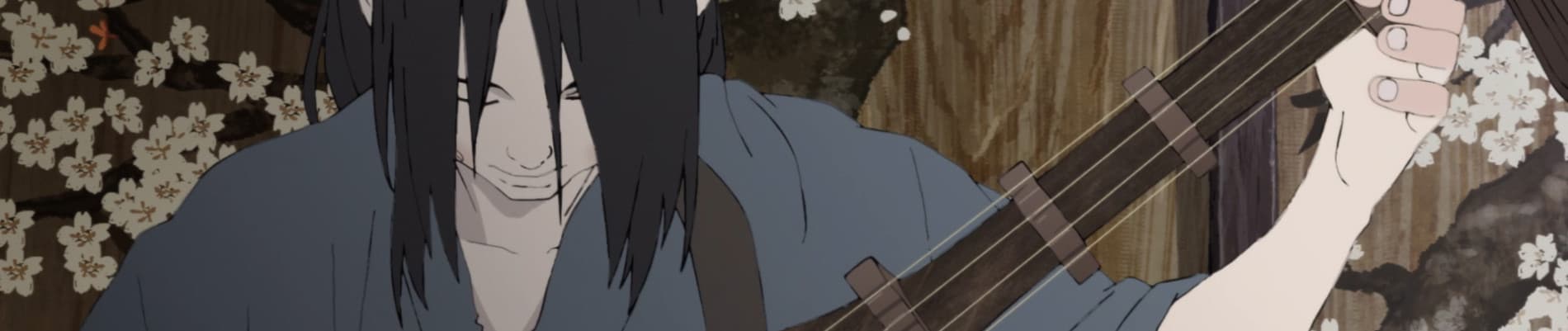
Inu-oh spends a lot of time detailing the societal constructs that serve to limit our personal expression. Tomona’s character in particular navigates and fights against these forces that restrict him as the film progresses. Familial expectations, artistic standards, gender norms, societal tradition; Hegemony and convention impose countless explicit and implicit limitations onto us. Initially, Tomona is driven by a motivation imposed onto him by his father, which he wants to respect, but at the same time can’t let control him. He breaks free from this control as he takes on a new name in joining the community of biwa players. But again, he feels restricted by the rules of this community, and breaks free by performing whatever and however he wants to on his own, and telling stories not often performed by others. His music as it’s depicted to us takes on a modern rock feel. This is utilized to simulate the contrast between what the music back then was like and how new and original his was in comparison, in our context sounding ahead of its time in a literal sense. As the film progresses we see his appearance also reflect a more free form of expressing himself, growing his hair out longer, wearing makeup, and dressing in more gender non-conforming ways–Gender often being easily one of the largest factors that contributes to limiting our self-perception and identity.
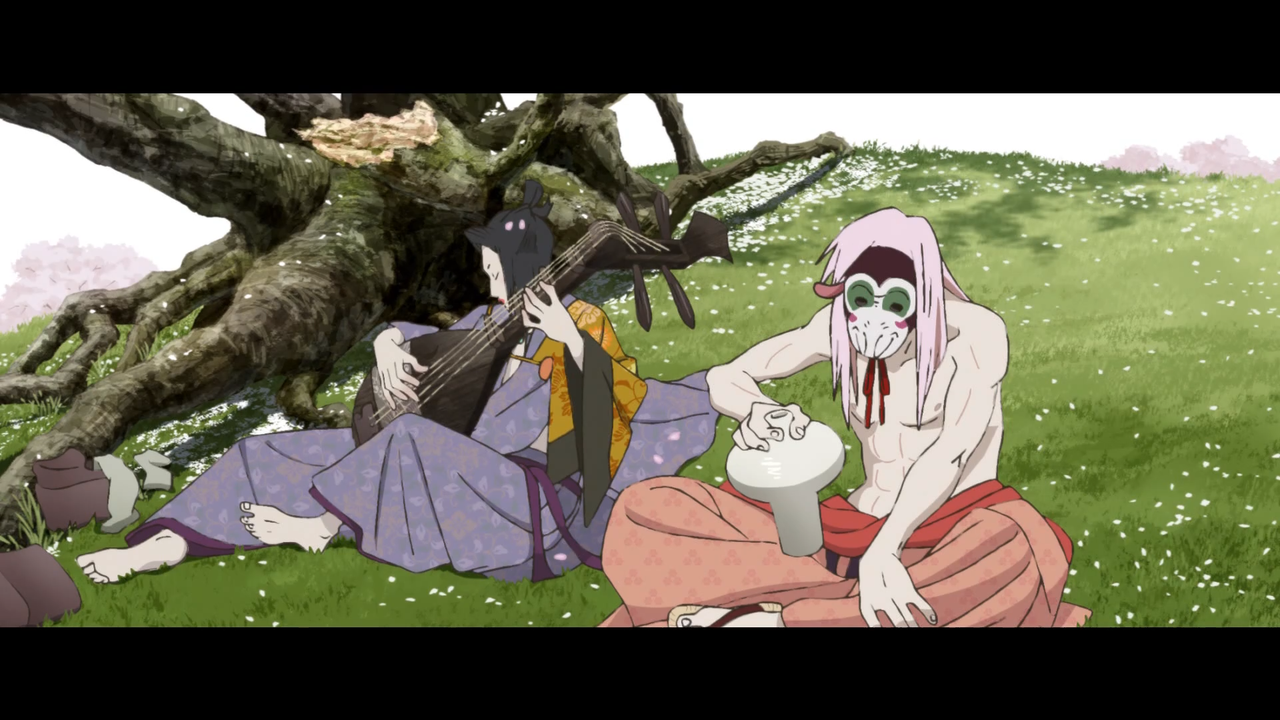
However, Ashikaga, the leader of the reigning clan at the time, works to shut down Tomona and Inu-oh’s acts. He states that only officially sanctioned heike stories are allowed to be performed. The inspiring, revolutionary performances by those outcast by society attempting to take it back for themselves are extradited. The forces of authority that impose these many norms and limitations onto us in the first place often take on this kind of austere self-importance. An arrogance with their control and at times even a belief that what they enforce is righteous or true. However, this is proven arbitrary and absurd in the face of the endless march of time which brings change to all things.
“Under the mask is yet another mask. Everything is fiction.”
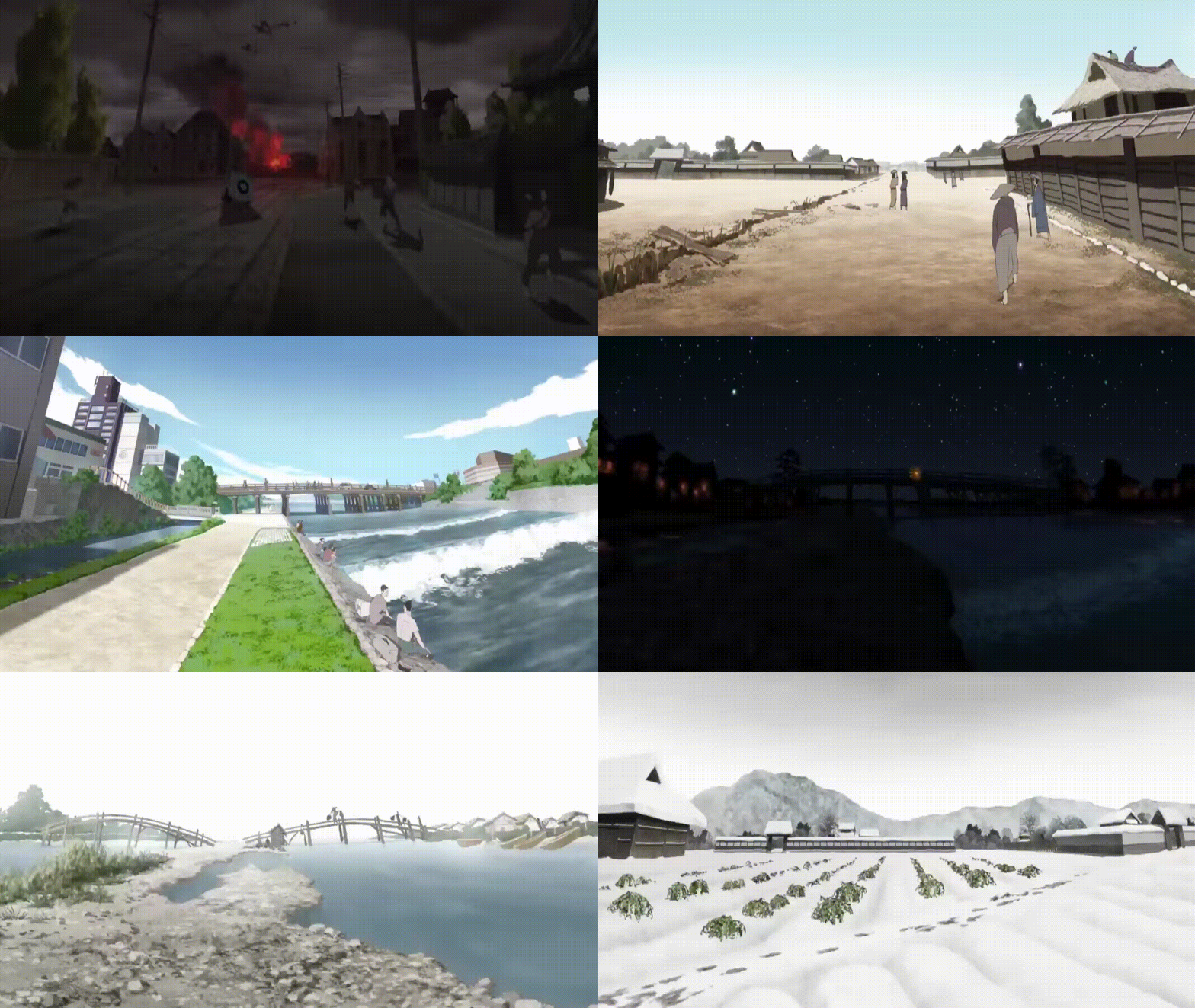
The only thing left, the only thing that proves to be truly real no matter the circumstance, is pure untethered self-expression. “I really think that music is freedom”, Yuasa said when asked why music plays such a huge role in the film (interview here). This freedom in this film extends to any creation of art and self-expression. So you should make your mask your own. Inu-oh attempts to give new life to stories once repressed and forgotten by hegemony and convention, and in the process, celebrate the timeless phenomena that is expressing them. This is why time is such a significant aspect in Inu-oh. It begins by framing our story from the present, as something we are going back in time to be told. One of the first scenes of the film is rapid cuts of the location of the Noh theater school in different times as we see how drastically it has changed dating all the way back to the story’s setting over 600 years ago. And the final scene depicts the spirits of Tomona and Inu-oh who have lived on into the modern day–those that have been true to themselves and expressed their art made eternal.
The relationship between art, such as the music and stories performed by Tomona and Inu-oh, and the power structures of society will always be tumultuous. The hierarchical tendency to control the stories and art that are normalized and accepted chips away at the freedom and creativity of the wider population. The social constructs and artistic standards defined by the hegemonic force will always be used to subdue the wider population to a second-class status. Self-actualization and class consciousness are antithetical to the maintaining of this status quo. Art, and all forms of expression don’t belong in such a structuralist environment–they belong to the people. They are an expression of the collective experience, and should be made and shared with the collective. The stories of the performances in Inu-oh are the stories of the people that have been taken away from them and forgotten, and Tomona and Inu-oh’s mission is to give them back. The composer for Inu-oh, Yoshihide Otomo, put it wonderfully in an interview following its release. “What I feel is important is to express that the act of combining words, stories, songs and dances, before being bound by words like “art” or “music,” always appears to people as a mass of noise. I think the director wanted to express the dynamic range of those things, and how that mass of noise is always something those in power will hate” (interview here). People are creating new stories each and every day just by living out their lives. Stories that deserve to be heard just as much as any other. Inu-oh insists on the validity and value of all people's stories. In depicting a blind biwa player and a cursed, monster-like dancer, it affirms the lives of those one would normally think have a handicapped perspective. It argues that the value you ascribe to one person’s perspective over anothers is false. Even Tomona, whose perspective of the physical world is limited in a very literal way, is able to gain a different kind of value through that experience that someone who isn’t blind wouldn’t be able to gain. Here Yuasa is urging us to let our own stories be heard–no matter who we are and what we’ve been through. And this doesn’t necessarily mean to create music, or stories, or drawings. It means to express yourself in whatever way fits. Find the art in your life, be it dance, fashion, sports, writing–any hobby that contributes to your journey of finding yourself. There are those out there already doing it–even people from 600 years ago–so there is no reason you yourself can’t do the same.
Just as much as he is celebrating the forgotten stories of the past, and he is affirming his own passion for creativity and creation, Yuasa is telling us the audience to go forward in our lives with passion of our own–whatever it may be–in spite of all the forces that may restrict us. In the context of the anime industry, he is urging those that come after him to embrace their own creativity instead of cowering away due to trends or convention. But it really applies to any and all forms of creation. With this, Inu-oh is a synthetization of the transcendent nature of art and storytelling.
“Where past, present, and future become one.”
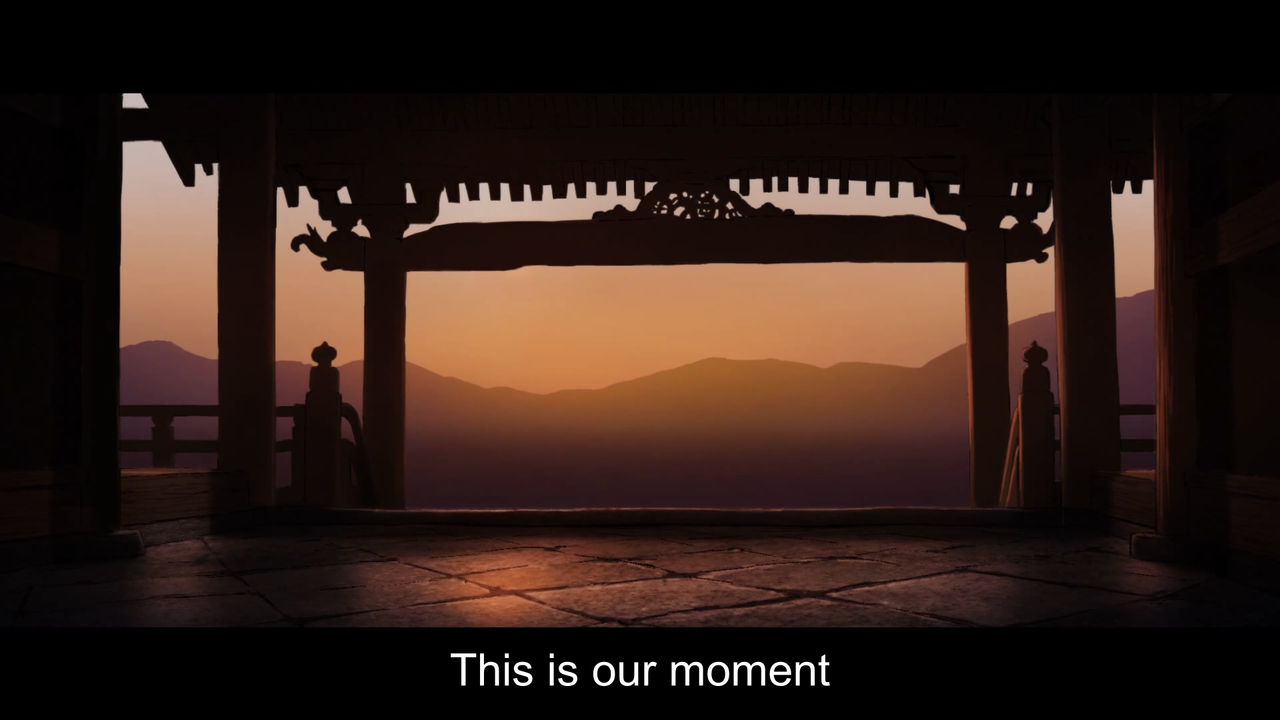
The immortalization of our ideas and emotions into art–in yuasa's case, into anime–is a life-affirming practice. Taking influence and grounding from the past, expressing one's own present moment, and presenting it to the world in which it will live on past yourself and affect the future. This film embodies this more than perhaps any other piece of media I’ve seen. A period piece back in time through Japanese history about the importance of living in the moment and being yourself, focused on inspiring the audience and the industry it’s a part of going forward. Expression through art, any art, is the most effective way to treasure the experience of life. To live life and to express the inherent beauty and importance of it. The value of stories and art, just like the value of life, is self-evident. As a perspective unlike any other, your experience has value–All experiences have value–It’s only a matter of expressing them to actualize that value in your own life.
s/o to @Wavieff , who made the original, best review for Inu-Oh, which helped inspire mine, so if you’re reading this and haven’t checked that out, do so :)
46 out of 47 users liked this review
