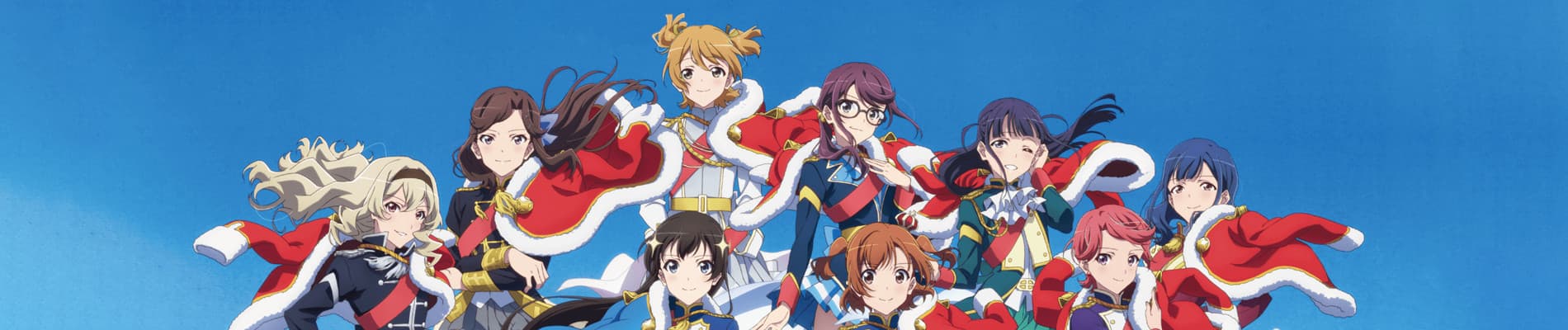

 Small premise: due to how dense Revue is I had, and preferred, to move around the concepts and words by helping myself with external works such as @Rewsula ’s review and [this](). Some words and lines may sound familiar but I didn’t mean to steal anything but just help myself in expressing what I wanted to write. With that said I will begin.
I want to take the shame because I dropped Starlight at the beginning and it took me MONTHS to finish it because, yes it was talking about the theater, but I couldn’t follow it and I felt misled by some friends telling me it was an incredible masterpiece. I couldn’t understand what the Revues were, what the giraffe was, what the school was about, and why they were fighting for a play even and so I was lost. There was a spark in the 7th episode because of the change of pace, but I still struggled; until the final episode of the first season when some simple lines made the relive all the episodes in the blink of an eye, and literally everything I watched made all sense within some seconds of thinking, and I started talking and talking about Revue to my friends but I wasn’t satisfied yet because I didn’t reach the real ending I was looking for.
I wanted a sequel.
But what’s so special about Revue? How did I end up loving so much a work I struggled to understand until the very end despite having that single moment where everything makes sense? Great question. But I do understand.
I will talk about this movie on 2 main topics: its themes and how they are shown, which in other words are just storyline and visuals, I may have said it in a terrible way but this movie is such an incredible work of direction and it felt wrong for me to speak about it like a normal review.

“Another thing I like about the movie is there are a lot of ‘unintentionally absurd’ moments,” says Furukawa, “a work is only good when they can make people go ‘Hey... what?’ “
And this is the whole core of the movie: incredible scenes determined by acrobatic movements, intense lightning, powerful music, and over-dramatic lines that at times feel out of context but in fact, they are meant for a reason.
But let’s not get ourselves off track, because we are not talking about the Baroque today, not entirely, but we are talking about the incredible stage that Revue Starlight is: the meeting point of the theater, the Baroque, and the anime world. However a part of the theatrical Baroque is indeed missing: the dancing, but what if I told you that the stage girls fighting is their dance? Their movements are sublime without sudden changes that break the smoothness and beauty, they all try to stand out their strong points that can go from simple beauty to their own skills; it’s not random that the music, even the sung ones that got released online, go with the scene with an alternation of stationary and flashy. Who else, in the real world, used these elements of moving with the music? Claudio Monteverdi and George Handel if we want to cite some.
And at this point we can even talk about the audience, the giraffe, who keeps saying “I understand” in front of what they can’t really understand at first sight, because it’s impossible, and the “wakarimasu” becomes a simple word of “Okay” where you don’t confirm the understanding but you confirm that you have taken the experience of it, and that is something that Furukawa confirmed himself because he doesn’t want you to understand some parts on the first watch but leave you with the wonder stuck in your head. And that was me, a lost spectator who after the first act (the tv series) said “Okay” and started desiring MORE to see what the true ending, the true sequel, was going to be because I wasn’t satisfied, not with the anime but with myself because I wanted to see more from these girls expressing their emotions on stage.
What’s the best way to ask for a sequel if not asking one of them and even making a deal?
But before diving into this review I will make one final introducing point that some if overlooked: the Revue Starlight is a Revue stage play that takes after, or even better is an homage, to the Takarazuka Revue founded by Ichizo Kobayashi; a “genre” of the theater where the predominant sex is the female, the western type musical is the absolute dominant aspect of it to allow differentiation from the Kabuki and the main theme is the Beautiful.
Each play includes a dance that wants to tell a story and here in Revue Starlight the dances are the fights of the girls but I see them as a metaphor for the actual dance, a thing that I will expand on as I go on.
The tv series was already spectacular in terms of recreating a Revue, actually many of them, but the movie elevates them with the simple “idea” of blending the art of the Revue with the style of the Baroque leading to an exaggeration of the visual and a magnificent view of what is happening, despite sometimes the actual actions being pretty simple and straightforward but this is ok because the theater is about being magnificent.
This is why I prefer to say “Revue: Starlight” instead of “Revue Starlight” because the Starlight is the Revue and it is exactly like a star: unique, splendid, and shines.
But now I am burning with the desire to talk about each Revue.

The Revue of Annihilation gives exactly the feeling of a sequence of murders.
This Revue starts already in a unique way that made me feel out of place: it’s on a moving train, so it is dynamic rather than the static stage that keeps changing, which is a genial idea because it hooks the spectator in a second because this is an unfamiliar view and makes you wonder to see what comes next and it’s spectacular to see a fight on the top of a train, right? The scene is incredibly dark, and its only sources of light are some light panels that give illumination to the “stage” that is moving to another stage. But it’s a 1 against everyone else, this is not a one-on-one fight, Nana is fighting against everyone else who has decided; we know that Nana’s wish it to never leave the Starlight and play it all over again because she doesn’t want to leave everyone and her great time so she decides to confront everyone and see if they are ready or scared to take on the new path, but Nana winning against everyone else is a statement to the other saying that they are not ready yet to leave this stage because they haven’t even finished it yet, there is still something to do.

What I find amazing about this Revue is the portrait of the silent anger Nana feels and how cold she is in the fight, even more for how easily she defeats everyone, and how everyone responds to her and not only her; everyone is still raw: Kaoruko still runs after the idea that she must have an audition to confirm her superiority to the expectations of the others, Junna is still extremely insecure and struggles to shoot the fatal blows to the busy Nana that in no time makes Junna become the reason of distraction of Futaba and Mahiru while dueling, who cannot defeat Nana, and Junna remains helpless in front of Nana and gets humbled. My favorite part was Claudine being almost “jealous” because Maya was going to challenge Nana instead of her, who is supposedly her eternal rival, and she even screams at her to go noticed which results in her loss. Something that all of them had in common, with the sole exception of Maya, was not being “on stage” with their mind if that is what I understood and this is why they all got eliminated by Nana. No wonder why everyone “died” in a pool of blood, which is an extremely heavy element to add visually and does it great job.
Going back on the visual presentation of the Revue I have to say that I loved the idea of setting up the stage, with the train disappearing and the set appearing, and I would say that it gives an idea of how serious Nana is with this; as well the song of the Revue is perfect for this, like every other song, because its dark and fast-paced instrumentals give an idea of stress and fear, like being overwhelmed by something bigger and stronger than you and you can only wait to see if you will be spared or not. But there is a reason why no one is dead and it is because this is not an audition, this is not a competition anymore

The Revue of Malice was my turning point for the movie that made me understand what were the intentions here and it was my brain telling me: “They are not joking anymore”.
This Revue is a whole massive and ridiculous masterclass and I say it with the least bias I can, even more, because I’ve never been a fan of Futaba and Kaoruko but this Revue elevated them to their absolute ceiling.
Let’s make a big jump back into the TV series and let’s look back again at why Futaba joined the stage girls: it was because she wanted to be by Kaoruko’s side; but this soon became a dependency of both parties with Kaoruko having to depend on Futaba for literally everything, even stated by Futaba in the movie itself, and Futaba at the same time suppressing her ceiling as a stage girl to stay with Kaoruko and use the excuse that she is doing what she is doing for the best of both (being the stage and Kaoruko), but in the movie, it’s made clear that she wanted to improve in what wants to be her future and she didn’t make Kaoruko aware of her decision to part ways, because splitting is the best for both as for Kaoruko to improve and become independent and for Futaba to improve as a stage girl. Kaoruko will never accept this and of course, gets mad, and she gets even madder as she listens to Futaba’s excuses for being lame as usual because she blames not having talents and mentions the other girls; Kaoruko gets jealous of course at hearing the other girls because she wants to be the only one with Futaba, and gets even madder when she hears again that it’s the best for both (being again the stage and Kaoruko) because in the deep she knows that they also have to split. Just like in their everyday life, it’s Futaba going after Kaoruko, and she says that she is tired of this, but again Kaoruko cannot accept it and decides to interrogate her. It is probably overlooked that Kaoruko is in control of the stage and she is doing whatever she wants because, just like in the everyday life, Futaba allows her to do so; Kaoruko keeps changing the environment as she likes and once she realizes that Futaba wants to change things she tells her that she cuts ties with her. I see their common decision being the typical lovers’ bad decision that, like in every romance film, ignites the love act and we can say that more or less also happens here with the cheeky Futaba on top (as stating the dominant role) expressing her feelings and ideas to Kaoruko who finally succumbs and accepts that this is the reality, which also happens with the act of love, which is stupid but important because Futaba gives her the care of her bike, but Kaoruko tells her that she cannot even ride it.
This Revue is by far my favorite in terms of creativity and you can see that the staff went crazy on it. For starters, I really want to highlight the presence of Claudine because as we remember from the TV series she was an important part of their episode and I find it sweet she is included here, especially for giving the shrug after seeing them starting fighting as a way to say “I have done my part, now it’s up to them to decide”.

The start of the revue is already particular because we are in a Japanese temple and in big display we have the Hannya mask from the Noh theater, which is used as a symbol females becoming demons for their jealousy and obsession, and the eye can easily fall on Kaoruko being in a slight Yakuza version, but Claudine feels off the theme and you can imagine that we are in some other times; Futaba makes her introduction in full 60s style with her outfit with her truck. My favorite part is the first duel because Futaba tries to find an excuse to her decision, but right at the end Kaoruko completely changes themes in a sexy one where she fully takes control of everything and overwhelms Futaba with: “What is that ‘For you’ nonsense?”, but wait a moment and observe the scene.

This is what I meant by “mixing cultures and styles together” as here we see a particular one with the statue of a Buddha, that becomes even a piano, in a stylish night club giving the sexy vibes I mentioned before, and again with Kaoruko being the absolute leader of this view. I also want to speak about her choice in the body language in HERE because it’s extremely “provoking” in her sensuality, especially when she puts her legs on the table to get closer to Futaba and whispers to her “to go outside” in probably one of the hottest voices I have heard in anime, but you can feel her anger.

And the truck sequence is breathtaking in how powerful seeing the lights of the 70s to 90s buses full of texts that are words and phrases meant to the other girl as a way to communicate without facing each other, but it’s useless. In the end they come to the common understanding only after the image of them as children and “I can’t win against the selfishness of a kid”, it’s time to let go and to switch sides because now Kaoruko has to go after her and perhaps wait for her.
You could almost say that this Revue is all in the mind of Kaoruko for how she wants to express herself to Futaba, since she is the absolute ruler for the most, but instead let’s say that it’s simply how her heart is seeing the discussion.

If the Revue of Malice was a masterclass of blending cultures and styles together, then the Revue of Competition is a masterclass of framing and expressing emotions.
The Revue of competition is particular because I believe it started all from a misunderstanding between Hikari and Mahiru: Mahiru always saw Hikari as a direct competitor to herself because she always felt that she was taking Karen away from her, so she started thinking that there was some sort of competition to win her. Or at least this is how I saw it.
Knowing what I said before, that the movie is the ultimate play-off of each Revue, the Revue of Competition is one of those that is best expressed in here for that meaning and even better it’s one of those few Revues that I believe full express its title; here we see a true competition in the literal sense with Mahiru taking the full control of the stage and challenging Hikari in various sports as if we were in an Olympic stage, but what’s the goal? The most obvious answer would be “Karen” but I believe this is the wrong answer, partially, because I think that Mahiru tried to challenge and duel Karen into making her be honest with herself on the reason why she ran away not from the stage but from Karen herself, despite their promise: in the whole “competition” it’s always Mahiru attacking Hikari, who is always the other defending and running away trying to find an excuse, and there is always the whole concept of “rivals” in the middle which I think is another way to define the competition of the stage girls to become a top star and it’s used to provoke Hikari running away from Karen, who is in that competition and no longer a rival, and of course someone who runs away and doesn’t consider herself a rival will lose eventually. You could say that Hikari not taking part in the stage is because she wasn’t being honest with herself on why she left everything and Mahiru’s stage is all an act that aims to make her being honest with herself, which is the reason why the Revue doesn’t end as soon as Hikari loses but only when she becomes honest with herself after being scared. She left because she was scared, and Mahiru did it perfectly with being scary. It’s all about promises: Mahiru loves Karen and of course she got angry when Hikari arrived from nowhere and Karen started praising her in no time, compared to Mahiru who was always praising Karen, and seeing Hikari running away and breaking the promise looked like an offense to her.
Mahiru may be saying that it was all an act but I believe that she was showing her true emotions, in the end she said herself that she was acting poorly.

I am going to be controversial and probably misunderstood on this but to ME this is the Revue excels at where others cannot: it’s extremely poor, compared to the others, in ideas of places because it’s all within a stadium however it takes the idea of frames to the next level better than any other Revue, it’s the whole idea of “simple yet beautiful”.
The first thing that comes in my mind is the whole idea of taking place in a stadium (which looks like to be from the 1964 Tokyo Olympics) for the simple fact that until this point we are used to a stage-like place that is not extremely gigantic where you can compress lots of things, but here instead it’s a massive place and we even go in the backstage of it and it may not sound relevant but it is. It is brilliant the idea of the stadium because passively it opens up the idea of transitions between sports and the fight, like I can talk all day how the sports are a metaphor of their fight even because more or less they do those movements (tennis for Mahiru to counter Hikari’s throw, Boxe for Mahiru attacking Hikari etc); but the actual best of this Revue comes with Mahiru’s horror and madness, which many would call Yandere but not to me. Mahiru’s stare at Hikari, while the camera shows the crowd of Mr. Whites (yes, I made the Breaking Bad jokes), was AMAZING and I felt the fear Hikari, then the whole “chase” to the elevator with a Mahiru that actually never goes after Hikari, but she still wants to escape the nothing, and the scene of the elevator OH MY GOD was mental. This Revue is incredible for the simple scenes taken to the next level with the exaggeration of the details. To end it, I even felt out of place at the end in the empty space with the big pillow because I got used to seeing so much that a single pillow felt bad.
Also yes, my male powerbuilder mind felt offended when Mahiru snatched that 194 kg.

Nana spent many many years living the same events and creating a solid bond with the Junna she knew, the only Junna she knew, and as we know from the previous works she didn’t want to evolve from there but only wanted to stay in the known universe, of course a sequel cannot allow that. The Revue of Hunting could be seen as Junna hunting down, or “killing”, her false beliefs about staging but let me explain: Junna has always been about finding excuses and postponing the future, as well she’s always been about using others’ words to express herself and never developing an own stage identity but here she is about to. The Revue of Hunting is enough similar to the one of Competition if we speak about the meaning of a stage girl, which is the desire to act on the stage at the best possible, and just like Hikari here we have Junna that “is not taking the stage seriously” simply because, as said before, she excuses her lack of own character and stage spirit. The main theme in here is Nana’s rage about this, and in fact, she tries to moves Junna to commit seppuku as a way to make her quit staging because not taking it seriously equals to not being worthy of it. Just like the fear of death, the fear of losing the stage is real and Junna cannot accept it; she evolves and she was beautiful.
My highlight in the Revue of Hunting is Junna herself that stops using words from others, because until then they had no effect on Nana and instead led to her second loss in a single Revue against her, but as soon as she came with her own very words Nana felt that something was wrong, the scared Junna used to failure wasn’t there anymore and instead there was one that wanted to improve and become the best. Isn’t it fun how the weakest stage girl was against the strongest one, and won?
To evolve Junna has to stop copying others and has to strike the other, she has to take from someone else the same way she takes Nana’s sword and duels her in a battle of achievements to evolve, cutting through every challenge she puts her in and eventually landing in the victory and defeating the Nana that wanted to see her stuck forever in the same place. She was beautiful.
And then they go their separate ways, Junna is now a real stage girl and Nana has accepted her defeat in this matter.

This Revue’s music is perfect, and top-notch. I felt everything. This Revue’s visuals are magnificent, I saw everything. I find it hard to express what I think about the technical side of this Revue because it is incredible and I really miss the words.
For starters: the seppuku scene was amazing with the stressing background music and the realistic recreation of the “ritual”, even with the white sheets, and the red lights symbolizing death and blood; Junna’s desperate look and heavy breathing can give full power of expression to this scene, which is helped by the unsettling presence of Nana, who wants to give to Junna an honorable death from the stage.
When it comes to the hunting the change of speed can be also seen in the arts themselves because everything is faster and overall it moves to a faster pace.
 The shot with all the blades aiming at Junna, as a way to ask to surrender, is amazing and acts even as a reminder that recalls to the seppuku.
This Revue starts by playing Faust: a tragic play where Doctor Faust sells his soul to the Devil in exchange of more knowledge and power, however as typical in the legends the Devil tricks him and makes Faust become his slave for eternity. Here the same thing happens, except that you can see the roles differently; Maya is the hero that seeks the perfection and wants to face harder challenges and in terms of stage girl, she is the perfection, she wants to find a play that will make her suffer in it for how hard it should be and Claudine, being her rival who’s always measuring up to her, offers her the ultimate contract. There are a few details to take notice here because the white bird is symbol of purity and that is often related to Maya because she is the ultimate stage girl, and that bird is always with her on the stage except for here when Claudine holds the bird in her hand (while it goes missing behind Maya) as a metaphor to saying that Claudine just obtained her soul. However, Maya metaphorizes herself as the ultimate stage tool and shows off the massive bird container which is empty, just like her soul (to which Claudine complains as she cannot understand what she took away from her) and shows off how she can adapt to any type of stage going from Middle Ages works to the Egyptian myths. Of course, the Devil tricks the hero and gains the advantage, but just like in every legendary poem the hero wins; but the Devil is unfair and can change every law as desired and in this case Claudine overrides the laws of the stage and tricks Maya by showing another star that she still has. Then she decides to be reborn as the stage girl she is and provokes Maya to show up. Of course Maya cannot accept such a provoke, she is the perfect stage girl and she must answer and she does it in style by climbing up the sage majestically like a queen, but here she wants to replicate the Sun King Louis XIV, and of course Furukawa takes after Le Roi Danse in this matter.

 It will be the ultimate battle and the round is won by Claudine but ironically she tricked herself, because the Devil’s deal was to continue fighting for eternity and so they will never stop and there will never be a clear winner.
Now, the Revue of Souls screams what I always wanted to say about this movie: it exaggerates everything perfectly. I’ve seen many “complains” that make sense because the TV series had arguably better fights, and this can be applied here, but it’s also an expression of absolute direction because here the fight is amazing to watch and I was going crazy while watching it: one frame better than the other, majestic shows like the waterfall of roses, the dynamic and exhausting view of a fight that never stops with so many lines going one right after the other that blend a duel with a conversation that recalls a wedding; the main color here is the white, the whole stage, and the red of the roses and it goes explicit in the lines of Claudine and Maya(“For me, there is you!”, “Right now you are the cutest you’ve ever been!”, “I am always the cutest!”, “You make me beautiful!”) and this makes me think that this Revue is a love act of a wedding between the two of them that decide to stay the one with the other forever because they complete each other, which could justify the idea of the eternal duel between the two of them.
Prove me wrong.
img45%(https://media.discordapp.net/attachments/1008017049320169513/1088874009606754304/SPOILER_vlcsnap-2023-03-24-17h11m22s125.png?width=1177&height=662) img45%(https://cdn.discordapp.com/attachments/1008017049320169513/1088874117727539260/SPOILER_vlcsnap-2023-03-24-17h11m25s652.png)

The Final Lines, the Ending, is everything about it should be, it must be about Karen and Hikari. I find beautiful that they look at the audience and converse about them, I found absurd that Karen suddenly died and Hikari saw everything through her eyes and prayed to see back Karen on the same stage with her to complete the Starlight together, to complete their lifelong promise, and as we saw at the beginning of the show she is REBORN, or even better yet she is REMADE into THE Stage Girl she so much wanted to be for the play she so much wanted to be in.
Another prop to Furukawa for deciding to use THIS shot in the pose of the “Pietà” by Michelangelo for this shot as a way to represent Hikari’s emotional devastation by the death of Karen, which can be seen as the result of her own actions of running away from her.
And of course the ending MUST represent what the director wanted and just like the whole movie this is frenetic, spectacular and unbelievable: the death of Karen is sudden and shocking while the talk about the audience is unsettling, the whole fall of Karen’s dead body is spectacular and her “comeback” on a train that goes through the sandstorm (in which the reference to Mad Max is pretty obvious) made me go crazy and so she is reborn again; the use of the lights to show off the girls is once again majestic and I felt emotional for such a visual masterclass that I was watching, and of course this ending is perfect because it’s unexpected but obvious because the better stage girl must win, and in this case it’s Hikari. The movie must be coherent to the end and it keeps its Baroque ideas and makes the whole final minutes wonder what did you just witness, which is the goal for such a movie.
But they’ve done it, their Starlight was the best ever made.
I loved this movie. I love the theater more than ever. I love the Revue of the Starlight.
Personal Scores:
Story: 10/10
Characters: 10/10
Music: 10/10
Animations: 10/10
Personal Enjoyment: 10/10