Spirited Away
a review by ShookieSeybah
a review by ShookieSeybah
This review maybe will be somewhat different than what you usually see in Anilist, as it is focused mostly on explaining the underlying meaning and messages of the film – but my personal opinion is still included.
Just to be clear – I think very highly of Spirited Away. It is by far my favorite film, not just among anime films. I believe it is a brilliantly crafted piece worthy of being regarded as a national treasure of Japanese culture. However, there is a lot of depth in it that a Western viewer may have some difficulty to grasp, at least in the first watch. My aim in this review is to provide some context and explanations that will aid others in seeing and understanding this depth – that makes this film even more impressive and intriguing.
There are a lot of ways to interpret the ideas and messages in the film, so I will do my best breaking down this review to different sections in a logical order, each section focusing on a different theme. I also must clarify that I do not consider myself an expert on Japanese culture and folklore at all, and what I write here is mostly based on some research I did specifically on this film and is subjective in many parts. If you spot a mistake I have made, I will be glad if you let me know.
 However, even a viewer with little familiarity with Japanese culture will easily recognize the visuals in the film as very Japanese, or at least definitely Asian. Even though Miyazaki usually refrains from explicitly exposing connections to Japanese folklore, many of the characters have clear similarities to beings in Japan's myth (that are expressed not only visually). This sets the film apart from similar Western stories not only in appearance but also in themes that those Japanese elements define. While a Western viewer may understand the meaning of these elements in some ways, they will probably mean more to a Japanese viewer. What purpose does all that serve?
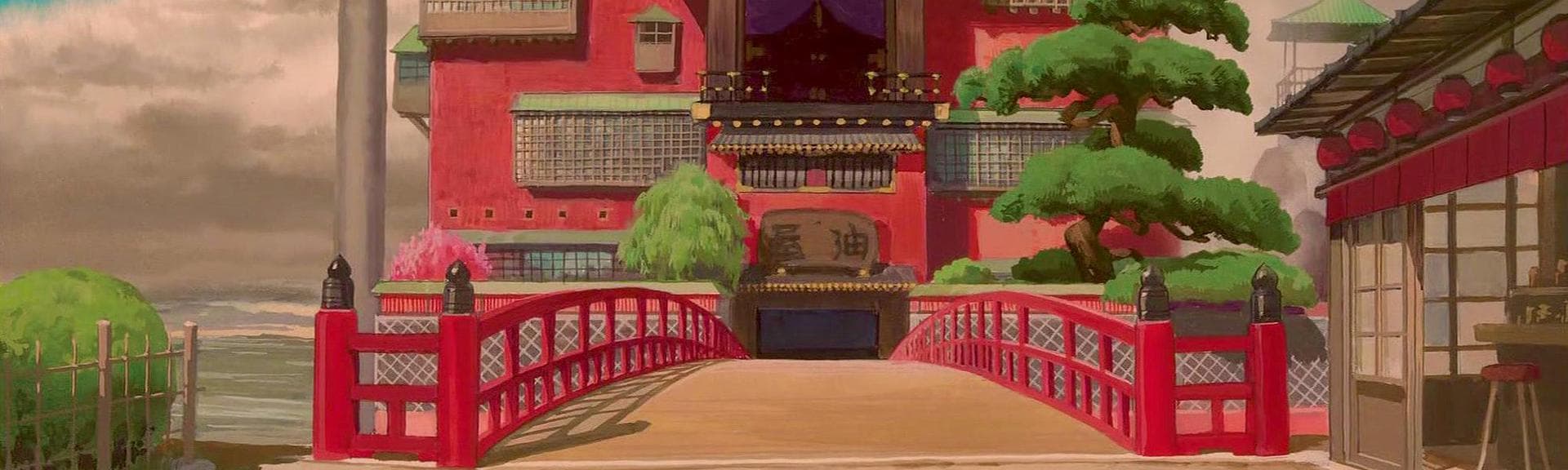
 First, borrowing symbols and characters from Japanese myth allows Miyazaki to further enrich the world he creates in Spirited Away, meaning it has more depth than you can expect from a world created in a two-hour film. The presence of creatures and buildings with deep roots intrigues you, and makes you wonder what is the full scale of the world Chihiro wanders into.
Secondly, Miyazaki intends to show the Japanese heritage in its full glory – beautiful, awe-inspiring, full of spirituality and many more things. Additionally, it allows him to make use of motifs found in Japanese folklore as building bricks for his own narrative. In the next section, I will explain this in more detail.
 The film's title in Japanese can be translated to "Sen and Chihiro hidden by the Gods". The name and the plot are quite straightforward references to this motif. But before we can understand why Miyazaki makes this reference, we should look into more hints to his message presented in the movie.
Chihiro's parents, despite being marginal characters, are an important hint. In the very first minutes of the film, we can see they drive a German Audi car, which is a bit ironic considering Japan is a major car manufacturer.
 Additionally, they do not seem to care much about how their surroundings gradually become more and more prominently Japanese. They rudely begin to feast on food even though the stall owner is not present, the dad excusing this behavior by pridefully placing faith in his credit card, until they eventually become pigs – a symbol of capitalism in the West.
The first impression Chihiro's parents make is not one you would expect from representatives of Japanese culture. If anything, their behavior is more similar to that of disrespectful Western tourists. Is them turning into pigs a punishment for it? Perhaps, but it is too early to deduce from this that Miyazaki dislikes Western culture. After all, in other films he has taken inspiration from the West, and said scenes are just the very beginning of Spirited Away.
Going a little backwards, an important thing to note about the stories of kids being spirited away is that the children rarely, if at all, ever get back unharmed. In a sense, Chihiro's journey has an un-Japanese ending – she does return safely. So, it's not as if Miyazaki is telling the Japanese viewers to fully return to their roots. But at the same time Miyazaki doesn't intend the Japanese audience to forfeit them.
Haku's clothes resemble those of a Shinto priest, he is trained in magic that appears in Japanese myth and is actually a river spirit. He is a very Japanese character in the traditional aspect.
 Haku is a major positive force in Chihiro's journey, and he helps her not only survive but also grow as a person. Through Haku's kindness, Miyazaki presents Japanese heritage as something positive that gives Japan its spirit and meaning. Despite that, it is still in Haku's intentions that Chihiro safely returns home.
 So what is Miyazaki's belief of how Japanese culture should be? A possible answer can be found in the ending. Before leaving, Haku tells Chihiro not to look back until she returns to her world. And after she finally crosses the border between the worlds, Chihiro does look back into the tunnel, for a few long seconds, thinking about what she has gone through and what it means for her, until her parents call her. One interpretation to this is that Miyazaki believes modern Japanese culture should respect its roots and heritage and appreciate the spiritual value it brings, but at the same time accept changes and progress that come from the West and modern times.

The employees of the bathhouse, including Yubaba herself, are motivated by money. Even actually enslaved by it.
In many cultures, names are strongly connected to a person's identity. Consequently, when Yubaba steals a few letters from Chihiro's name after signing the work contract, in a way she steals Chihiro herself. It is said in the film that knowing one's real name is necessary to return home, so if Chihiro had really forgotten her name and thought of herself as Sen for the rest of her life, she might have never gotten back, forever waiting for her next payslip.
 When No-Face enters the bathhouse, the employees frantically fulfill every request he makes after finding out he can freely produce gold – and for this reason alone. All this without first questioning his suspicious and sudden appearance – until it's too late and some of them are literally devoured. Furthermore, shortly after No-Face leaves the bathhouse, the gold created by him – the one and only thing that has motivated everyone to work so vigorously - turns into ash, making their hard work absolutely meaningless.

No-Face suffers of this – he doesn't have anything to which he feels attached. In attempt to obtain an identity and a sentiment of belonging, he absorbs (metaphorically and literally) his surroundings. No-Face's behavior in the bathhouse reflects the atmosphere prevalent there – he becomes greedy, short-tempered, violent and manipulative. However, after leaving the bathhouse and joining Yubaba's more peaceful sister in a rural setting, he becomes much calmer and perhaps happier. This is another means Miyazaki utilizes to criticize capitalism.
 But No-Face's character also has another message – having no identity is a miserable fate. When Chihiro actually asks him something we all want to ask – where he came from – his fierce demeanor stops for one moment, he crawls into his shell unable to answer her clearly, instead admitting he's extremely lonely.
 This relates to the value Miyazaki sees in Japanese culture – abandoning the heritage may lead to immense loneliness and emotional emptiness.
 In Japanese folklore, young children are said to be closer to the gods, which is one reason there are many stories of kids getting lost in the spirit realm – they are believed to be naturally drawn to it. It appears that Chihiro is no exception – even before going through the tunnel she feels she has arrived at a strange place.
Chihiro is able to understand things that other characters cannot, in the mythical sense and by simply being young. Throughout the film she retains behavior and innocence befitting a ten-years old kid, yet she is definitely not a fool. Free of adult interests, she manages to see the harmful influence of the greediness that drives the bathhouse and finds value in things others regard as undesirable or useless.
She keeps trusting Haku when others tell her she should not; She welcomes No-Face into the bathhouse despite his odd behavior; She holds onto the vomit-inducing food the river spirit gifts her; She doesn't lose sight of her goals no matter how much gold No-Face offers her.
 These and more of Chihiro's actions likely stem from childish mind and innocence, and she is awarded greatly for them. Without having done them, it is highly possible she may have not managed to return home and save her parents.
Through Chihiro's behavior and bravery, Miyazaki makes us ponder if we actually get wiser as we are absorbed deeper into adulthood and tells us not to take the insights of children lightly. The characters in the film seem to have learned that, and by the end of the film they root for Chihiro, despite finding her repulsive at the beginning.

The animation that pays attention to every tiny detail, Joe Hisaishi's impressive music that accurately amplifies the emotions and tone of every scene, and Miyazaki's experience in directing and storytelling go a long to enhance the visual, auditory, intellectual and epic experience that is Spirited Away. Some may think my praises are exaggerated, but in light of what I've covered in this review, I adhere to my reasons to consider Spirited Away as a true masterpiece.
I hope this review has contributed to your enjoyment of the film and inspired you to explore it more in depth or re-watch it. If you'd like to comment on this review or have a discussion with me about Spirited Away, you are more than welcome to reach me as you see fit through Anilist.
28.5 out of 30 users liked this review
