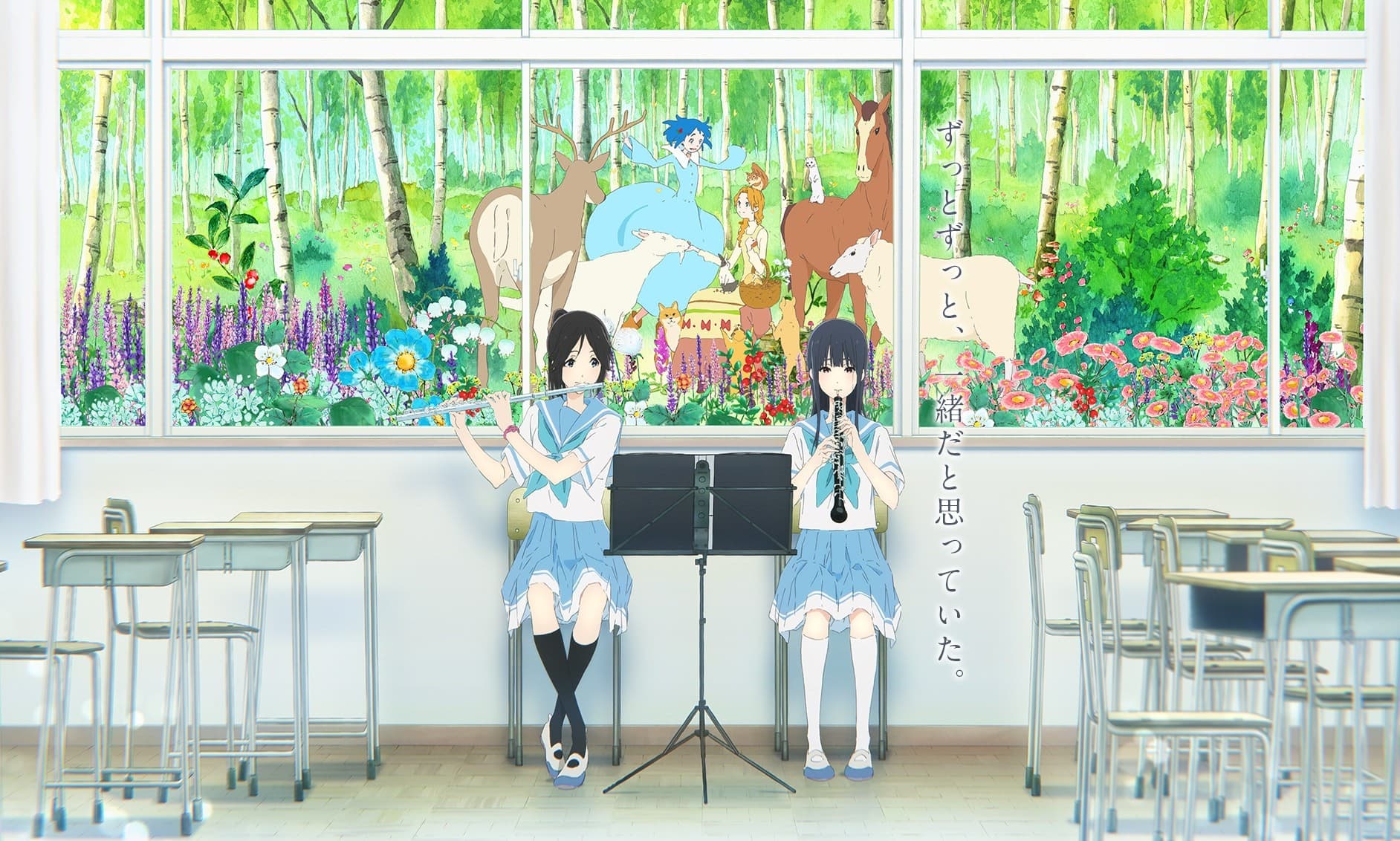

Let's all take a step back and dip ourselves into introspection. Are we alright with our relationships? Is it helping us become a better person, are we helping them become one? What have we gained in keeping it as it is, what have we neglected? Can we be ourselves and bloom in each other's gardens or are we wilting in parasitic symbiosis?

Liz and the Blue Bird zooms into the sensitive grounds of codependence with an aim to break away from it through self-discovery and growth in the fulfillment of the act of letting go, presented under phenomenal direction by Naoko Yamada conveying artistically a story of two close adolescent girl friends oblivious to their potentials and subconsciously repressing them on account of the other as they journey on through the mundane colors of everyday high school life gaining cumulative realizations ultimately gathered together for the decision to separate ways as two joint entities.
A lot has been said about Yamada and team's technical expertise, yet I would like to follow suit nonetheless as it is a topic most appropriate to mention. For one, it can be seen in the slight shifts of facial and bodily expressions layering the interactive depths of casual and emotive activities. Although the touches can be described as subtle, the refined details of character interactions and motion picture elements are actually rather conspicuous especially to the interested and attentive viewer (I mean, as with most story pieces). Precisely because it isn't that straining to notice that makes Liz and the Blue Bird all the more connecting, unlike some fictional pieces which make us double think of a high possibility that these details engage us in apophenia and not meaningful ruminations.
Concrete examples are found from the beginning. The environment is calm, the music a soft set of chimes, the camera gives a second for the gate's bars, footsteps stand out from the silence of the school as introverted Yoroizuka Mizore enters the scene. Nature is motionless as another unknown person walks past Mizore. Now, all of this is directly contrasted when our resident Miss Popular Extrovert Kasaki Nozomi presences and the trees start rustling and a bright yellow plant sways with the wind and the music kicks up in liveliness mirroring Mizore's inner state. Everything is intentional: the distance between the cast, the focusing camera, the timing of the soundtrack's play--all are evidently executed with a delicate touch.
The challenge from others I've mostly observed, and have experienced myself on the first watch, is ascribing meaning to these decisions. It is not only until the climax near the end where the build up gushes into a stream of pathos, yet it isn't even that explosive with cannonball barrage of screams and tears flying everywhere to begin with. That isn't what Liz needed to be. I found in my rewatch that the atmospheric tone--resembling feathers soft and faint with yellow and blue hues on lighter tints--taking things slowly and minimalistically tells us, the viewers, to put ourselves in the main duo's shoes, and to observe their relationship where words usually fail to be spoken through the cues of the frames and the soundtrack laid out by the team. It is rather identical to the complexities of human relationships, especially one between two troubled, opposite individuals yet too blinded to see their worth. When it does come so much more overt such as in the absolutely phenomenal performance of Liz and the Blue Bird's third movement, it delivers perfectly, where everything needed to be said can and has been said through this powerful mode of communication in the form of instrumental music. Right afterwards, the film carries its momentum in upfront confrontation, now with the release of repressed words.
"So pretty. Like a lake mirroring the blue sky."

Liz and the Blue Bird heavily relies on figurative comparisons in bringing the main protagonists to life as a technique to fill in the lack of dialogues between Mizore and Nozomi, appropriate in the reflection, in the parallelizing, of the characters to each other and to the the fiction inside the storybook the movie's title comes from, all in relation to the setting of the school and the plotline of the future chasing the students' shadows. What I love about this approach is its thematic relevance. Through the presentation of x character against AND as y character the author successfully explores in wide breadth and profound depth the story's intent. Couple this with contextual cues, then what simple messages that have been conveyed will turn into, at the very least, subconscious and natural amazement of the film's coherence what with its smooth meshing of concrete and abstract narrative elements. And yet, this influence is not only limited to our standpoint as viewers, as the plot itself shapes how the characters are feeling in a more sensitive level. I mean of course this is the same with other pieces of art, but Liz and the Blue Bird executes this in a more elegant and clarified way. It's like the characters are a life of their own, and watching this film is an invasion of privacy. In the same way, observing it casts us into the characters souls and live as them in all its sensitivity. The clarity of the sound heard in footsteps and even from the opening of the zippers of bags attests to the intimacy, putting us in the living characters' shoes.
To illustrate (well, literally), the association of Mizore and Nozomi with Liz and the Blue Bird, in the viewer's perspective, gives us clues on what the protagonists represent. Initially, the judgment is fixed: the ordinary and lonesome Liz is the fictional counterpart of the shy and reserved Mizore while the Blue Bird who roams freely with energy from place to place with her exceptional capabilities is Nozomi. Additionally, there was a moment, at 47:36, where Nozomi opens the window and then we softly hear birds chirping in the background.

And so the film reinforces the idea that Liz = Mizore, Blue Bird = Nozomi. This was not really debatable as the movie exacerbates this conclusion early into the film especially as we see it through the eyes of Mizore. Although, even from the start, we see Nozomi giving Mizore a blue-colored petal, indicating her perspective, but that was easily overpowered by Mizore's lens. And it's very easy to be drawn into a depressed character than peering through the extrovert's actions, right? One is overt and relatable to the majority, while the other, is not really someone authors focus much on.
There is this notion that depressed = deeper, a more conflicted character is more profound; joyful = shallow, the sociable, especially when compared with the introvert, is someone less interesting, one with less issues. But Liz and the Blue Bird takes care of that unnecessary stigma and so much more assumptions regarding relationships in general. It tells us that this thought process is mistaken in the fictional sphere and in the real world. How does it convey this to us? That is by showing both Mizore and Nozomi, our film protagonists, that they are mistaken as well, with the twist that Nozomi can also be Liz and Mizore can also be the Blue Bird.
What we learn is essentially what the characters have learned on the fly, too. That's what I meant by the cast having a life of its own, like us. It's such a cool thing to do, the author talking simultaneously to the viewers and the characters in a similar degree. This allows for a more striking impression to the already-immersed observer where they can experience a more chasmic connection to this piece of art. This multifaceted, multidimensional storytelling intertwining the viewer, the characters, and the author and their team together makes for an experience consciously enlightening.
Retracing back to the topic of comparisons as this wields significance in the nature of human relationships, allow me to enumerate another scenario where Yamada's stylistic techniques fine as gossamer shine on the screen.
How do comparisons come to be? Through the power of descriptions preceding and succeeding the subject/s to be compared to, and take note that comparison is not strictly contrast. This is not limited to adjectives--nouns are an available source to be extracted for a more poetic understanding as well. Comparison and description are also not only bounded to the literary mode of words. Visual appearance and figurative imagery, symbolism, and even auditory variations can be tools for the said goal. Liz and the Blue Bird combines all of this with an adjective as the glue holding the main idea together: "disjoint."

The term "disjoint" denotes separation and disconnection. In mathematics, disjoint sets are two or more sets that have no elements in common. The mentioned word reflects the situation between Nozomi and Mizore as close friends yet separated entities all the same in the misconceptions brought about by their weaknesses and our fundamental complexities as human beings. There is an air of tension and sort of awkwardness that saunters throughout since the beginning and incrementally thickens around Mizore and Nozomi because of codependence and insecurities. Mizore, gloomy, pushes people away for she only cares about Nozomi's attention. Specific moments emphasize her head's position protruding like a bird's beak to Mizore's wiggling ponytail bait. The latter is as nonchalant with a composed gait as ever, but her little changes in bodily expression reveal something more to her reactions. The physical distance between these two as band members belonging in different sections only prolongs the unspoken unease and only furthers their emotional distance.

In another example, where a shot focuses on Mizore's still-taken-apart oboe, "disjoint" can also mean that there is a mess up within the characters. Since their respective musical instruments represent themselves, as per Taki-sensei's direct implication of such, this interpretation might not be too unreasonable to think. Nozomi's uncertain hold can be seen in her unsure exterior conduct.
These subtle details are proofs that their internal conflicts are affecting their relationships, and that this is something they need to tackle head on. What triggers their solutions is through reflection of the art that is reflecting their situations, and the expression through art. In contemplating on art that which resembles life, one can gain the wisdom essential to move forward.

Now with the critical shenanigans out of the way, I can FINALLY talk passionately about the poetic resplendence Liz and the Blue Bird bears and the sentimental link I have with it.
I strongly believe that this movie is one of the most accurate depictions of codependency in human relationships and what it means to grow from it: to jointly take flight by letting each other go. Such a heartwarming yet bittersweet theme embodies a pristine spring breeze flying the winged skyborn spirits up in the air where they originally belonged, leaving behind their shackles no matter how dear. But before seeing the sights from the view of the heavens one needs to cultivate fertile ground for the caged bird to gather enough strength to break free from the bars they've both received from others and given to themselves.
Such is the journey for Mizore and Nozomi both. They are lonely beings who had a chance of seeing the lovely side of the world that can only be viewed through the lens of another person, thus making it hard to see each other off, with the proximity entangling the two fruther through the course of time. Mizore took so close to her heart Nozomi's outreached hand. And like a savior to the damned, she saw in her the light that she can never attain as a lowly individual. Nozomi admired Mizore's musical talent so piercing to the soul. I can sense inferiority that stems from the experience akin to raising a child only for them to shine brighter than you in no time. Not having been scouted by Niiyama-sensei dealt a large blow to her self-esteem. These brew conflicting emotions as the two truly care for each other deeply, echoed by the storybook counterpart.
But maybe that's the issue: their closeness only intensifies stagnancy and the toxic elements present in their relationship. Their friendship, rather than being a mutually beneficial one, became a ground-sucking swamp that perpetuates the conflict were it not for their assigned back-and-forth in the band giving them a chance to express who they are, the journey allowing the interference of outside parties.

It's hard to recognize problems by yourself, difficult to find solutions on your own. This is especially true when you don't uphold honesty in the relationship you have with yourself and with others, because deception and avoidance only pushes acceptance and action away. This endless running towards comatose sustained by air particles of torpidity due to the fear of enacting upon major decisions meant to move us towards the next stages of our lives was painful to see from our characters, especially because it hit too close to home.
But I can't really blame Nozomi and Mizore for being stuck, they're sensitive youths who have yet to know and understand their own potentials; they passed a blank sheet when asked about their future career plans. So much more fog enshrouds us from other people, making human relationships all that more difficult to handle. It is an Olympic sport to know others, much more to get to know them deeply. A great deal is hidden from what we see; the inconspicuous that are too subtle for our self-centered eyes reveal more about someone than their outward expressions and actions at times. Thus Yamada's emphasis on subtlety by making use of Mizore and Nozomi as artistic subjects to convey to the viewers a message to try to understand people more, especially ourselves, for if we are yet to fathom our true identities, our actions towards others will most likely be skewed consequently.
And if we're stuck on what to do, try to ask others for some nugget of wisdom. Mizore's huge mistake was closing herself off from other potential friends and only finding the world in Nozomi's company. Thankfully, there were people like Ririka who genuinely did their best to be closer to her, Reina who had given her observations, and Niiyama-sensei to spark realizations of her true skills. Nozomi, too, was guilty of hiding under her shell. Bar her slight shifts in bodily behavior, she is quite enigmatic for most of the film. Huge thanks should be offered to Yuuko and Natsuki for pushing her to heal her wounded pride by not attending the music school Mizore will study in, rather, start searching herself slowly but surely. And we cannot neglect Liz and the Blue Bird, the storybook and music, for giving the two a chance to unearth their hidden potentials.
So now we understand, Mizore and Nozomi have their own fair share of internal struggles. Being codependent is like grabbing the hand of someone you love and suffocating yourself with it, okay with it despite the pain as long as they are close enough to hold you with their affection for you're still a chick who do not know how to stand on your own, even when you already have the resources and capabilities to work on. In the transition to university, feeling lost in the future with no skillset that lasts until death to speak of is stupefying to say the least. To peak in high school and regress right after is a terrifying thought to deal with. This will only be exacerbated when a promising soul meant for the future is twinkling right beside you; it makes one feel frustrated because as you compare yourself to them, although you're faring arguably better than them right now, you can already feel the tables turning once you both leave the nest.
Both are charged with claustrophobia as songbirds stuck in a cage of feathers. The spider web becomes more sticky the moment you compare yourself to others pessimistically. The sensitivity in this story that is relevant not only to the youth, but to people of all ages, resounds strongly.

"Music sometimes has aspects that cannot be fully expressed in a score. Please read between the lines of the sheet music. And sing your heart out."

Liz and the Blue Bird ensemble music is one of the greatest invoker of tears to me personally. Its orchestration is masterful in a grand performance where Mizore finally declared her status as a Blue Bird as she unleashes her repressed potential in an erupting gale from the burst of her wings, inevitably Nozomi loaded with guilt in taking in just how much Mizore held back for her, and resignation as she accepts with salted notes her lag behind her beloved friend, flute blowing the wind skywards for her Blue Bird to fly higher. There was joy, sorrow, hope, and melancholy in the release of emotions through the sound of music. Although wordless, the oboe and flute spoke for their users in a language that transcends letters which can only be amplified by genuine emotions. Mizore's forward confidence, her assertiveness that echoed from the start felt liberating. Nozomi breaking down in the middle of the performance, her disarrayed state reflected through her abrupt halts and the volume of her flute in letting go of Mizore was like a sorrowful dirge, and it was emotionally stirring. The performance was a release of years-long struggles, a triumphant expression that comes from the acceptance of one's strengths and weaknesses. It's wondrous to see the two sides of the story.
As if that celestial concert was not enough, Liz and the Blue Bird provided us with the blessing of direct confrontation, where the two girls voiced out their frustrations and love to one another. The twist where both were Liz and the Blue Bird was executed profoundly again in these sequences. Nozomi thinks she's an ordinary girl, but Mizore asserts otherwise. It goes to show how important it is to appreciate ourselves for really, we are worthy of self-love. We are worthy of freedom from the self-cuffed shackles of inferiority.
The musical confession unlocked the padlocks they've set by themselves, the I Love You Hug set them free from each other. Thus came the arrival of Blue Birds who were once disjointed in togetherness now jointly taking flight in separation.

And this is not all to say that their relationship was entirely parasitic. Mizore was once homeless until Nozomi gave her solace and opportunities from the concert club. Her dedication to the oboe reflected her love for Nozomi, and now it's become her mightiest weapon in her battle with the future. It was thanks to Nozomi that Mizore learned what love is; there just needed to be regulations bound in the affection for it not to veer away from invigoration and into toxicity like it did. Nozomi gained a plethora of lessons from Mizore as well, especially regarding how she should view her own future self to survive in the looming shadows of tomorrow. Mizore's bombardment of fondness assured Nozomi of the amazing qualities she possess as a person that she can hone or at least use to discover something worthwhile by the road. To both of them, the future is not yet hopeless, and that is because they now begin to understand what it is they need to. The first thing on the agenda is to provide a fantastic Liz and the Blue Bird performance. The next, attending separate universities.
There is a need to let go of the physical distance that enveloped them in Kitauji High School. This little school is but a miniscule portion of the possible sights that they can, rather, will inevitably see. The protagonists are different people leading different lives, and perhaps having some sort of break for their next saga would prove beneficial in the long run.
Especially for students, these things hit extra hard. Leaving our friends to live a highly different life, although needed, is something that is hard to accept. But reality is harsh--there is a need to let go of certain things in order to mature. Sometimes, that certain thing might be the best and only friend we have. Maybe they aren't even the only friend we have, we were just too tunnel visioned by the circumstances trapping our everyday school lives in a vortex of anxieties. Other times, that certain thing can be someone we hold so dear, someone that drives us to persevere. But maybe, we're persevering for something that was never meant to be ours. Talking to people can truly clear the doubts we have preying on us everyday.
And there's no way to sugarcoat it: if the situation strongly requires it, let go and take flight. At least, to me, it did wonders, after too many years of mulling over it in grave fear. But now I know how it feels to fly like a complete person.

Some needless personal thoughts
Spoiler, click to viewclick to hide
It was funny how the few anime movies we watched together included Liz and the Blue Bird. Mizore and Nozomi both relate each other with both the storybook characters, both them and I relate to both Mizore and Nozomi (this has become like a hall of mirrors type of thing haha). It was a year before we let go of one another in mutual understanding due to numerous complex reasons. I distinctly remember the awkwardness that seeped back-and-forth between our mobile devices (we were in a video call) during the climactic scenes. But it's weird. The film impacted me more right now that we're apart. Liz and the Blue Bird gave me an assurance that the decision made was right. And so this Hibike! spin-off turned into a precious memento that safekeeps my memory of some of the most major decisions I made.
Liz and the Blue Bird is a complete package of uplifting practical communications from the heart animated as an aesthetically pleasing story book told in multiple perspectives with morals which gives us wisdom on how we conduct ourselves in our relationships with others and with ourselves, a voice that advises us to be wise with our decisions especially for our assured flight in the long-lasting eternity of the future. It is an experience worthwhile, something I'm grateful of doing another time, alone.
