Suzume
a review by brandotendie
a review by brandotendie
this is Shinkai at his most Ghibli, and i mean that in the best way possible.
from the first five minutes you know that this will be a different Shinkai movie. there's no brooding male protagonists pining over potential/lost loves, barely any Radwimps needledrops, but instead it's brimming with a sense of whimsy and adventure, with Shinkai going full tilt with its fantastical elements. everything from its surface conceit of a girl hopping across Japan in chase of a magical cat to its symphonic and swooning fantasy scoring (the best one in a Shinkai film yet), has very clear and overt Ghibli influence.
but what makes this movie so special is that Shinkai isn't channeling only the great master found in Miyazaki, but also more importantly, the quiet masters of Takahata and Kondo. it really feels like Shinkai is trying to push himself as a filmmaker here, drawing upon influences and wearing them on his sleeve, remixing and implementing elements of past masterpieces to create something wholly unto its own.
in doing so, Shinkai creates a world of magical realism; not quite an isekai like Spirited Away but more of an urban fairy tale a la Whisper of the Heart (which gets a namedrop!) and Kiki's Delivery Service (which gets a needledrop!!).
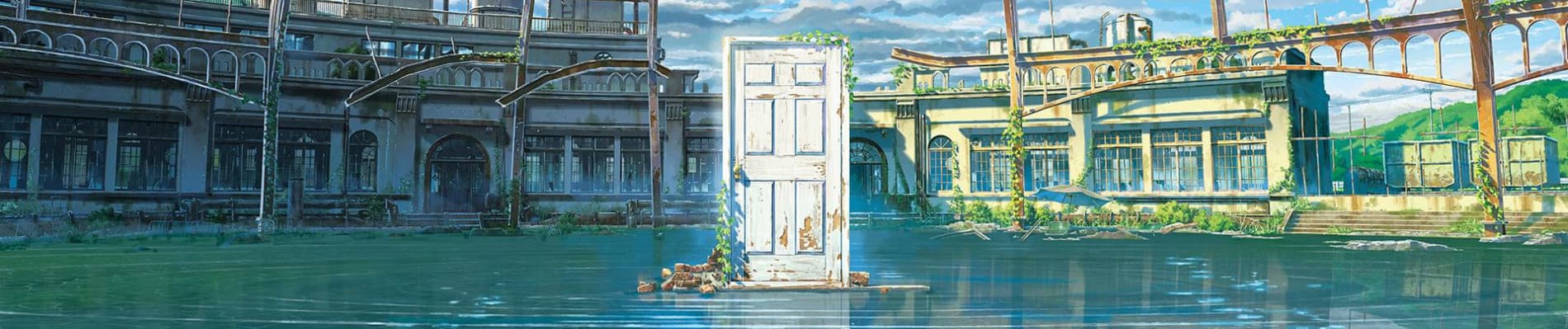
Shinkai's stylistic inclinations shine in this regard, due to how beautifully these worlds of his contrasts the magical and arcane. it never feels like Shinkai is veering AWAY from the style he's cultivated, instead he BUILDS UPON it: the rendered spaces and minutiae of Shinkai's candy-colored hyper realism feel more lived in than ever, not just high definition backgrounds or clips to put in a tiktok compilation, but spaces where people have lived, where every crack and layer of rust isn't just there to look aesthetic but to evoke entire lives, whispers of past occupants and users bound to the inanimate.
it's even more impressive then, that not only is Shinkai able to weave his signature romantic tropes with the more brisk pacing and fantasy elements of a Ghibli location-trotting adventure, he's also able to seamlessly ground the film by incorporating central themes of grief and collective trauma.
Shinkai is not one for subtext, this is clear in his monster hit Your Name and probably why a lot of people hate that movie lol. so of course in Suzume he states his main goal of the film outright: this is a movie about 3/11.
from the beginning, you could already tell where things are going, but it was still flooring to watch how Shinkai so tastefully highlights the effect this event had on Japan and how its youth is still haunted by it though they would prefer to just forget about it. Your Name resonated so much with Japanese audiences not only because of its core romance, but because it was an escapist fantasy that evoked 3/11 imagery, a saccharine "what if love erased disaster? what if love can make us all forget?". Suzume is a rejection of that. instead it asks Japan to NEVER forget, and instead to remember TOGETHER, using that collective trauma as a way to connect with others to heal, but to also forge a new future.
it could have been so easy for a film dealing with such heavy subject matter to come off as hokey, as hamfisted. the way Suzume addresses such things explicitly and still manages to feel like it's not forcing anything is really masterful work. Shinkai accomplishes this by focusing on the BONDS made through collective trauma instead of the trauma itself; it felt like a healing film. i can't imagine how it'd feel for the Japanese audiences.
aside from its themes, Shinkai succeeds in translating that catharsis on a universal level through the way he structures his narrative, but more specifically, how he focuses on the characters.
one of the main problems i have with Shinkai even though i love his work is that a lot of the time his female characters just don't have agency or depth. they're always damsels (even if they have superpowers) and they always feel like some sort of goal to be attained by the titular protagonist. this translates well when it comes to his films about longing and male ideation of women, but it gets trite and exhausting when its done straight-faced over and over.
flipping the dynamic here to have a female lead was the best decision he could have possibly made. i love the how much focus was put into the feminine perspective in this entire film. the first half is such a comfy road trip movie where you get to meet an ensemble cast of colorful characters (predominantly female) across Japan.
that time spent with the plot put on vibe mode breathes so much life into this world, and really brings home the theme of connectivity, of ghosts in our midst, of collective trauma as a cohesive whole made up of millions of remembered fragments of lives past. it's astounding how perfectly Shinkai balances his tendency to linger on beautiful landscapes and rendered backgrounds with the need to give context to them, filling them with a soul that makes them feel more than just eye candy.
Suzume herself is a wonderful protagonist. her empathy and her spunky attitude has you really root for her from the beginning, and her chemistry with the male lead doesn't feel anywhere near as contrived or one-sided as his previous films. sure, the male lead doesn't have much depth or much to do, but it serves to highlight all the other characters we meet along the way, and also serves to give Suzume more screentime to flesh her out.
but yeah i've been a Shinkai defender for the longest but Suzume is what truly feels like a graduation for him as an auteur. the last time i got this feeling was Peele with Nope: all of their influences are crystallized and distilled, all their auteurisms and stylistic flourishes are refined and more potent than ever.
it doesn't try to reinvent the wheel by any means, but when you succeed Gen Z spiritual successor to Whisper of the Heart then you're nothing short of a master director in my eyes.
59 out of 68 users liked this review
