I can already tell this review will not be appreciated by many so I'm going to try to explain in as much detail as possible the reason behind this (relatively) weak score.
Shinkai is not someone I've ever felt strong emotions about, be they negative or positive. In fact, for all I don't understand why he's so appreciated, I still recognize his movies have some level of merit and a certain style to them, on top of being very beautiful. Which is why I'm never going in his movies with particular expectations: I just wait and see.
To me, Suzume no Tojimari felt different from what I know of the dude. Samey but different. By choosing to focus on action and drama first and relegating his characters to the background, Shinkai tries to call upon his inner Miyazaki to emulate the fantastic and whimsical Ghibli movies, and you cannot miss it: using recurring plot points as allegories for real-life aspects that may affect us all (but especially the Japanese), displaying a strong sense of adventure and side-characters hopping left and right and at times bending over backwards to help the protagonist, weaving supernatural plot points throughout his movie, it definitely felt like Shinkai was attempting something else, which is very commendable because not every artist is able to attempt a different take and keep their personal touch, which is the case here.
Let's skip the fluff and whatever compliment one could make about the visuals (it's a Shinkai movie, what do you expect?) and immediately start by mentioning the best parts of the work: the message. It's a particularly strong message, not exactly about grief this time around, but about hope, humility, will to survive, relationships, gratitude, love, acknowledgement of our weakness, and so on. We are transient beings, and we are nothing compared to what our planet can do, which is why we must respect it and fear it. Continuity is one of the greatest illusions of life, and we must stay humble and acknowledge that tomorrow is a hope, never a promise. As an illustration of that, the stunning imagery of the normal, buzzing metropolitan city where people just live their everyday lives, unknowing of the invisible threat of a terrible disaster about to strike, was certainly THE highlight of this movie and was a grim reminder that it may all go to hell at a moment's notice.
This movie makes it seem like the Worm is the main threat, but what REALLY is the threat is the byproduct of the Worm: the earthquake. In that regards, the movie will probably resonate more with a Japanese audience as they are very familiar with those natural phenomena, but what you need to keep in mind is that the earthquake could have been replaced by basically any other disaster: the most important idea is that the Worm is an allegory for a force that humans must fear and which could strike mercilessly at any moment, which is a very Miyazaki-esque concept.
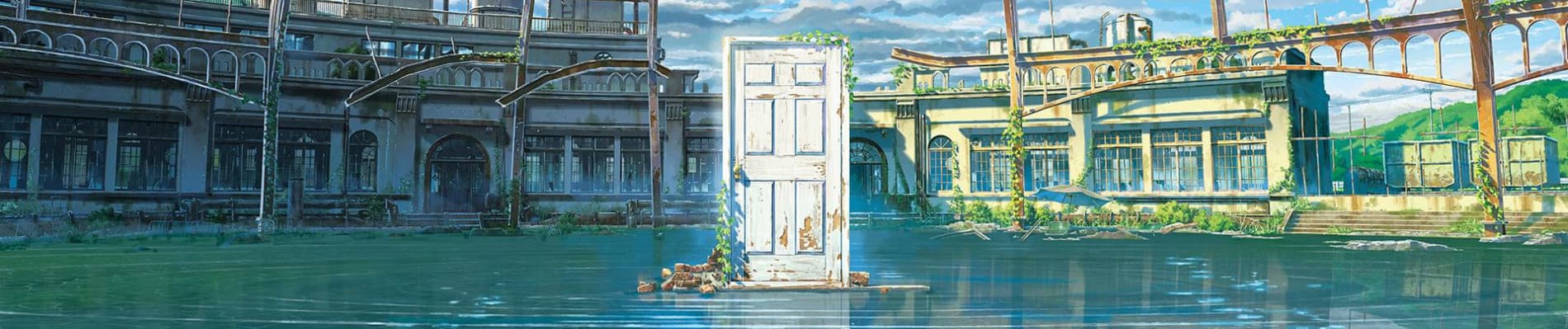
Opposing the aspect of fear and humbleness, there's the idea of love and strength. Bonds create strength, strength allows people to overcome hardships, hardships favor the creation of bonds. It's a virtuous circle that lets the group grow stronger in the face of seemingly overwhelming odds and not give in to despair. By calling upon the remnants of those bonds between people in those abandoned places and asking animistic gods to grant them power, our protagonists manage to delay the catastrophe. And the allegory for that bond is the door. The door is what people open and cross all the time, many times a day. It's a symbol not of division here, but of habit, a link between people and their next destination, where more people await them. It's a symbol of wonder and adventure too, as opening the door means breaking the safety of the room, letting the unknown flow into it, but it's also a symbol of repeating those same gestures that effectively make our world safer. To show this, there's a clear emphasis on using keys during the whole movie, even beyond the tool of the Closer, but with such a simple act as Suzume opening/closing her bike lock.
If the themes of the movie are particularly powerful and intemporal, the same cannot be said of the execution however, which is bringing me to my first critic: most of the rest of the movie was sadly of questionable quality, be it the side characters, Suzume's grief about her dead mother, or the romance side plot, it all felt rushed or badly touched upon. In fact, I would have given this movie 30 more minutes in order to develop all this properly to avoid the “last minute” rush that was displayed at the end, especially with the montage of doors being opened and closed, and hands touching. This was very hamfisted and it felt like the director saying “wait, you STILL didn't get the message? Lemme spell it for you.” I am also conflicted about the side characters in this story, who somehow understand things without getting so much as a single clue initially, and do their best to help the protagonist despite not knowing what's at hand. Maybe this is just my perception as a Westerner living in a Western society, where people aren't exactly ready to do several hundreds of kilometers on a whim to help a total stranger, but there's such a thing as plot convenience. And regarding Daijin, I'm full of incomprehension on that part: did he really think that by getting rid of the man that Suzume fell in love with and would go above and beyond for, he'd get Suzume to like him? Now that's hard to understand.
I was thinking about complaining about the romance, which is terribly unneeded here although it does play into the “relationships” theme of the movie, but instead, in order to end this already long review, I'll touch upon what is, in my view, the weakest part of the entire movie: the script. If it was nothing particularly offensive at first, halfway through the movie, the characters just start saying things for the sake of saying things, which are often not interesting nor relevant, and try needlessly to lighten the mood despite the movie heading towards its serious climax. And once the story's dramatic part becomes engaged, it becomes a chain of cries and shouts which really wore thin. By the end of the movie, I swear I had enough of hearing “OKAA-SAAAN!” or “SOUTA-SAAAN!” for the rest of my life. Talk about hamfisted... The rushed aspects of the movie which I mentioned earlier, also don't help as it prevented me from emphasizing with the main character, which in turn made the script even harder to swallow when the movie went full circle.
As a conclusion, I'd say that Suzume is wasted potential in my view. It has an amazing message with very apt metaphors and allegories about life, about relationships, about humility, but the execution was lackluster and sometimes rushed. If you liked it, more power to you, I can't blame you. As a matter of fact, I wouldn't call this a bad movie at all: it's beautiful, it has a good musical score, the thematics are amazing, and it does have a certain feeling of adventure, hence the rating, but had the plot been trimmed of its load of side characters and had the script been reworked a bit, I'm sure it could have been so much better.
40.5 out of 60 users liked this review
