It can be abundantly difficult detailing just why you love a series as deeply as you do, enough to afford it the highest score possible and place it on the esteemed list of your favourites. Today, I find myself crossing that bridge with Barakamon: the beautifully wholesome manga illustrated by the genius Yoshino Satsuki and adapted into anime form by the immensely talented Kinema Citrus whose produced series like Made in Abyss, Is the Order a Rabbit?, and Rising of the Shield Hero in their relatively young age in comparison to industry giants like Kyoto Animation and Toei Animation.
They were only founded in 2008, making about them 15-years-old. The studio’s practically a baby in comparison to KyoAni’s 37 years and Toei's 75 years of existence.
And yet, they basically managed to assemble the Avengers when bringing Satsuki-sensei’s Barakamon to life, bringing aboard big names like Tachibana Masaki, Majiro and Kawai Kenji who’s been a part of wildly successful series like Attack on Titan, Fullmetal Alchemist 2003/Brotherhood, Mob Psycho 100 and Sword Art Online 2. They were giving it their all to afford Barakamon the best possible chance of succeeding and I’m so happy they did.
The visuals were warm, bathed in a golden sheen that felt like art directors Katou Hiroshi and Hoki Izumi were snuggly wrapping a blanket around you and pouring you a cup of hot chocolate before painting you a cosy masterpiece to get lost in. A feeling of warmth courses through every bit of art and animation, infectiously spreading through the rest of the series to create a world so pure it feels magical.
The premise: A 23-year-old man-child strikes an old man harshly critiquing his calligraphy, citing it as mechanical and fixed; textbook in nature with no soul. This leads him to be banished by his father, sending him on a soul-searching journey to a countryside island inhabited by warm-hearted people. The island’s warmth is present immediately when Handa, our 23-year-old man-child banished to the island, is given a lift on a cheerful elder’s tractor, fortunately, too, considering the bus only runs once a day in the country. Upon arriving at his home, he’s greeted by the village chief who gives him a tour of his new home, which already looks like it’s been used by people playing cards. He asks if anyone’s used it and the chief can only pale as two of the three “squatters” run-off behind them, telling him, “Nope, not at all.”
During the tour, he finds the last one hidden beneath the sink; a rambunctious little girl by the name of Naru. No matter how many times Handa comedically hauls Naru out and double locks his door, she always finds a way back in, in a Looney Tunes-like fashion. Handa even gave up trying to keep her out and lets her see his work. This decision ultimately ends up going against him when Naru, sincerely praising his calligraphy, says it’s just like the textbooks at school, not too dissimilar to the director’s critique.
Pride wounded, he scrunches up the piece of paper and harshly dashes it at her before storming off. Handa can initially appear as a bit unlikeable, at least at first but when you put yourself in his shoes, you understand he’s just a relatably flawed character. I enjoy writing stories from time to time and if someone were to critique them harshly, I might take it the wrong way, too, even if the feedback is constructive in nature like the director’s was to Handa’s calligraphy.
After parting from the cinnamon roll, Handa is given a moment of introspection and he mentally beats himself up over how he reacted to her honest words. For all Handa’s flaws, which he had a lot of them, he can at least self-reflect on what he did wrong even when his pride threatens to get in the way of that. He even feels a little guilty when Naru tracks him down to apologise. She didn’t know what she said to make him so upset but she could tell it did and for that, she was very sorry. It was a massive step toward forgiving himself and apologizing to the director for lashing at him.
After all, this little 7-year-old girl could be the bigger person to smooth things over between them then surely he – as a 23-year-old – could swallow his pride and owe up to his mistake.
What follows is an oddly human moment between the pair, from pulling each other into the water, to watching the sunset, culminating in the villagers all coming to Handa’s house to help him unpack and settle in a touching act of kindness. People need other people is the message I believe Satsuki-sensei wants to convey with Barakamon and through Handa, a once solitary young man, she’s most certainly accomplishing that.
The characters:
Seishuu Handa – A fantastically flawed character who’s a by-product of his own environment. All but sealed away from the frivolous things in life, he was never allowed to just be a normal, happy kid, spending time goofing off with friends at the arcade and enjoying an evening at a festival. His life essentially revolved around calligraphy, restricting him from truly growing up and maturing, and so, understanding this, is it really any coincidence that he wouldn’t know how to take criticism levelled at his work and would instead lash out at an unfit elder past his prime? Punching director Kanchou was an absolutely reprehensible act that can never be condoned, but I think understanding the whys and hows of Handa’s breaking point is essential to better appreciating his rehabilitation on Naru’s home island.
I’m of the belief the choice to make Handa 23 and not 16 or 30 was so Satsuki-sensei could believably depict him as both the sensible adult and the childish man-child with levels of growth to undergo. It would’ve been obnoxious seeing a 30-something young man be this childish yet not really believable for a 16-year-old child to be so wise at certain points. 23 is the perfect middle ground to encapsulate the transition between childhood and adulthood.
With Naru, he’s able to experience a piece of his lost childhood while still putting his foot down and being the sensible adult when she innocently puts herself in danger, and a beautifully unique friendship forms between them. The evolution of Handa's calligraphy exemplifies both his growth and his friendship with others, particularly Naru. Starting off as well polished, but dull, mechanical and fixed before becoming much more expressive the more his bonds grow.
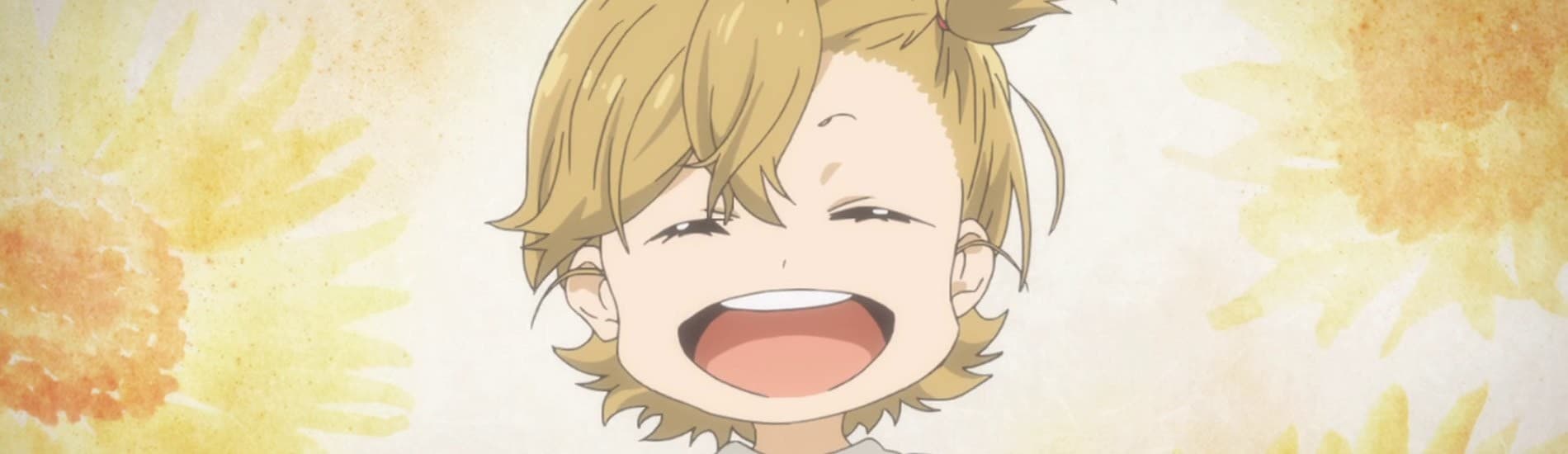
Kotoishi Naru – The precious cinnamon roll that cheerfully bulldozed into Handa’s life whom she and everyone else affectionally refer to as “sensei” due to his profession. Through Naru, Satsuki-sensei’s exquisite character writing is most present. Children in stories usually turn out to be irritating since writers often make the mistake of trying to portray them as “realistic” as possible. I’m of the opinion characters shouldn’t be realistic at all, otherwise you risk ending up with extremely unlikeable annoyances like Max/Masato, Haruno Sakura, and Hanagaki Takemichi, and the latter regularly requires an excessive amount of plot armour and convenience just to survive in his own story as a result of being a “realistic portrayal” of a loser.
Instead, rather than being realistic, characters should aim to be believable. On the surface, those two terms might seem alike so here's an example of what I mean.
An anthropomorphic gorilla would be “believable” in worlds like Dragonball and One Piece while an average guy like Tadano Hitohito would stick out like a sore thumb in any delinquent manga.
Rather than asking yourself, “Does someone like this exist in the real world?” you should be wondering, “Is this character believable in MY world?” Characters, above all else, should either be interesting, multi-dimensional, believable and fun and with Naru, Satsuki-sensei most definitely achieves the latter two.
She’s just a bundle of fun that could put a smile on your face even when you’re in the worst of moods and her chemistry and friendship with Handa make for delightful viewing. Even when Handa gifted her a simple coupon to do anything she wanted it made her year, because to her, just spending time with Handa is a win in itself. Fantastic character.
The cast of side characters are also exquisitely written and added to the wholesome ambience of the show, be it Naru’s fellow cinnamon roll bestie Hina, Naru’s older friends, Yamamura Miwa and Arai Tamako who inappropriately influence her, Naru’s cheerful, good-natured grandpa, Kido Hiroshi and his father, the village chief, they’ve all been immensely likeable and just plain fun to watch. I particularly love the comedically sinister turn the music takes whenever Tamako goes into her mangaka persona, too.
In conclusion: Barakamon is a wonderfully wholesome Iyashikei perfectly fit for lifting your mood. Even if you’re NOT into slice-of-life anime I still highly recommend you give Barakamon a chance. It encapsulates everything that makes Iyashikei so special, depicting a heartwarming setting that feels like it’s healing your very soul.
Final score: 100/100, of course.
An absolute must-watch for everyone.
56 out of 58 users liked this review
