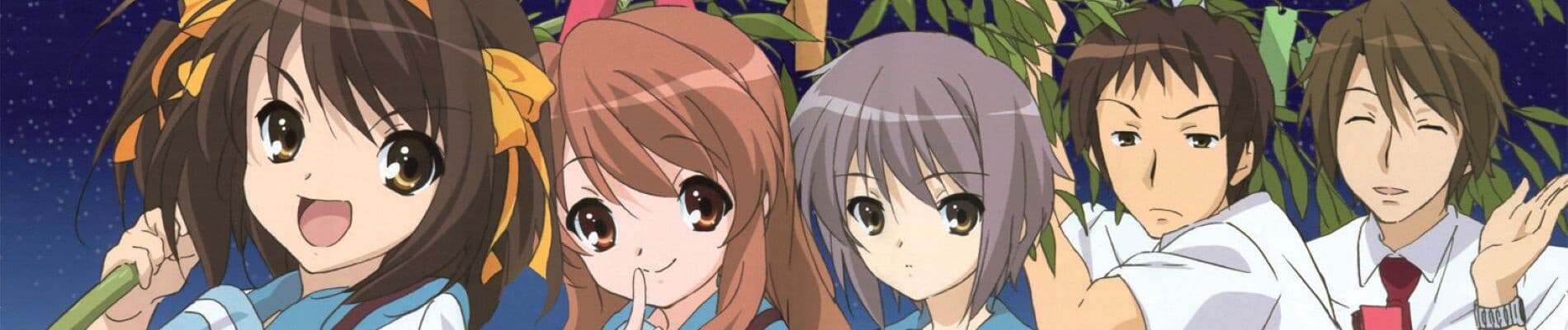
Despite losing its relevancy a while ago, The Melancholy of Haruhi Suzumiya maintains to be an iconic anime series to this day. It was a staple of the anime fandom in the late 00s–a time when anime was way harder to obtain, the most common way of consuming it being through watching Cartoon Network, watching episodes on a dodgy streaming site, or watching episodes in ten-minute slices on YouTube. Well, in America anyway. Despite all of that, the fact that it was released out-of-order, and some episodes having no context at all at the time, Haruhi was still a hit worldwide. Goes to show you that ‘vibes’ is a huge contributing factor to whether or not an anime is a hit.
In order to fill in gaps (and piss off many viewers), Kyoto Animation made a successor to The Melancholy of Haruhi Suzumiya (2006), named…The Melancholy of Haruhi Suzumiya (2009). Only slightly confusing.
The Melancholy of Haruhi Suzumiya (2009) is nearly identical to its predecessor, The Melancholy of Haruhi Suzumiya (2006). The second season of Haruhi shares the same name as the first season, which is understandable when you find out that all of the 2006 edition of Haruhi is contained within the 2009 edition. The fact of the matter is that this isn’t a ‘second season’ and more of a ‘remake’. The confusing part is that KyoAni includes episodes from the original series un-edited. Hell, the first ‘new’ episode doesn’t come to episode eight–the only reason I could tell that it was from the new season is because it had a different opening and ending. It makes it a nightmare to log on sites such as AniList or MyAnimeList. Like, how am I supposed to categorize an episode that I’ve watched if it gets counted twice? Do I just count it twice? Or only when it’s actually an episode from the 2006 edition? Clearly, KyoAni didn’t have pedants like me in mind when it came to the Haruhi series. For shame.
With the 2009 edition containing all of the 2006 edition, it renders watching the first iteration pointless. Not that you’re missing out on much, since the broadcast order in season one was swapped around to make little sense chronologically. The first episode in the season one broadcast order is the twenty-fifth episode chronologically–yes, it’s so far in the future that it requires context from the 2009 edition to make sense. Of course, there are, presumingly, traditionalists that prefer the broadcast order over the chronological order. I personally see no reason to watch The Melancholy of Haruhi Suzumiya in the broadcast order since there’s no payoff. The only reason why the first season was broadcasted in that order was to end on a high note. It serves no purpose beyond that as far as I know. If you want to have the plot make sense, watch in chronological order.

The plot of The Melancholy of Haruhi Suzumiya is pretty simple: Kyon is selected by Haruhi Suzumiya, an energetic, annoying, and eccentric classmate, to be the second member of the SOS Brigade. Haruhi forms this club to research and investigate for proof of the supernatural. In her ideal world, aliens, espers, and time travelers exist. Thankfully for her, they do! It turns out that Haruhi has god-like abilities, and can will all three into existence. Too bad for her that they’re hiding in plain sight, purposely never letting her discover their existence.
All three other three members of the SOS Brigade are important in their own right, since they all were gifted powers by Haruhi. The third member, Yuki Nagato, who’s the sole member of the Literature Club, has her clubroom annexed by Haruhi. That’s fine though, since Nagato is actually an alien sent to keep watch of Haruhi. Nagato is essentially silent, only speaking when spoken to or when she really wants to. This makes dealing with her challenging at times, but she is also more useful and less of a headache to deal with than others. She’s by far the most powerful person within the SOS Brigade, besides Haruhi of course. The fourth member, Mikuru Asahina, is ‘forced’ to join the Brigade like Kyon. Asahina, being the prototypical ‘alluring, cute girl’, is a time traveler from the future that’s ALSO here to observe Haruhi. Her inclusion makes coming to the SOS Brigade Clubroom worthwhile for Kyon, and Haruhi often uses her physique to obtain things she wants. Her fragile demeanor lends to her being frightened easily, something Kyon doesn’t mind if it involves her clinging to him. She’s rarely useful beyond following Haruhi’s outlandish demands. The fifth, and last, member is Itsuki Koizumi, who fits the bill of being a ‘mysterious transfer student’. That alone is good enough for him to be invited to join the Brigade. He accepts, because he’s an esper that’s here to, you guessed it, watch over Haruhi. Unlike Nagato and Asahina, Koizumi acts as a yes-man for Haruhi, which gets really on Kyon’s nerves. His insistence on always going along with Haruhi stems from him wanting to keep her happy, since his job as an esper is easier if she’s in a good mood. It doesn’t help that Koizumi is also a type-A ‘gentleman’, making it hard to find fault with him.
Kyon is the only ‘normal’ person in the SOS Brigade. Unlike Nagato, Asahina, and Koizumi, he doesn’t have any special powers anointed to him by Haruhi. And unlike Haruhi, he doesn’t have god-like powers. Kyon’s inclusion is mere happenstance–only because he was the one to suggest that Haruhi form her own club instead of trying to find the one perfect for her. For whatever reason, she has picked him to be part of the brigade–and since she has the power to rewrite the world to her will, he has to be included, whether he likes it or not.
Haruhi, unaware of her god-like powers, uses them for the silliest of reasons, such as changing the color of pigeons in one area or having specific cherry blossoms bloom out of season. The reason why her power is used for silly reasons is because…well we don’t exactly know why. The theory behind why she has these powers is disputed by the members of the SOS Brigade. Whether she was born with these powers, anointed by god, or given them after performing a ritual is unknown. All we know is that she has them, and that her finding out would only mean bad things.
Part of what makes Haruhi, or at least this iteration of Haruhi, so infamous is the inclusion of the ‘Endless Eight’ arc. For those who don’t know, Endless Eight is an arc where Kyon and friends find themselves stuck in a time loop. This time loop, like most other things that happen in this series, is caused by Haruhi unconsciously. She can stop it at any time, but since she’s unaware of a time loop happening in the first place, she doesn’t. The only reason why Kyon and the rest of the SOS Brigade know about the time loop existing is because of how it interferes with other characters' abilities.
What makes the Endless Eight arc interesting is that it isn’t just eight of the ‘same episode’, as some would want to imply. Yes, each episode goes roughly the same plot-wise, but to say they’re ‘the same’ is being dishonest. None of the episodes reuse animation from the other, making each one of them different, even if they’re the ‘same’.
It goes without saying that Endless Eight is not made to be binged. It was only bearable because I watched only around two episodes a day. Even though the episodes are animated differently, they follow the same pattern. They do gel into one episode after a while. The fact that Nagato has the memory of all of the past time loops is crazy, but not tragic when you consider that the two weeks that repeat are filled with fun activities. It’s not like Nagato is spending those two weeks at school learning the same thing or in solitary confinement. It does get a bit dull–a point which is driven by the fact that we have to sit through this eight times. We get to feel what she felt, because watching the same episode eight times might as well be the same thing as going through the same two-week period fifteen thousand times. For all intents and purposes, Nagato doesn’t seem to mind. You have to keep in mind that this is the same girl that idled in her apartment until it was time to go to school and meet Haruhi. 600 years is nothing compared to having the entire knowledge of the universe, something that would make a mere mortal like you or I freak out and kill ourselves. I don’t think she really cares either way. If she did, she would do something about it.
Endless Eight is the defining Haruhi arc, if not for all the right reasons. It is true that it does start to get old to watch after the fifth or sixth episode. It’s at this point where the episodes start to feel the same, even if they’re technically different due to having new animation and lines. For it to be enjoyable to watch would be defeating the point, but really anything past the third episode until the last episode due to these episodes having no new plot developments past a certain point. I enjoy weird stunts like these, but I can perfectly understand why someone would consider this pointless, if not pretentious. I was very glad to be at the end of the Endless Eight arc, but at the same time, that was the point it was driving home. It's things like this that set Haruhi apart from other anime series. The light novel version of ‘Endless Eight’ is only a short story. It only covers the last instance of the two-week loop. In a way, the story is better that way, since it’s way easier to consume. Not as much when it’s the ninth time you’ve seen it in the last week, but I digress. The difference between animation and light novels though is that it’s easier to justify having eight of the same episode, rather than eight of the same chapters. Both would be controversial, but reading the same thing eight times would actually be torture. KyoAni saw a shot to go crazy with it and took it. Would I have taken it? Probably not, but I respect their decision to. It’s the only time (I know of) an anime doing something like this. That alone makes it interesting. It also makes you miss the other parts of the show–my favorite songs from the OST were missing from Endless Eight, making the arc all the more boring. One could say that was the point, but I heavily doubt that was intended.
The reason why I talked so much about Endless Eight is that, as I said in the paragraph above, it’s the defining Haruhi arc. It’s such a long arc that it’s impossible to ignore. Realistically, you could only watch the last episode if you want to keep it similar to the light novel, but let’s be honest: not many people have read the Haruhi light novel, so how would they know that? The only reason it worked is because of how the 2009 edition of Haruhi was adapted; with them being the second through the ninth new episode, but episodes twelve through nineteen in the chronological/airing order. You could skip episodes three through seven of Endless Eight if you wanted. It’s your call.

Outside of Endless Eight, The Melancholy of Haruhi Suzumiya is slice-of-life at its best. There is a multitude of reasons that make this so: The fact that Haruhi herself isn’t presented as anything other than what she is, an extremely baffling and uncontrollable girl, is satisfying. One thing that always slightly grinds my gears about slice-of-life anime is the insistence on having the ‘most beautiful girl’ in the cast–while Asahina was selected for that role by Haruhi, her skittish behavior makes you feel more sorry for her than anything else. Haruhi also hogs so much of the screen time that it makes whatever effect she wanted Asahina to have rendered moot. This alone makes Haruhi more interesting than your standard slice-of-life, which often takes the easy route out with which tropes it assigns its characters.
The storylines in Haruhi are often banal from the surface. From going on vacation to a villa on a private island to filming a movie for a school festival, Haruhi herself is the one that livens these arcs with her latent ability to ‘create data’. This manifests in ways such as nasty weather suddenly popping up to less subtle ways such as a cat speaking in Japanese minutes after Haruhi states her wish for it to. It’s unknown how she’s able to manipulate the world–the only known is that the rate of manipulation increases whenever she has mood swings. When she’s in a bad mood, ‘negative space’ forms. When she’s in a jubilant mood, she can get carried away with what she changes. The main job of the other three members of the SOS Brigade is to make sure that she doesn’t find out about her powers, which is where most of the comedy comes from.
Due to all three other SOS Brigade members having different powers, they all belong to different factions. They only get along because all three of them share a mutual interest in keeping Haruhi happy. To Asahina, that means being Haruhi’s plaything. To Koizumi, that means going along with Haruhi no matter what. To Nagato, that means protecting Kyon whenever someone tries to kill him. Kyon is the one person to experience all the different types of supernatural phenomena that Haruhi has spawned into the world. His annoyance at being chosen by Haruhi never gets old.
The Haruhi series avoids issues many other shows with time travel as a concept by never taking itself seriously. The fact that there’s more than one way to time travel is a perfect example. If the Haruhi world sounds like it was hastily made up in someone’s head, it’s because it was! Her supernatural creations contradict each other, a product of one girl’s imagination running wild.
Above all else, The Melancholy of Haruhi Suzumiya is fun to watch because Haruhi’s goal every day is to have fun. It’s why a dull trip to a remote island can be interesting. Or how watching a really crappy homemade movie can be fun to watch, knowing that you watched five episodes of the SOS Brigade making said movie. Endless Eight is just a part of it–a part that can be shortened if you’d like. If you wanted to be a weird ‘light-novel purist’ (something that I don’t think exists), you could watch only the last episode. Or you could do what I did and watch them all because it isn’t all that bad if you don't try to binge them in one night…okay maybe it does get a little bit old by episode six. But isn’t that the point? We already had this discussion, but I’d like to add that it’s disappointing that Endless Eight’s inclusion sunk its rating. I mean, it has a lower rating than the 2006 Haruhi adaptation, which is definitely an inferior product. What makes this adaption of Haruhi so good is how it fills in the gaps that the 2006 edition had. And it does it without ret-conning anything and having episodes from 2006 flow with episodes from 2009 without it feeling janky. It speaks to KyoAni’s animation skills. Haruhi is one of the most lively slice-of-life anime out there. And it isn’t an accident knowing how on point KyoAni was at the time.
If you’re going to watch The Melancholy of Haruhi Suzumiya, then don’t bother with the 2006 edition. The 2009 edition has much more to offer. Endless Eight does take away from the enjoyment, but there’s nothing stating that you have to watch every episode. I’ll look down upon you, but you can still do it. Haruhi would be required viewing if you had an Anime 101 class. KyoAni did everything well, even the parts that made the show suck on purpose. Funnily enough, finally doing all of Endless Eight gave me a greater appreciation for Haruhi. I enjoyed it way more than the first time I watched it, when I only watched the first and last episodes of Endless Eight. Needless to say, it’s a must-watch. Its sequel, The Disappearance of Haruhi Suzumiya, is also a must-watch.
62.5 out of 68 users liked this review
