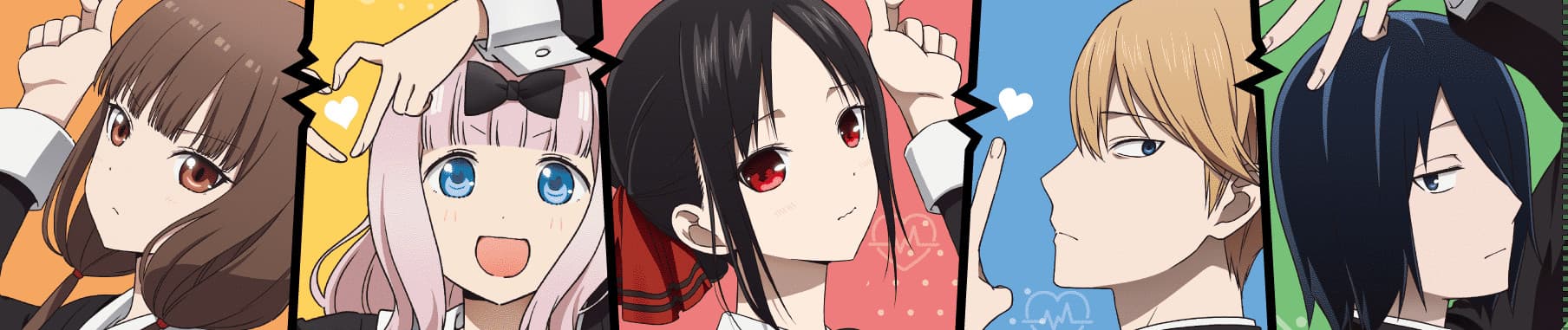
I remember reading an interesting interview of Aka Akasaka (original creator behind Kaguya-Sama) a while back. I have since forgotten most of it, but a few remarks about his character-writing philosophy stuck with me.
I was chewing on these three principles when I realized that Kaguya-Sama was more than a love story. On a greater, ‘deeper’ scale, it’s about contradictions—all sorts of them. That one friend who gives godlike romantic advice, but lacks dating experience of any kind. The unbridled joy and subtle jealousy you feel upon witnessing someone else’s happiness. The desire to break free and write your own story, but being too paralyzed with fear to take action.
Symbolic contradictions have been present since the very first episode of the first season. Prodigious students are also bumbling idiots. Beneath the elegant, sophisticated demeanors of the student council’s members lie something much more unsophisticated and relatable. Our heroine and hero, Kaguya Shinomiya and Miyuki Shirogane, are one and the same in their shrewdness and ‘genius’ status, but wholly different in their socioeconomic background and gendered perception of love. Maybe it’s because I’m older and (hopefully) wiser, but these paradoxes seem to take on a whole new meaning in its third season.
Or rather, everything is taken to the next level this time around. The imminent prospect of a life beyond the insulated bubble that is Shuuchin Academy spurs a sense of urgency. Relationships and dynamics naturally progress to the next stage. The secrets behind each character’s actions—their motives, deeper sentiments, and vulnerabilities—begin to unravel. More so than ever before, there is an air of maturity emanating from the student council room. It is no wonder then that Season 3 dives so intimately into the fabric that holds its existence. It picks every character dynamic apart with laser-like precision, revealing all of the admiration, resentment, selfishness, and selflessness within. It even probes into the crux of its own premise—on whether love is inherently a power struggle or war.
This profundity blesses Season 3 with unprecedented emotional weight. Every season so far has sought to gradually dilute its light-heartedness in favor of somber drama, but Season 3 handles it most deftly. Season 1 and 2 only metaphorically disarm Shinomiya’s and Shirogane’s (and Ishigami’s too) ‘weapons’ to reveal their vulnerabilities. Yet Season 3 does so literally. There is a sense of finality to everything. The events of Season 3 only mark the half-way point of the whole story, but it’s clear that they represent the end of something and the beginning of another. If not the actual ending, then they represent a shift—a transformation in how the characters interact with one another and a reinterpretation of its central premise.
All this talk about emotional triumphs make Season 3 seem like ‘that one sequel that suddenly gets really serious and deep.’ And there might be some truth to that. But telling you that it’s the entire story would be a lie.
The existence of Season 3 is a contradiction in its own right. It so earnestly examines the inner workings of its characters, as if trying to redefine the very meaning of Kaguya-Sama as a whole. Yet Season 3 remains fundamentally identical to its two predecessors. Everything I loved about Season 1 and 2 is still present. The jokes are hilarious and the sweet/cute moments are, well, sweet/cute. Even as the Shuuchin student council develops with the passage of time, every member retains their distinctiveness and charm. And, as I alluded to earlier, there is still that ‘light-heartedness to seriousness’ narrative structure.
One of the more interesting “fundamental identicalities” between Season 3 and its predecessors is the way in which Season 3 continues the creative liberties of Season 2. The visual experimentation was a fun way of adding depth where the original manga could not, and gave the anime adaptation a ‘metaphorical’ or ‘meta’ vibe. And, for Season 3, this visual flair returns in full force. The animators almost seem to ‘nerd out’ this time around. There are shoujo manga aesthetics, gay smut references, and even an entire rap segment. The scope of visual play expands into the realm of geek and popular culture, beyond trope parodies and age-old metaphors. Health bars, different animation styles, and dramatic stand-offs—to name a few more—add a certain spontaneity to each episode. Due in no small part to these creative freedoms, Season 3 retains a sense of chaos reminiscent of the first several episodes of Season 1, despite having a structured narrative arc like Season 2. In that way, Season 3 is the best of both worlds. It blends the impulsive fun of Season 1’s battles of wits with Season 2’s visual experimentation and more defined story arcs (a better fit for the story Season 3 is trying to tell).
In the end, I’m not a Kaguya-Sama fan for how ‘deep’ or profound it is. I love it for how goddamn entertaining it is. But Season 3 is arguably the closest the anime has gotten to Aka Akasaka’s more thoughtful vision for his storytelling. This season seems less like ‘Romcom Death Note’ or high school drama galore. Rather, it concerns itself more with the human condition of its characters and the complexity of human relationships. It’s a much more pensive Kaguya-Sama. Yet, at the same time, it’s no less entertaining than the previous two seasons. Either way, I love it all the same.
TL;DR: It’s pretty good.
40 out of 45 users liked this review
