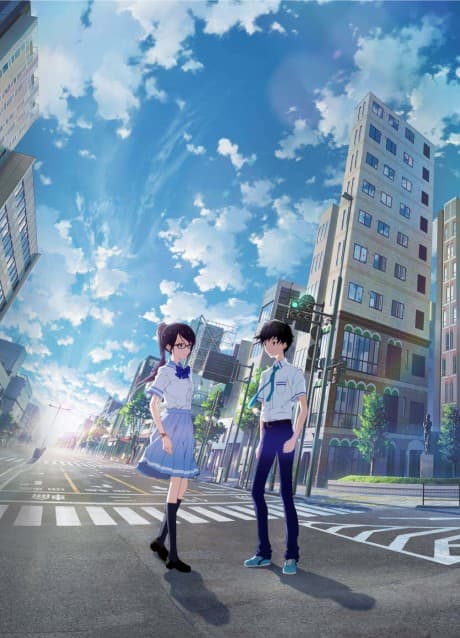
This is a spoiler-free two-part review for a two-part movie. You are reading the review for: "Blue"
Intro
To Me, The One Who Loved You (Red Background), also known as "Kimi Ai," and To Every You I’ve Loved Before (Blue background), also known as "Boku Ai," are a pair of films that can be watched in any order. For convenience, I will refer to them as "Red" and "Blue" respectively throughout this review. The following review will be kept spoiler-free, but if you're seeking quick recommendations, it is suggested to start with "Red" and then proceed to "Blue" in the same viewing session.
The Good
Although I expressed my dissatisfaction with "Red" in its review, "Blue" stands out as a surprising improvement. The voice acting in "Blue" is notably more emotive, with a refreshing presence of inflection that adds depth to the characters. The contrast is stark, and even if they had chosen random people off the street for the voice acting, it would have been a vast improvement over "Red."
As "Blue" was created by a different studio, the art style also differs, and in my subjective opinion, it is more enjoyable. Both films utilize the distinct art styles of their respective studios intentionally, which may initially appear odd but becomes clearer as the story progresses.
While both films contribute to the overall context, starting with "Red" is recommended as it lays the foundation for a more satisfying conclusion in "Blue." The logical progression of the storyline is easier to grasp, as events in "Blue" are often consequences of actions from "Red."
Unlike "Red," which struggled as a standalone film, "Blue" fares better in that regard. The plot in "Blue" is more coherent, and the dynamic between the lead characters is genuinely interesting. Through improved voice acting and a well-crafted script, viewers can witness a natural and compelling development of their relationship.
The Bad
Admittedly, the plot itself lacks excitement or engagement. While the characters in "Blue" are somewhat interesting, their relationship doesn't reach its full potential. This limitation was expected due to the ambitious nature of the project, aiming to provide two standalone movies that combine into a larger narrative. Both films share weaknesses, including an overuse of scientific jargon that adds little value. Instead of pretending to have complexity, valuable screen time could have been utilized to provide clear explanations of concepts. Both films also struggle with a strong central theme.
Conclusion
Individually, the dual movies offer a mixed viewing experience. While "Red" falls short in terms of voice acting, soundtrack, and standalone appeal, it serves as an exposition dump for the more enjoyable "Blue." The improved voice acting, distinct art style, and a more coherent plot make "Blue" a passable standalone film - a high 6/10 on its own. Starting with "Red" and progressing to "Blue" enhances the overall understanding and satisfaction of the storyline. Despite its flaws, the combined viewing experience showcases the clever overlap of the two plots, which adds intrigue for those seeking a puzzle-like narrative. While these movies may not satisfy viewers seeking a simple and entertaining plot, those with the time and inclination for thought-provoking experiences are in for a unique and mind-blowing journey.
27 out of 29 users liked this review