I came into I Want to Eat Your Pancreas knowing that it would be a sad series. I've read a fair share of works marketed as "sad love stories involving terminal illness", and while I'm not sure I'd call it a genre it is at least a thing that is recurring. Your Lie in April is another manga I've read marketed like this (Planning to re-read that one since it's been so long), and while I think I enjoyed it overall it didn't hit me in the same way it hit a lot of other people. I Want to Eat Your Pancreas, however, caught me off guard and is something that I know will stick with me for a long time.
The story opens on the funeral of Sakura Yamauchi, an event our unnamed protagonist does not attend. Sakura Yamauchi had a pancreatic disease. This is a fact she kept a secret to anyone outside of her family. One day, a boy in her class discovers Living With Dying, a book she's been writing about her experience, in the hospital. He gives the book back to her and becomes the only non-family person who knows that her life is short. This begins the story of their relationship counting up to Sakura's inevitable death.
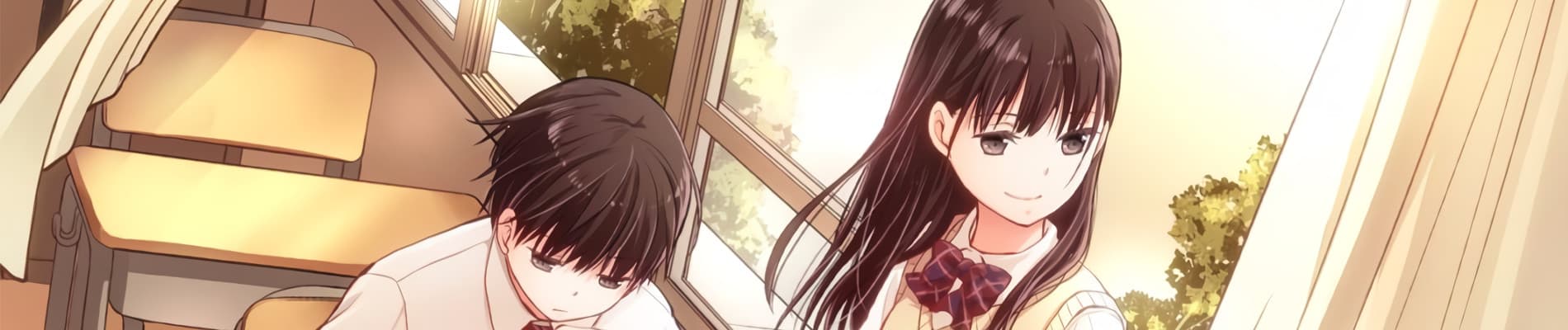
The two leads of the series are what drew me into it so much in the first place. Sakura and our protagonist (Whose name isn't revealed until the second-to-last chapter so I won't be revealing it here) are both people who I can really see parts of myself in. The protagonist is, as he's referred to by Sakura, an introverted young man. He's never really had any connections with the people around him, openly stating that he doesn't view himself as very interesting. He isn't particularly interested in the people around him, either. While I've never really discounted the people around me, I have always generally kept to myself and have had a hard time reaching out to people and making connections with them. In high school I particularly tried my best to just stay in the background like mr MC here more or less does. I think it was this relatability that invested me so much in his story, and how his relationship with Sakura ultimately leads to him coming out of his shell and viewing the people around him with more interest. It's something that makes me want to engage more actively with the people around me.
Sakura Yamauchi is the polar opposite of the protagonist. She is an unabashed extrovert beloved by everyone in her class, withholding her disease from them so that they don't view her differently than they would if she was just a normal girl. This withholding could be seen as an extension of her greatest insecurity: she views herself as little more than the connections she makes with the people around her, like she always has to put forward her ideal self instead of her true self. This is why her discussion of her disease with the protagonist sometimes comes off as flippant. She hides her fear so our protagonist will continue talking to him as he always has. The reason she first took an interest in, aside from him finding her notebook, was that even though he was very introverted he was genuinely himself. I mentioned I saw myself in both out leads, and in Sakura I see my tendency to deflect to those around me. While this isn't something she actively does, her defining herself by connections does have some similarities to me prioritizing myself below everyone else in most situations. They aren't exactly the same, but it was enough that I became deeply connected to her.
Sakura's friend Kyoko is also worth mentioning, as she's probably the supporting character who gets the most screentime and development. I wish she and Sakura had a little more time onscreen together, although due to the nature of this story I can understand why they don't. She dislikes our protagonist since she's a bit suspicious of this boy who suddenly started hanging around her close friend. She's never portrayed as a bad or mean person, and Sakura wants her and the protagonist to get along. Without getting into spoilers, she and the protagonist eventually are able to come to more of an understanding, and the way they did is quite satisfying.
Connection is one of two big themes in this manga, as I hope my previous paragraphs have shown. Our leads compliment each other perfectly in this regard; one viewed the people around him with no interest, the other views other people as the only way to make herself interesting. Neither are the best way to live your life, and they learn that through each other. I'm finding I'm drawn to works that lean heavily on connections and communications, probably since they're something I'd like to focus on more in my daily life. I'm glad that this series turned out to be such a shining example of it. Before I close out this review, I'm going to do a brief spoiler section since I just have to talk about the Big Thing.
This series has nice art, but I wouldn't call it my favorite. The character designs really don't stand out and are all pretty basic, but considering how grounded this story was it's not really a detriment. I looked up the anime movie adaptation after I finished reading the manga (I haven't seen it yet but I would love to someday), and it really struck me how different the art was from the manga. Almost makes me more excited to check it out, especially since the characters aren't drawn quite as young as in the manga.
I highly recommend I Want to Eat Your Pancreas. It surpassed all of my expectations that I had going into it, and I might even consider it one of my new favorites. Heck, even the admittedly eyebrow-raising title makes sense in the story itself. I could have come off as goofy in a weaker story, but here it works perfectly. It's honestly been a bit since I was able to see myself in something so much, and it gives me hope that I'll be able to find myself in much more manga to come.
20.5 out of 21 users liked this review