Tengoku Daimakyo
a review by Magenta
a review by Magenta
Preface: This review is split into two main sections. The first part is a general review of the show in its entirety and the second is a review of one specific problematic aspect of it. If you just want a general review, only read the paragraphs in italics.
Note: Due to the ambiguous nature of Haruki/Kiruko's gender and name, I will be alternating which name I refer to them as. This is because every way to refer to them felt wrong, so I am going with the option that feels the least uncomfortable.
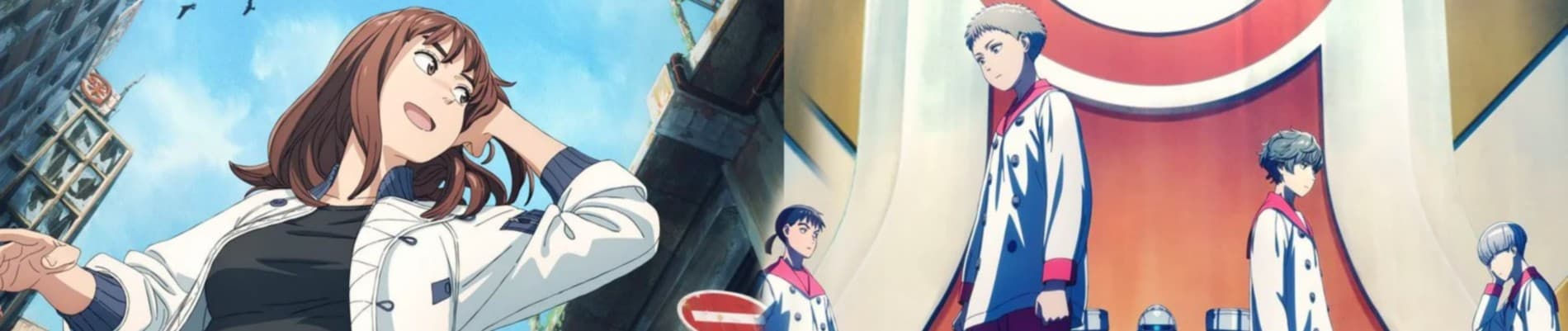
Heavenly Delusion is quite different from most other anime. It isn’t some abstract art piece, but it always never makes the most sense. In the first episode, we are dropped into the middle of two plotlines, or in media res, to sound pretentious. The only tenuous threads of vague world concepts link the two initially, but for the most part, it is like two different anime happening at the same time.
In the post-apocalypse side of the story, not much time is dedicated to actual plot progression. The journey of the two leads consists mostly of a search for their respective destinations without direction as to where they are going. Maru and Haruki each spitball directions they can go towards or find out things that might vaguely be related to their goals. However, they usually end up in a story tangent unrelated to the main plot that typically lasts for an episode or two. For most of the runtime, the story feels like it is an aimless collection of side quests.
However, the fluid nature of Heavenly Delusion’s story structure, although on paper counterintuitive, is its biggest strength. My earlier description of that structure as aimless and directionless should only be taken as complementary despite those words’ typical derogatory undertones. Rather than just being a world that acquiesces to the happenings of the plot and the development of the characters, the world is full of characters experiencing their own stories in the post-apocalypse. The self-contained stories that come into view present entirely new ecosystems existing on their own. The Japan of the 2040s feels like a place that has been lived in, rummaged, and savaged. The journey of Maru and Kiruko feels like a true adventure because of the expansive world they are traveling across.
Ironically, by spending so much time not focusing on the main plot, when they do actually come up, they feel all the more rewarding. These side stories, as well as being good on their own, also make the drip feed of info in the main story feel more meaningful. That with the fantastic world building heavily feeds into making the main mysteries all the more enthralling.
Heavenly Delusion doesn’t hold the viewer’s hand. It expects its audience to be willing enough to be lost in its plot. While it is acceptable to watch it in a brain-off way, letting the events of the story pass you by, the series wants you to watch it like a detective. You, as the audience member, are given an incomplete story the show expects you to put together by yourself. You are the one that has to figure out the connections between the facility of Heaven and the post-apocalyptic hell of modern Japan. The mysteries that the characters want to solve doubles with the mystery you are supposed to solve. This level of maturity that this story treats its audience with is hard to come by in anime.
And all of that mysterious atmosphere and meticulous world-building is bundled together with amazing presentation. Even furthering the vibe of the post-apocalypse is very immersive audiovisuals. It is consistently a feast for the ears and eyes. The most standout aspect of a stellar visual and audio design has to be the backgrounds. The backgrounds are detailed to an eye-opening extent. Here are some standout backgrounds throughout various points of the show.


These are all gorgeous images that can each speak for the decrepit state of the world. They can paint an emotional picture without any context of the greater show. Nothing immerses like the overgrown vines growing across the wrecked environment of normal society. Nature finding its home in abandoned environments shows how the characters live on the remains of a previous world.
But I actually lied earlier. You see, these backgrounds aren’t from various points in the show, they are all from the first 5 minutes of Episode 1. All of those detailed backgrounds that each paint their own little story within them pass by in just a few minutes. And it isn’t like the quality of backgrounds goes down past the beginning. In a series that can have its ups and downs, the enthralling visuals and backgrounds are consistently amazing. Even during some more boring points of the story, it is still engaging just due to the high visual atmosphere.
Heavenly Delusion is as enthralling, as it is engaging, as it is thick in atmosphere. It is rare to come across something that can so consistently impress with its mysterious story and gorgeous visuals. It is a marvel to behold that everybody should see for themselves.
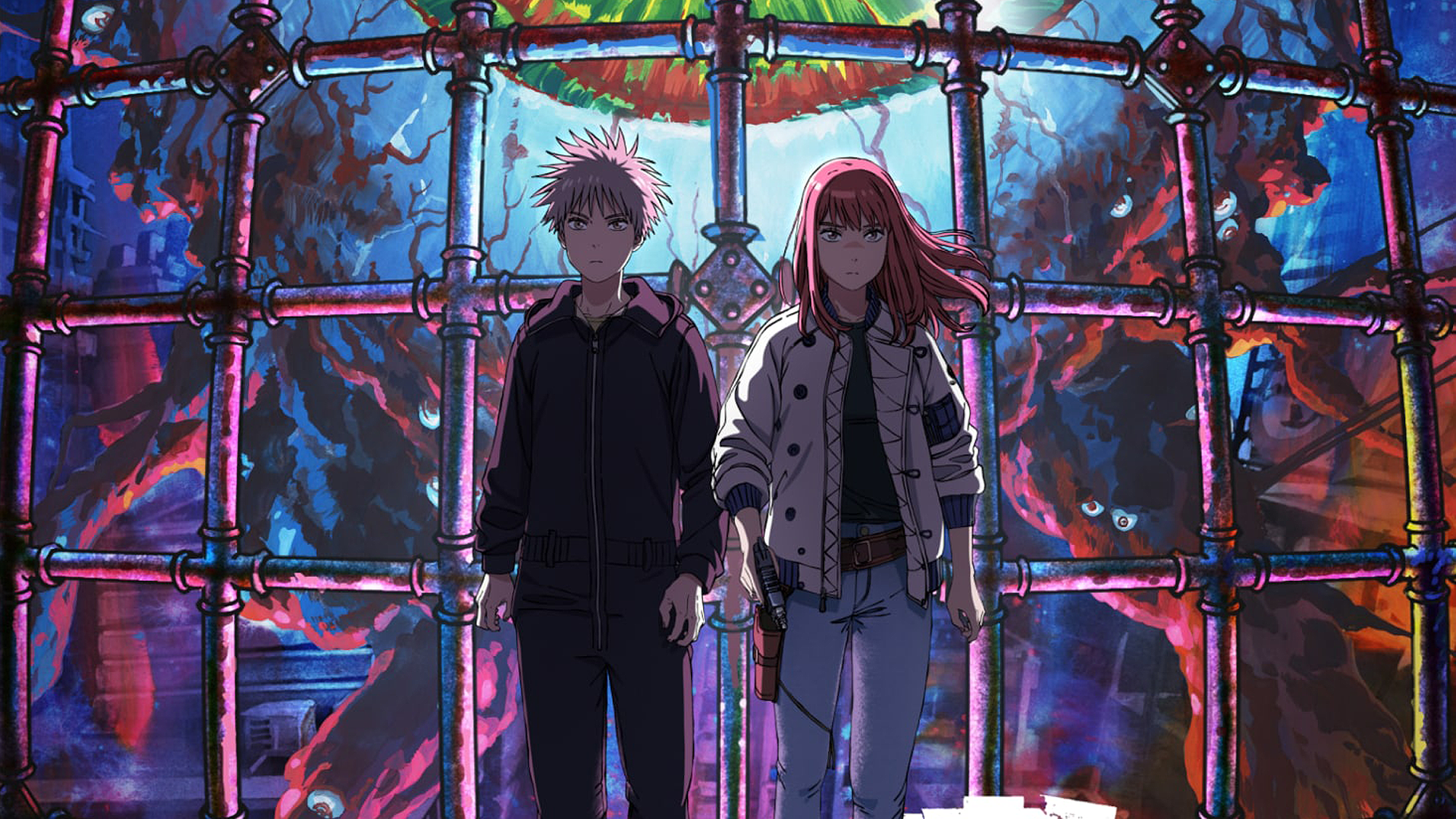 ___
___But that isn’t the end. I wish it was, but it isn’t. Throughout my entire long-winded praise of this show, I left out one very important aspect of Heavenly Delusion. You see, I was initially planning on just leaving the review at that. Then after watching a very certain scene in the penultimate episode, this very aspect became something that can’t really be ignored. That aspect is everything surrounding Haruki’s gender.
I do commend this show for attempting to portray a transgender character. Of course, it isn’t a completely clean representation of the average trans person, as Kiruko is just trapped in the body of their sister and not born in the body of a girl. But if they aren’t transgender, then they are at the very least transgender-adjacent. When Kiruko first mentions their gender to Maru, they use the line:
“My body’s a woman’s, but in here, my mind’s a man’s.”
Lines like that draw parallels to common language surrounding gender fluidity. Given the grace as to which the story develops itself in every other aspect, it should be expected that Haruki’s gender is treated with mature understanding. Why should anything else be expected from a series that is so mature in literally every other aspect? But, that isn’t how things turn out. Instead, Heavenly Delusion depicts a truly terrible representation of a transgender character.
I am going to adopt a very different tone of voice when discussing the matter of Kiruko's gender because it exists in an entirely different realm of quality compared to the rest of the show. I emphasized earlier how mature the writing was in having respect for its audience. But in this element of the plot, that respect goes completely out the window.
I am not just going to talk about THAT SCENE at the end of Episode 12. It is a very controversial part of the story, but this half of the review isn’t only going to be a diatribe of it. It may be somewhat obvious what my thoughts on THAT SCENE are just due to how I am referring to, but we have to work toward that. Because I actually don’t have completely negative thoughts as to how it is handled. Initially, when this component of the story is introduced, it is actually done quite well.
In Episode 3, the first time when the complicated gender identity of Haruki is indulged in-depth, this topic is treated with the expected level of respect. I’d go so far as to say that this episode is one of the best in the entire season. Its exploration of Kiruko’s past feels progressively emotionally visceral as it goes on. Haruki’s hallucination during the body-swapping operation and subsequent panic attack after they find out that they now are trapped in the body of their sister are stand-out moments.

The whole hallucinatory sequence is so beautiful in every way, it is probably my favorite scene of the season.
The pure intensity of it makes it all hard to watch, but in a good way (unlike a certain later scene). Combined with the mysterious atmosphere and detailed visual design that makes the rest of the season fantastic elevates the episode to a fantastic degree. In the first few episodes, the plot surrounding Haruki’s gender is very well written, mostly.
The word ‘mostly’ is there because Kiruko’s gender fluidity is initially imbued with incestuous subtext. The very first indication of Haruki’s fuzzy gender is when they try to kiss themselves in the mirror while they are naked. With the context of the Episode 3 backstory, this scene turns from quirky to weird. Not weird with a positive connotation like the complex mystery is, but it is weird in a deeply off-putting way. This is further compounded in the third episode when Kiruko is straight-up called a siscon.
It isn’t like Haruki’s feelings toward their sister being coded with incest really go anywhere. The incestuous subtext stops showing up after these small moments in the first few episodes. They are completely ignorable, as on the whole, this part of the story is still very well written. However, when taken into the larger context of the story, these moments can be seen as a bad omen.
Kiruko’s gender is primarily developed through their relationship with Maru. Maru finding out about Haruki’s gender ambiguity after revealing his general attraction towards Kiruko as a girl should provide for well-thought-out, meaningful drama. The inklings of a mature romantic subplot involve Maru navigating through how much he wants Haruki’s gender to be taken into account when factoring in his feelings for them. This can be seen at the beginning of Episode 5 when he beats up a gang in a depressive state. He uses the line:
Ever had a girl you like turn out to be a guy? Can you imagine?
This is a good scene to start an interesting inner conflict within one of the main characters. Sadly, this is one of the only scenes where this conflict is taken as a serious plot point. In the subsequent episodes, Maru’s attraction to Kiruko and their gender is treated with the touch of a jackhammer. Rather than being played for drama, it is played for comedy. And not in a well-written type of way, more like in the “why is this happening, get me out of here” type of way. By far the most blatant offender of this is in Episode 6 when Maru sexually assaults Haruki despite their pleas otherwise.
This isn’t to say that the show’s comedy is bad on the whole. Levity should be expected in any type of dystopia. The small talk between the main duo about the many mundanities of their adventure provides for effective and efficient humor. Little diversions like the back and forth over what to name the car Juichi gave them are funny. In turn, details about the world get built out as well as the chemistry between the two leads. But it is very jarring when that briefly gets thrown out of the window to do the very groan-inducing comedy.
Especially in the middle episodes of the series, there is a misplaced need to place Kiruko in sexual situations that are supposedly comedic or for Maru to feel relentlessly horny about them. This is a more systemic problem with how anime, likely written by male writers, mistreat their female characters by putting them in oddly sexual situations. That whole topic belongs in a wider discussion of how a patriarchal society like Japan treats women, but that topic can lead to such a large rabbit hole that it will take until the heat death of the universe to get to the end of it.
But while this whole discussion usually dips into misogyny, in this case, it also falls into transphobia. To treat a character struggling with their gender identity as a sex object is a gross degradation. When the plot focuses on Haruki’s gender so much, it can be painful to see it kneecap itself by not treating it with the respect and maturity it deserves.
But still, these problems are still kinda ignorable. Yes, those scenes filled with distasteful sex jokes aren’t great, and those are a few minutes of my life I am never getting back, but they aren’t that important in the wider story. An unintentional positive benefit of an aimless story structure is that when there is a bump in the story that isn’t completely desirable, it can be skipped easily.
At a certain point though, this can’t be ignored. And that point is THAT SCENE at the end of Episode 12.
It's not very good.
It's bad even.
Like, really, really bad.
Concerns about degrading a dysphoric character into a sex object don’t really go away when there is a RAPE SCENE???
Even removing all aspects of Haruki’s muddy gender from the scene, is still terrible from a narrative perspective. Even if you wanted a scene where Robin rapes Haruki (which you don’t, this is just a hypothetical), then it shouldn’t be the second scene they share together after they reunite. Yes, fucked up things do happen in the post-apocalypse, but there is nothing about a post-apocalyptic hellscape that would make somebody suddenly become a predator to the person that they were a mentor for. This behavior was previously foreshadowed in Episode 3, but how it was reintroduced here is far too abrupt. It is good from a narrative perspective to have Kiruko's idealized version of their hero fall apart before their eyes, but it is if we skipped straight from the start to the conclusion of the plot point.
With how it is placed in the story, it just feels shocking for the sake of it. But you can still shock an audience while still justifying the buildup for that shocking moment. The destruction of Heaven that is happening in the facility side of the story is a good example of how to properly shock the audience. Even if it is an accidental collapse of the facility, it still makes sense narrative-wise due to the childrens’ growing curiosity of the outside and the inner turmoil of the adults running it. It is staggering to see two scenes meant to be shocking back-to-back with such a vast gap in quality.
And when you do take the transgender theming of Kiruko into account, this all jumps headfirst into the direction of transphobia. Robin explicitly mentions to Haruki that he is raping Kiruko and that they just have to watch. The story context for the rape is inseparable from Haruki’s genderfluidity. This level of tactlessness in this depiction is an extension of Maru’s sexual assault scene but somehow taken to an even more twisted extent. It is abominable that the only way a character can express their feelings towards Kiruko is through a sexual assault of some kind. Even if it is now an antagonistic force expressing this sentiment, the fact that this can only be expressed through the sexualization of said character is terrible. There is a potential for a nonsexual style of storytelling when it comes to dealing with how trans characters interact with others, but it is squandered so heavily.
I don’t want to think about this anymore, here is another detailed background from the first few minutes of the first episode.

I am purposely distracting myself, so let’s just end this.
Even after ranting at length about the horrid depiction of transgender identity and genderfluidity in the story, I can’t really put down the entire show for it. Even if I revile this one part of it, I still enjoyed my time overall. The mystery is still enthralling, the visuals are still beautiful, and the world-building is still fantastic. But it is also hard to swallow something that puts down an entire marginalized group in this way. Media like this is hard to evaluate just because the problematic aspect of it doesn’t erase what good there is. However, just because of the high quality of everything else doesn't mean that there shouldn't be an important discussion about how to do representation correctly in stories like this. Good representation of minority groups is generally a positive, and there are many anime that do representation well. But it is good to see an example of how to do it poorly, to learn from in future stories that try to go into something like this.
In all, Heavenly Delusion exists in two realms of quality. In one where most of it resides, it is a magnificent spectacle that embodies everything great about anime, and in the other where one story aspect of it resides, it shits itself to the point where it represents the absolute worst of it.
Because this anime exists in a murky quality bubble, I am not giving this just one score. I am giving it two. One for if you take the bungled LGBTQ+ themes into account and the other for if you don’t. I can’t decide which one to go with, so I am declaring this a choose-your-own-adventure with two paths. Choose which score you want to go with because I am indecisive.
The third-to-last paragraph was a better conclusion than this one and the penultimate one where I just explained the scoring system of the review, so just pretend that is the end. Please excise the final two paragraphs of this review from your mind like Kiruko’s brain was excised from their body.
Thank you for reading to the end of the review if you did. If you have any criticisms of how this review was made, you are free to message me or reply to this activity to critique what I had to say.
Also, please don’t like or dislike the review without reading it.

247.5 out of 301 users liked this review
