Tengoku Daimakyo
a review by ZNote
a review by ZNote
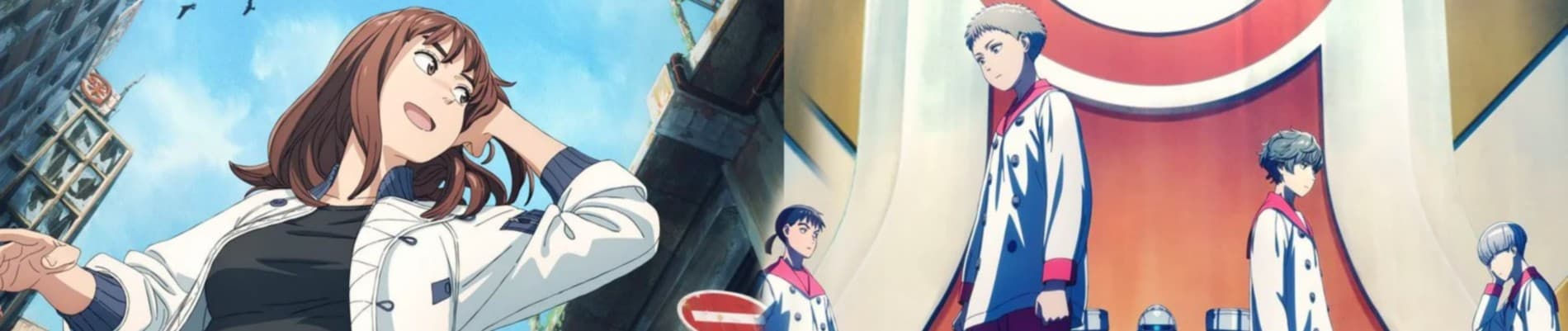
Heavenly Delusion is a world that is more lived in rather than explained, a story in which its earliest images of urban decay and the clean pristineness of the nursery contrast like night and day, telling us everything we need to know within seconds. The former is subjected to the ravages of catastrophe and left humankind to their own devices, buildings left to rot in the overgrow of greenery and decrepit highways. The latter is so clean and saccharine with children running and playing that it feels mystifyingly sheltered, if not outright false. As far as these two places’ geography and ideology is concerned, they could not be further apart. But even so, the stories of these two locations weave together to make a fine science-fiction tapestry, visually and acoustically beautiful while delving into the darker remnants of what its world means as a breathing space and to the people within it.


In both settings, its characters are constantly chasing their own metaphorical rainbow. For Kiruko and Maru, they are bound together by job contract to find “Heaven,” someone who looks exactly like Maru, and two people that Kiruko knows from their past, though it becomes rather apparent that the duo’s relationship is more than merely a professional commitment. In the midst of their foraging and scavenging, they can only wonder at times of life before the catastrophe. The children in the nursery begin exhibiting behaviors foreign to their cloistered place. They indulge their new, curiosity-laden impulses either with the setting directly or with each other. Even at times where one narrative appears to be left behind and the other takes centerstage, they are constantly bound together by mysteries that thematically complement the seemingly-separate threads. In that spirit, the two stories are always moving in parallel, even if the actual number of minutes spent in each place is unequal.
Heavenly Delusion piles mysteries on top of one another in a mesmerizingly organic and multifaceted fashion; much like its characters, it rewards its curious viewer with an answer to a burning question every once in a while, before managing to pull the wool back over the eyes and have several other mysteries crop up. By allowing their curious impulses to take over, the characters are, in essence, knocking on Heaven’s Door to see what lies beyond. It provides just enough give to whet the immediate appetite, all while having several cards still up its sleeve and ready to slam on the table with telegraphed finesse. Each new piece of information learned brings some knowledge about the world, but in order to get it, slaying the vicious Man-Eaters or trying to reconcile one’s unfamiliar feelings is a consequence or payment that needs to be made. With all the forces pressing down upon the characters in Heavenly Delusion, there is an inherent interplay between freedom and imprisonment involving body, mind, and soul that is constantly and amorphously shifting. Adjusting to each new situation or truth, and the characters striving for their own sense of self-signification despite them, pervades the show’s glimmers of triumph and its imposing melancholia.
But glimmers are worth holding onto, and solace is often found in the company of the few people who really matter. As Kiruko and Maru forage through old buildings, the practical reason is obvious – they need supplies. Underlying all of that though is the desire to see just what lies waiting to be understood or uncovered, both of the world and of the other. As children actively living in the aftermath of the catastrophe that struck the world, their own curiosity fuels their relationship. They do not have all the answers (no one in their world has them, apparently), yet even so, it does not stop some of the adults they encounter from making disparaging remarks about them living the bulk of their lives long after the catastrophe initially struck. However, in the midst of all that jadedness and cynicism hurled their way, they allow themselves to wonder. That wonderment provides its own kind of spiritual and emotional refuge.
It is a kind of familiarity that is born when you have been with someone for a long time, or understand someone well enough to know what they are more or less thinking to the point where you inherently trust them without necessarily saying anything. It moves beyond trust, though – it allows you to laugh and maintain your spirits in a world that seems like it is always trying to crush them, and with someone else there with you, things don’t have to be so bad. In a sea of empty houses that have creaked floors, broken windows, and cars that stopped working long ago, actual danger does rear its ugly head from time to time. All that scavenging and foraging may have been to find supplies, but the shelter each one seeks is walking right alongside them. It will keep them safe from whatever travail or horror comes their way, giving each action-oriented encounter a smoothly-choreographed zeal, and a sincere laugh when they comedically find unused toilet paper. And when they find others who have established their own small communities in the apocalyptic wasteland willing to help, they see in them what they see in each other, just in another form.

And for the children in the nursery, they begin to taste the “forbidden fruits” of the literal and figurative boundaries of their imaginations. You can only keep someone inside a sphere for so long before they long to wonder whether there is more than the limit of what they know. In their youthful and hormonal naivety, allowed to foster unfettered(?) and undeterred(?) by the powers that be, they likewise find solace and meaning that transcends the self and moves into something more intangibly fragile and flickering. As one of their own says, it’s a love that you’ll know is different than anything else. All the while, the viewer acknowledges the suspenseful knell that’s ready to sound, but there’s an assuredness in knowing that they, too, have found refuge and will survive with one another.
Whether through Kiruko and Maru, the children in the nursery, or the many peoples and places that are seen and heard, Heavenly Delusion is thus a grimly communal series where the setting can be vicious and choking, violent without remorse, and difficult to stomach. And at the same time, it is capable of producing tender mercies, sincerity that stands against the specters of death waiting in the wings. Every day, the characters see and learn a little more, grow a little closer, and attempt to find what they need to find. Not every truth, person, or monster beyond Heaven’s Door is pleasant, but the feeling that they can, and will, carry on is always there.
One tip for the weary – if your gun isn’t charged, run like hell.
194.5 out of 210 users liked this review
