Goodnight Punpun
a review by baba13
a review by baba13
_Meet Punpun Punyama. He’s an average kid in an average town.
He wants to win a Nobel Prize and save the world.
He wants the girl he has a crush on to like him back.
He wants to find some porn.
That’s what he wants, but what does he get…?_
What can be said about Goodnight Punpun that hasn’t been regurgitated consistently? I’m not sure, but I still want to write my thoughts on this masterpiece. Rarely has a piece of literature spoken to me on such a personal level. There is a ton of depth, symbolism, and attributes to attract the more sophisticated reader, yet it speaks upon these matters on such a real level that I think most folks should be able to grasp the beauty of Punpun. The cover itself is a work of genius, immediately defying expectations. From the moment you read the first chapter you grasp, yeah this is not a feel-good story. Throughout the manga, the author blatantly stated he’s sick of this status quo, he wants to depict something real which he wanted to explore with these characters, especially Punpun.
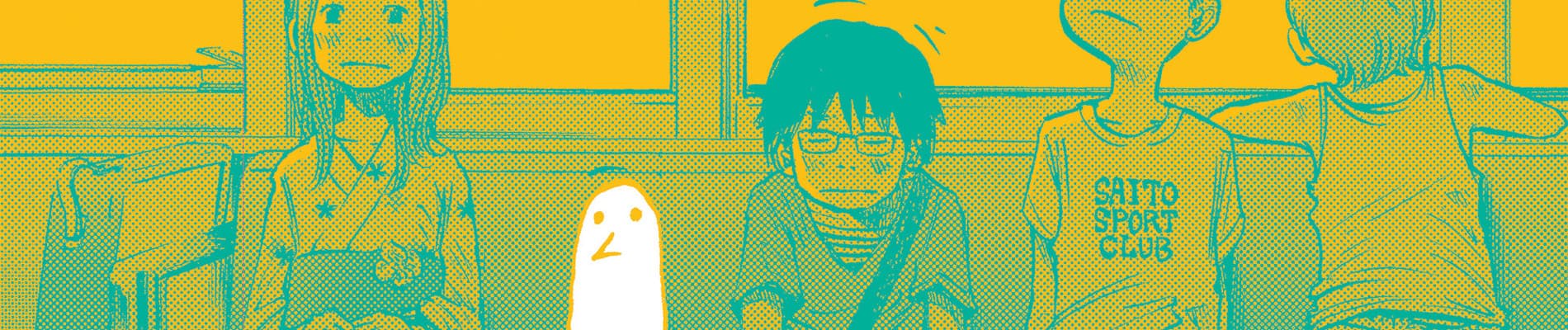
Goodnight Punpun is a coming-of-age slice-of-life drama. Yet it’s so much more than simply that, it’s an examination of people from a societal perspective. How it’s like to grow up in the modern age, it’s so relatable because Punpun is a failure. At every significant life-altering moment, he often makes the wrong choices. One of the reasons we gravitate towards shounen protagonists such as Goku or Naruto is their unwavering optimism, and even if failure occurs, they still put their heads up and move forwards and be better, not regretting certain life decisions and pursuing idealistic dreams. Sadly, for most folks, they don’t live like that; we all face failures, certain choices you wish you could have changed, and sometimes our dreams are mere fancies and cannot be achieved. Punpun is a realistic person to a frustrating degree. Punpun might be an extreme example, but we face issues similar to what he faced in life to some degree. The psychological exploration of the series is phenomenal, and it’s largely the reason why we so relate to these characters, seeing events unfold in such a unique presentation. In the Onodera family, in particular, their character design is initially just a faceless caricature. An example of Punpun, he's initially depicted as a bird and transforms as the series progresses, helping us to identify with these characters so intensely.
Inio Asano is not just phenomenal at depicting psychological aspects; every fasciate of what makes this medium special. The dialogue is beautiful; I loved all the exchanges, especially characters like the uncle, Punpun, Sachi, Seki, and others. There is a lot of beautiful banter and philosophical musing that I think is applicable in this modern age. The uncle's and Sachi's musings in particular are so real. It might be one of the best visual examples of a mind deteriorating, depression, and mental illness in general.
The art is beautiful, it’s this stylised realism that doesn’t cross the uncanny valley. He definitely uses a lot of digital assets, I think at one point there’s an interview where he stated he regretted using too much as it hurt his own art style, which is something he addresses in Dead Dead Demon's Dededededestruction. Regardless of that fact, it’s masterfully done, and I would say that even moments that can be a tad jarring reinforce certain themes more strongly. He depicts heightened emotion to the point that you feel discomforted. I think every time the uncle breaks down, it tears my heart just observing it. I don’t think he's up to the level of mastery in art like Samura, Inoue, or Kaoru Mori, who can capture the most subtle details, but what Asano makes up for is that rawness. There’s this brilliant sense of isolation in the art, the composition is brilliant, and there's so much that goes beyond just good-looking art but complements the narrative to its maximum potential. He does this surrealism or magical realism (?) portion of the manga.
If you have read my prior reviews, beautiful art is just one element, but how does manga flow? Thankfully, the panel work is fantastic. He uses the double spread phenomenally, and those moments just speak to you on a personal level. I really enjoyed the black backgrounds whenever Punpun spoke, and then in those rare moments when it’s just a normal speech bubble, you pay attention immediately. So yeah, the panelling and art—I don’t have any complaints, just a fantastic job.
One comparison I didn’t expect to make, but a lot of this novel reminded me of Dostoevsky's ideas of human desolation, shame, and the "pain of being forgiven." Brother Karamazov explores Russia and it being poisoned in turn, Onodera's family embodies the dysfunction of the Japanese household at the end of the millennium. There are remarkable similarities, even in the cast.
One thing I discovered when I was writing this review is that Punpun’s God is a photo of the author's friend smirking. An embodiment of adulthood and its complexity. This ties into the tragic aspect of Punpun: it's not the disappearance of innocence itself, it’s how easily corruptible it can be. As certain figures from his life fade, Punpun’s god becomes more prominent, radical changes to his appearance occur as a result.
This is a sad manga; I understand why the author dislikes labelling it as depressing or surrealist art. I do think there’s a bit of a misconception of Punpun, with it being labelled a nihilistic and depressing manga, but it’s more an acceptance of immorality, failures, etc., certain topics that are hard to deal with in the real world. Similar to Dostoevsky's work, it’s not just sadness, there’s hope that transpires throughout the whole manga, there’s sincerity and beauty. Punpun wants to depict reality, and people have high moments in their lives. The uncle's narrative is the best example of that.
The character is just so brilliantly flawed. I could go on in length talking about Punpun Onodera, Sachi Nanjou, Aiko Tanaka, The Uncle, and the themes they represent. I don’t think it’s necessary beyond the fact that they are wonderful. I should state that the Pegasus plotline isn’t just a hoax. There’s a pretty good interview from the author that talks about Pegasus:
That’s when I decided to use this character I’d put in earlier — Pegasus — to do a parallel story. Just as the Punpun and Aiko story is a homage to romantic comedies, the Pegasus Orchestra is actually a homage to shonen manga. I’m pretty sure no one understood this at all from reading the manga, but Pegasus was assembling a team that really was doing battle with evil.
…
I wanted to use Pegasus as a mouthpiece for the sort of things I couldn’t make Punpun say, because Punpun was already defined as a character.
You should be able to find the interview which was very educational and generally a lot more than that. But yeah, Pegasus is fundamental to the narrative, it isn’t a waste of time.
The Ending I felt it was fitting.
In Conclusion, Goodnight Punpun is a masterpiece and it’s one of the great of the medium. exploring themes such as family, love, failure and others so masterfully. It’s a must-read!
45.5 out of 48 users liked this review
