Everything about Shokei Shoujo no Virgin Road screams comically bad pseudo-deep isekai to me. An anime that aired last year even did the so-called first episode twist better. Yet, the overall reaction kept saying subversive thriller. It's like Re:Zero, if Re:Zero was cheaper, blander, and lacking any depth.
The English title, The Executioner and Her Way of Life, refers to Menou, the female assassin protagonist, who speaks every line like she's a caricature of a lone wolf killer. Her introduction is agonizingly cliche: A mysterious organization recruits a child to assassinate superpowered teenagers. After witnessing the traumatizing impacts of their powers, she vows to prevent history from repeating itself and becomes a ruthless murderer. Her goal is to murder teenagers who've been mysteriously summoned into her fantasy world from modern-day Japan, known as "Lost Ones." The Lost Ones arrive with a random superpower called a "pure concept" that supposedly could lead to catastrophe if used in the wrong hands. The plot, such as it is, revolves around Menou's desperate efforts to find a way to kill Akari, a seemingly immortal Lost One with the pure concept of time, who she is convinced will be the downfall of humanity. Their chemistry is light-hearted, even though Menou hides the fact that she wants this girl dead. All the show has in terms of levity is their banter, mostly because Akari mistakes their companionship for mutual attraction. The rest of the show is pure edge, the painfully serious kind, not the trashy-fun kind.
From the beginning, Menou is a mouthpiece to dump exposition on the unfortunate viewer. The writer arbitrarily added a generic character with the appearance of a standard male isekai hero, but only for her to spout world-building at him in the most unnatural way possible. Menou's role is to speak lines that insert what the writer wants the audience to think before being an actual character. She delivers these lines so seriously that it's funny. Everyone talks like this except for a few selective oddities.
Menou develops gradually as she struggles to overcome her need to murder Lost Ones and reconcile with the assassin who conditioned her. The rare times she broke her serious persona to have banter with Akari was actually pleasant. Akari's tongue-in-cheek sense of humor plays off Menou's straight man act because the writers know how to place jokes appropriately. Akari flirts with Menou, vies for her affection, and asks to go on dates, usually for humor rather than a sincere relationship. The show is undoubtedly at its worst when it separates Menou and Akari.
Although Akari comes off as a shallow comic relief character at first, developments in the show's second half add depth to her personality. After a few convoluted twists, you find more to her than meets the eyes. Ultimately, she is a shallow husk of a protagonist used as a plot device when needed, with little space to grow. The excitement of her time-reversal power wears off when you realize it was done exponentially better Steins;Gate. Even Re: Zero's first cour utilized its time travel mechanic much better. She is characterized by laughably melodramatic and overwrought flashbacks. You would have a more enjoyable time finding another anime to watch than piecing together her lore. This is an extension of the show's larger issue, mistaking poor storytelling with foreshadowing. Rather than hint at mysteries, they deliver the twist first and expect you to be impressed when they reveal the build-up. It's like telling a joke by saying the punchline first; you haven't achieved anything. You've just made your story needlessly confusing.
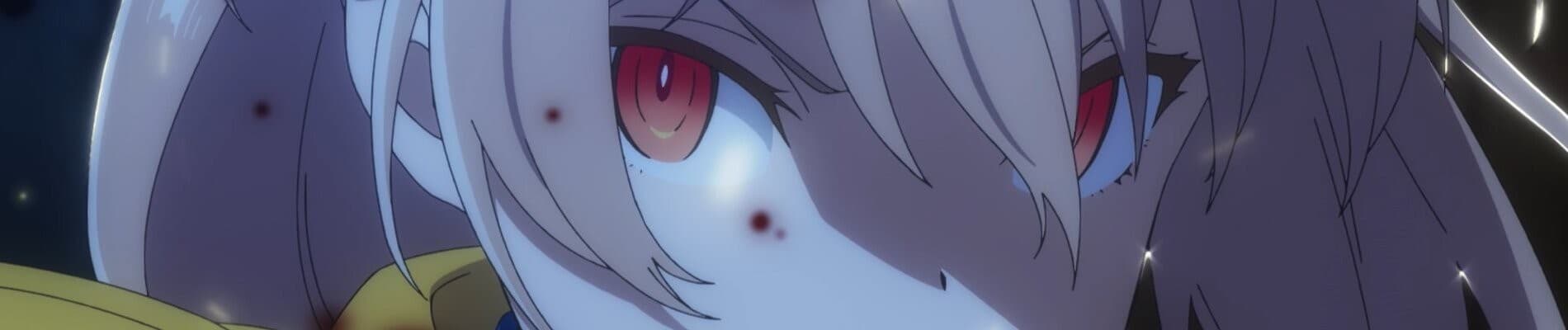
Menou's assassin companion, Momo, is a caricature of a psychotic lesbian—two words I despise putting beside one another. She is introduced with laser red eyes, only to speak as in a moe voice and motorboat Menou. Cute-but-unhinged archetypes like Momo are so played out in Executioner. After the third secretly evil moe character it’s clear the author either ran out of ideas or has an obsession with the trope. For most of Momo’s screentime, she clings to Menou, hiding in the shadows to tie loose ends. Momo's rival, a rather unconvincing tough-as-nails swordswoman, gives her other things to do, thankfully.
There are no thrills to the action unless you count gratuitous viscera for the sake of it entertaining. Blood, gore, children getting diced up, but there's no impact. It's all faux darkness to seem more mature than it is. The creators were seemingly trying to one-up other isekai anime labelled as "mature" with its outlandish blood and gore.
I would be remiss if I did not mention the remarkable quality of the visuals and audio. In terms of J.C. Staff productions, it's comparable to One Punch Man's second season; frequently reused animation loops, low-detail character designs, and janky CGI monsters. Sakuga cuts are used sparingly, but admittedly the bombastic fight scenes look exhilarating when they try. However, the sound design is exceptionally bad. What little sound effects they include are pleasing, but it's as though their audio team ran out of time frequently. I especially loved how Menou could perfectly hear Momo talking outside of a moving train from the inside because they forgot to add wind or distortion. Visual effects such as the sparkling Ether dust, and the show's magic system, have no sound whatsoever. Part of what makes the final episode so anticlimactic is the janky CGI that undermines its attempts at grotesque body horror.
For all of the exposition dumps, the show offers little explanation for the magic system and power scaling. They mention different tiers of assassins offhand but never show how that status affects their powers. Fighters wield giant swords made of light, launch explosions, and throw magic circles every which way. I'd be lying if I said it didn't have exciting moments, but ultimately the fights are tensionless. Seconds before death, one of the heroes will inevitably reveal a cheap gimmick magic ability to save themself. It's repetitive, predictable, and never as shocking as the author intended. This might feel original if there weren't already a hundred violent isekai anime. Instead, it is derivative of the same story it's attempting to tell.
The early 20th-century attire juxtaposed with modern technology sets the show apart from a production design standpoint. The Lost Ones influenced architecture, design, and technology powered by magic rather than electricity. Don't think too hard about it. Obviously, the writers didn't because the more you do, the less it makes sense. If you're interested in the people inhabiting the fantasy world… well, you'd be better off reading the light novels because backstories, politics, and lore are sparse.
Shokei Shoujo no Virgin Road is so heavy-handed and awkward it comes across as a parody. It feels like you're watching the script's first draft because of how the story is told in such an ass-backwards way. There are some redeeming qualities, such as the relatively ambitious production and hints at queer romance. But, ultimately, they are overshadowed by a shitload of problems. The characters talk in cliches and tedious explanations instead of dialogue. It is so self-serious in the face of utterly idiotic writing that it leads to plenty of unintentionally funny scenes. All of the plot twists and gratuitous violence were the show's attempt to shock us. The shock factor is what the story was built upon, truly. It is a lazy attempt at subversion that never found a reason to exist.
32.5 out of 50 users liked this review
