All of us have looked back on our past and felt unfulfilled. It's natural to regret poor decisions. All of the missed opportunities, people you never met, mistakes you made. If you could change the years you regret the most, would you?
Imagine the most generic school harem anime possible: Remake Our Life is what comes to mind. Forgettable character designs, monotonous background music, and archetypal love interests compete for the everyman protagonist. Kyoya, the bland harem hero, is a failed adult who gets a second chance to relive his college years. After getting fired from his dream job at a game company, he mourns his wasted youth. He regrets not enrolling in an art university, then falls asleep. Upon opening his eyes, he is ten years in the past and instantly decides to go to college. Once enrolled, he immediately recognizes his roommates as successful artists from the future. His writing skills impress everyone—because he accidentally stole the idea from his only male roommate. Though he regrets benefitting from his friend's failure, he still reaps the rewards. Some of the rewards include ladies who quickly become attracted to him for his generic looks and filmmaking talents.
He is where he belongs: A place where people recognize his talent. Kyoya embodies the everyman trope prominently utilized in isekai light novel adaptations. A businessman in a dead-end job living with his parents, he yearns to relive his youth. Suddenly, an unknown power transports him to the past! He takes this monumental once-in-a-lifetime opportunity to... enroll in college. Now he can become the man he has always wanted, an artist and professional womanizer. Kyoya lacks discernable characteristics or individuality, making it easy for you to project onto him.
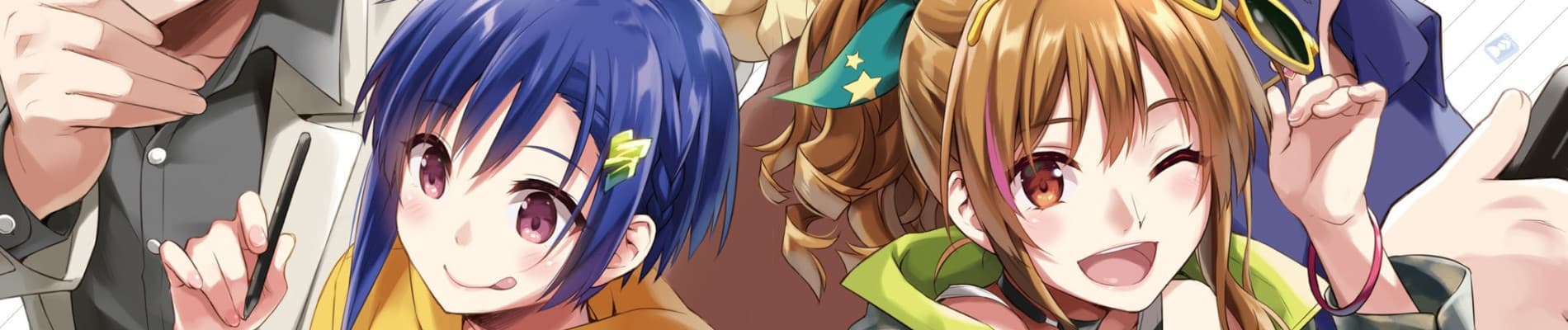
All the girls surrounding Kyoya are the same height and body type to be as marketable as possible. For this reason, I will refer to them by hair color first. Though three out of five of the main cast are women, their dialogue is mainly with Kyoya or about him. As the poster art suggests, this is a harem anime dressed up with melodrama. You'll see plenty of fanservice at inconvenient times, but they tone it down after the first couple of episodes. Shinoaki, the blue-haired girl, is a sleepy and airheaded artist. Her character arc begins and ends in one episode—she questions her talent, and Kyoya quickly reassures her that's not the case. This moment sparks a flame of love. There is no romantic progression or chemistry between the two, which just happens to us. We are helpless passengers aboard this slowly derailing train. The red-haired girl, Kawasegawa, is a little too confrontational for her own good. Frequently she harshly criticizes people for justified reasons; however, the direction frames it as a bad personality trait. Suddenly dark music plays or cuts out altogether, and they use close-ups to emphasize the anxiety she causes. She works through this flaw—which being critical isn't really a flaw at all, and that's the crux of her arc. She has a cute side that she only shows to the main character. Is it love? Watch to find out. Her primary purpose in Kyoya's story is to provide motivational speeches and assist him on art projects.
Nanako, the blonde girl, is stern and has character development—reserved for the show's first half. She becomes irrelevant afterward. As an actress conflicted about her future, she deals with self-doubt and insecurities. Although her turmoil seems exaggerated with melodramatic dialogue, she is more compelling than the rest. She, too, has a cute side that she only shows to the main character. Their romantic development is gradual rather than forced. If only Kyoya had the character depth to compliment hers. The dialogue, especially involving Nanako, is awful: they utilize her for fanservice and to fawn over Kyoya, only to sideline her shortly after that.
What the hell kind of friend are you? There's a recurring problem here: Kyoya assumes the wants and needs of his friends without actually asking them first, and the story rewards him for this. At best, it's presumptuous to believe you could solve someone's issues for them. Though the show pays lip service to this idea, it is ultimately a mistake it continues to make until the end. I wouldn't say I like the term "self-insert" because it implies the author wrote himself in the story as the main character. Instead, Kyoya is an avatar for the audience. He is an everyman—generic in every sense for us to project onto him. We can live our fantasies like a hot college film student surrounded by single attractive women. And no judgment if you want an ego boost. The ladies vie for his attention; one girl even says the classic "I won't lose" line, implying she'll never give up on her love. The other men are, of course, perverts, unattractive, or lacking the talent Kyoya possesses. There are a couple more recurring faces that leave little impression.
Attempts at self-aware humor fall flat without follow-up. Kyoya's friend says, "All of those girls, for no reason, are in love with me as soon as the game begins!" He shrugs it off, and then things move on to normal. Cue the fan service and girls fighting over him despite being thoroughly mediocre. Jabbing at the cringe-worthy nature of dating simulators is funny but woefully misguided here. Remake engages in the same harem cliches it mocks, and in the words of a better writer than me: "Self-awareness does not absolve anybody of anything." We've been aware of a show's problem, but there's no subversion. Shinoaki continues to dizzily follow Kyoya around like a lost puppy, and Nakano pines for him in the background. Tsurayuki, the aforementioned male roommate, has the unfortunate role of getting pushed around by our hero. Kyoya does his best to apologize and explain, and it works to keep him in order. Similar to the ladies, his insecurities manifest as imposter syndrome. He worries he's not contributing enough—and this is an intriguing theme that Remake cuts short.
The art is utterly forgettable—generic character designs, bland background art, and minimal animation. Of course, dynamic artwork is unneeded for a shallow harem LN adaptation primarily made up of tedious conversations. The music adds insignificant emotional impact because it's recycled repeatedly—kind of like a typical visual novel soundtrack. The catchy opening track sung by the leading ladies somewhat makes up for the lackluster OST. The outro is mellow and relaxing, shown on a movie reel to reference the film they created. Remake suffers from coming off as insincere in its portrayal of artists at times; during the film screenings, characters tell us how great the short films were, but the viewer rarely sees them. When we're supposed to believe these are super talented artists, you have to prove it. There were moments it did prove to us their talents, such as with Nanako's singing and Shinoaki's art, which fulfilled this potential.
In the ninth episode, the show evolves. It threw a curveball to grab our attention as it sunk into mediocre melodrama. The author finally used the time travel mechanic, though it was ultimately in vain. He attempts to confront the implausible fantasy premise of the show with a Butterfly Effect sort of twist. Credit where credit is due, Kyoya develops ever so slightly, but not enough to be relatable. The dialogue primarily consists of narration to catch us up on new information—similar to a recap episode. And you have to admit, recap episodes are pretty dull. Despite the balls it took to make drastic changes so late, this was ultimately the weakest part of the show. There needed to be a practical reason for forgoing the character development of the first eight episodes.
Ten years ago, the tacked-on-time travel premise would've been inventive. Today it's derivative. Better anime have done this premise before Steins;Gate, ReLife, Orange, and even Erased. Ironically, the main character travels to the past to relive his youth, never realizing our experiences—even the cringe-worthy ones—make us who we are today. Flawed, imperfect, but unmistakably ourselves. Like Kyoya's memories, mistakes, and poor choices, Remake Our Life should've stayed in the past.
28 out of 44 users liked this review