Steins;Gate
a review by Goukeban
a review by Goukeban
[My opinions on Steins;Gate have changed quite a bit since I wrote this so I no longer stand by many statements made here. I decided to leave the review as is and not make further editing]
It’s unusual for me to begin watching something already with the intent of reviewing it. Normally, the decision comes when I’m already a few episodes into the show, or after I have just finished it and believe that I have something interesting to say about it. I can’t exactly point out a specific reason for deciding to review Steins;Gate, but I’d most likely say it was sort of a personal challenge to analyze another work from the “Untouchable” category. The previous one didn’t grant me a single enemies anyway.
Truth be told, I wasn’t exactly expecting this series to lend me much to talk about. That has nothing to do with any particular negative bias that I had previous to watching it, just that, since I focus on making analysis that don’t come off as derivative, having interesting content to insert in the review is something I constantly worry about, and word of mouth regarding Steins;Gate didn’t give me the idea that I would have anything unexpected in my path. Let’s see how that turned out.
Story and Characters
I apologize for starting this section right on a criticism, but I couldn’t think of a proper introduction. One of the most noticeable and well known traits of the series is how slow its first half is. You perhaps heard the comparison before, but some claim that up until episode 12 Steins;Gate much more closely resembles a slice-of-life with a time-travel twist to it. Now, slow pacing in itself is not an issue, but it requires careful work from the writer’s part to make the most out of it. A slow paced show is at its best when it gradually adds layers to the characters through their interactions or flashes out the world in a manner which, while not developing the narrative by huge leaps, creates an encompassing overview of the setting. That just sounded remarkably pretentious to say, but believe me, it’s much simpler than what I made it out to be.
The point I’m getting at is that Steins;Gate intertwines the slow development of its first half with what can be considered, in simpler terms, as filler. It’s not the usual kind of filler, though, that visibly disconnects the narrative from its normal segment, wastes your time, breaks any sense of progression and can potentially lead the audience to rage-quit (NO, I’m not bitter!), it’s a style of filler that is stealthily played within the story and intertwined in the interactions between characters. It’s noticeable that this is just padding, though, when you finally realize that there is plenty, and I mean PLENTY, of these segments and they help develop fuck-all. It’s not to say that such trait is a massive detriment to the series, though. As I said, the writers were clever enough to hide it within the narrative and depending on your attachment to the characters even these fillery bits can be enjoyable, and since we’re talking about characters, let’s get to them:
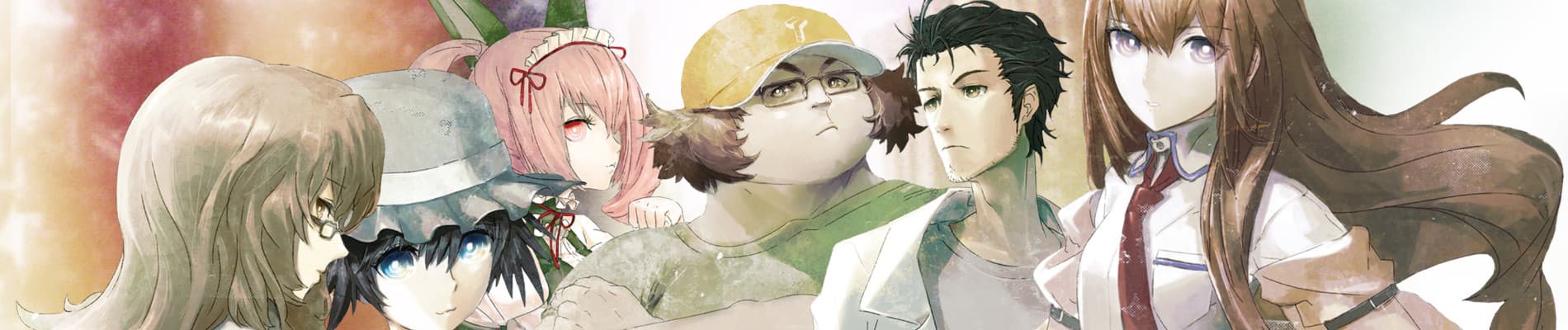
Okabe Rintarou, or as he prefers to call himself, Houoin Kyouma, is the lead character and self-proclaimed mad-scientist. Okabe frequently acts in a goofy manner and spouts chuunibyou delusions about a supposed “Organization” bent on dominating the world, and it’s his lunacy that drives the first steps of the story, more than his competence even. One would think that this is a coping mechanism, but as the story gets serious he drops this attitude and is shown to be truly disturbed by the consequences of his experiments.
Makise Kurisu is the second most important agent in the story, resident tsundere and the best character in the show. No, really, from the beginning she displays knowledge that makes her an asset to the group over even Okabe, has highly curious personality, her development starts to appear bit-by-bit already in the first half, with plenty of subtlety to read into and she even has a mild woobie backstory that, low and behold, is actually well-written, with clear effects on her demeanor and motivations.
Hashida Itaru, mostly known as Daru, is the hacker of the group and resident pervy-otaku, although in certain moments he offers a better voice of reason than Okabe. Not much though. His character is meaningful to the plot due to his knowledge of computers and hacking, but his personality offers very little when it comes to development or dimension, he acts as the moe-obsessed geek throughout the whole series.
Shiima Mayuri is Okabe’s childhood friend and the primary source of “moe” for the series. Despite having one of the hottest character designs ever (Shut up, it’s true!), she doesn’t have much going forward in regards to character depth, development or brain power anyway. Her role in the story consists primarily of getting the crew an old computer and providing motivation for Okabe later down the road, as her security is put in jeopardy by the constant shifts in timeline.
Amane Suzuha is the tomboyish action-girl that constantly fills the audience’s mind with questions of how much does she know of what is going on within this timeline. Thankfully, when the time comes to reveal what is the deal with her character the narrative doesn’t waste time in laying out the important details. Also, knowing the stakes she deals with in the whole ordeal, her development packs quite a punch.
Kiryuu Moeka appears originally as a mysterious woman looking for an old computer that Okabe later uses in order to decode documents about the experiences with time-travel. Very quiet and inexpressive, fitting the archetype of a kuudere, she seems reluctant in interact with the rest of the cast and only opens up near the end. These traits would be fit to start a solid development, but the reveal of her backstory makes Moeka a fairly shallow character.
Urushibara Ruka is the graceful, polite, shy, endearing, feminine and gullible third male member of Okabe’s crew. Yeah, fate was kind of cruel to the kid. He greatly admires Okabe and wishes to have been born as a girl, a wish that is granted in one of the alternative timelines.
That sure is a sizeable number just for the main cast! While all of them play a part in the story, it’s noticeable that four of them are really meaningful to the progression and only Okabe, Kurisu and Suzuha are effectively well developed and display more than one or two dimensions. The majority of the cast focuses simply on playing one specific personality trait and don’t exhibit much depth besides their defining quirks. The segments of the first half of the story that are relevant to character development come in small, tender moments related to backstory, mainly in regards to how they affect Kurisu and Okabe. These tender moments help to highlight a big positive from Steins;Gate: very clever sense of timing. The series understands the point where it’s most effective to insert the juicy bits of character development, foreshadowing and backstory, when enough of the cast has already been shown so that the addition comes out as meaningful and natural as possible. You probably knew that Kurisu had some sort of family issue beforehand, with plenty of hints from her behavior, so when she finally opens up the information already has ground to stand on. You might find a few points where it slips a little (no, episode 12 Kurisu, Mayuri is really not that smart!), but this is generally one of the aspects of the narrative that the series excels at.
It’s by the end of episode 12 that shit really hits the fan and the cast begins to deal with an effective opposing force, either as a known enemy or simply the natural force of the time-continuity operating. At this point, Steins;Gate does an excellent job of raising the stakes at a very short period of time, helping mitigate the slow pacing seen previously. As soon as Okabe starts to understand the deep repercussions of their previous actions, the crew goes on trying to undo the timeline changes, in a process that involves ordeals ranging from trying to bring moe back once again to Akihabara, to getting Ruka’s penis back to where it belonged in the space-time continuum. No, I didn’t write this by accident and yes, it completely makes sense in context. This specific section of the plot is where it’s most visible that Steins;Gate has its roots on a visual novel. While the series retains for the most part the sense of urgency and seriousness, episode 18 in specific represents quite a departure from the rest, being more comically focused and significantly lacking the urgency seen in the previous and later episodes. Perhaps another point where the series could have performed better is on the antagonist’s side, since SERN, supposedly the main antagonist of the story, has only an indirect presence in the narrative. That is only a matter of “could” though, and I don’t believe it to be a reasonable complaint to detract from the rest of the work.
It’s also at this point that Okabe’s progression manifests at its best. We’ve seen before how he is capable of dropping his delusional façade for a moment and take reasonable decisions, but it’s when he is forced to go through multiple timelines to protect his friends that the stress and the despair begins to take a toll on him, displaying his most vulnerable dimensions, from where he’s forced to take the hard decisions needed to fix everything. All of this also affects Kurisu, who has been his main support during their journey. The conclusion both arrive at is the highlight of their development, showing that Steins;Gate bases the bulk of its appeal not on the time-travel element itself, but on the heavy emotional repercussions characters go through because of such element. Now, this is quite obvious to those who watched the series, but it’s worth mentioning how effectively Steins;Gate ties all of its loose ends as the progression takes place, a result of very sober writing that avoids turning a complex subject into a mess of plot-holes.
Presentation
When it comes to visuals, there is little about Steins;Gate that can be perceived as particularly striking, despite the distinct style. One thing to help keep the series apart from other anime in regards to aesthetic would be the rounded faces, streamlined facial features and the presence of actual gravity affecting the hair in this universe, which allows characters to retain a cute outlook without appearing too otherworldly. Not to say that it strays in huge leaps from the trademark visuals of the media, like what you would see in a Satoshi Kon work, but it has enough of an identity to make it instantly recognizable
One aspect that is noteworthy about Steins;Gate’s aesthetic is the use of “metallic” shades for the colors, especially in scenes with sharp lighting. Scenes around the time of sunset appear not even in tones of yellow, but golden, while in portions that take place earlier there is a silver-like color-pallet. The same treatment is given to primary colors and in-doors the scenery is washed-out, driving attention to the cast. It’s hard to read any symbolic meaning behind such decisions, but they fit nicely with the aforementioned sober style of the writing and progression. It also blends well on the technical aspect, helping keep the animation consistently fluid, the character models stable and the movement expressive. Though, I still don’t get where do the shadows from cars go sometimes and I doubt that different timelines would properly explain this issue.
When it comes to sound, what generally takes the spotlight is Mamoru Miyano’s performance as Okabe. Miyano has displayed prior and after to Steins;Gate his talent for playing either flamboyant and over the top goofballs, like Tamaki in Ouran Highschool Host Club, to serious and heavy characters, like Kiba in Wolf’s Rain, and while many would hardly say that Okabe is a heavy character, he does have an inclination for drama. The performance Miyano gives to Okabe helps shift progressively from the over-the-top to the dramatic and even gives the real sense of bitterness to moments when the character is trying to play-off and hide his sorrow. One performance that is not so sharp, though, would be Tomokazu Seki, of all people, playing Daru. His character is constantly played in very cartoonish manner and lacks the variation and spice the others display. Okabe, for once, only pretends to be a delusional chuunibyou driven loony, but shows different layers through the acting, while Daru doesn’t go out of the pervy-otaku role, both in character as in acting, throughout the series duration.
Personal Ramblings
Looking back I wonder if I sounded harsher to the series than what I have intended. In fairness, how good is a series, to me, is not simply a matter of how many flaws it has, but what qualities it has to make up for them, what is the source of any of its flaws and how it goes about balancing the issues with the qualities presented. Truth be told, Steins;Gate is not the kind of series that needs defending, being the third highest rated anime on MAL and the eighth most popular. Do I think it is overrated in any form? No, but, putting my judgment aside, that is because I don’t really accept the idea of an “overrated” work of art. Calling something overrated implies that there is such a thing as an objective standard of quality to which all of anime, or movies, or books should obey, an idea I don’t buy into. It just so happens that, in this case, I agree with most of the series reputation.
Perhaps the interesting thing to do right now is to ponder the source of the series success. I think the first step to achieve that was having an interesting hook, and that sure is something the series provides from episode 01. From then on, it likely built its appeal on the charisma of the cast, while it developed the rules for its universe. The air-tight narrative sure made the experience of following the story unfold quite rewarding for the viewer who has a stronger affection to the science fiction and mystery genres, and while I personally was already expecting that, making my experience more a matter of confirmation bias, it’s easy to see how that style of writing syncs with other preferences. Of course, all of that would barely matter if Steins;Gate didn’t have the strong development it has for its main duo, so it’s no wonder that so many people who have the series among their favorites also have Okabe or Kurisu among their favorite characters.
Steins;Gate is another series of the Must Watch group, one that had an impact and reputation among the anime community, strong enough to place it among the titles that need to be experienced by everyone who considers themselves an anime fan, despite whatever judgment they might come up with after finishing the series. It frankly took me a while to get to this one, considering the popularity and expression it has among anime circles, and while I may not have become as attached to it as most people do, it seems reasonable and honest from my perspective to state that it is, in fact a really great series.
33.5 out of 44 users liked this review
