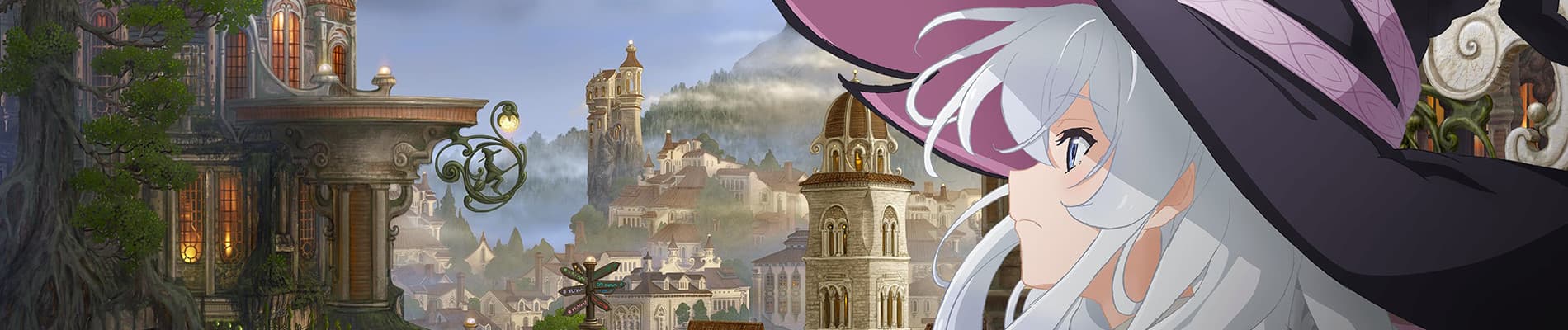
Apparently, after overusing the same new format all over again, I decided to go back to the old one. However, this will rather be started with a thematic analysis than the casual review.
"Sometimes, you have to be selfish to reach your dream."
Before getting into the plot and characters etc. I believe it would be fair and perhaps, more intriguing to see the aspect that exist on this show. So, first of all, let's talk about the philosophical theme as one of major elements that was provided into the story. Wandering Witch: The Journey of Elaina, or also known as Majo No Tabitabi appeared to introduce a new height of character development which appeared to be idiosyncratic to Ayn Rand's The Virtue of Selfishness.
In that book, Ayn Rand stated that selfishness is of being synonymous to such act of an evil, whereas it is of a murderous brute who tramples over piles of corpses to achieve his own ends and pursues nothing but the gratification of the mindless whims of any immediate moment. Yet the exact meaning and dictionary definition of the word ‘selfishness’ is: concern with one’s own interests. Rand also rejects both options as forms of selflessness, and offers a new concept of egoism — an ethics of rational selfishness that rejects sacrifice in all its forms. This concept does not include a moral evaluation; it does not tell us whether concern with one’s own interests is good or evil; nor does it tell us what constitutes man’s actual interests. It is the task of ethics to answer such questions. Selfishness, however, does not mean “doing whatever you please.”
Morality is a matter of principle, not divine revelation or subjective desire. A properly defined principle — one that identifies an actual truth about human action — should be acted upon consistently, never compromised. “There can be no compromise on basic principles or on fundamental issues,” Rand writes. “What would you regard as a ‘compromise’ between life and death? Or between truth and falsehood?” Moral principles are indispensable guides to action in real-life situations, if one’s goal is to attain individual happiness. However, moral principles are not a matter of personal opinion — they are based in the facts of reality, in man’s nature as a rational being, who must think and act successfully in order to live and be happy. In order to make room for her “new concept of egoism,”
Rand identifies the opposite of selfishness as altruism (literally, “otherism”) and argues that making service to others the hallmark of moral action obscures the real issues in ethics: What are values? Why do we need them? How do we decide who should be the beneficiary of our actions? Only when one answers these questions, Rand argues, is one in a position to evaluate egoism and altruism as good or evil. Egoists are generally assumed to prey on others. In Rand’s view, however, individuals derive indispensable benefit from exchanging values with other people. “A trader,” she writes, “is a man who earns what he gets and does not give or take the undeserved. He does not treat men as masters or slaves, but as independent equals. He deals with men by means of a free, voluntary, unforced, uncoerced exchange — an exchange which benefits both parties by their own independent judgment.” In this broad sense, Rand’s “trader principle” encompasses not only economic transactions but all voluntary human relationships.
In such articles as “The Ethics of Emergencies,” “Collectivized Ethics” and “The ‘Conflicts’ of Men’s Interests,” Rand argues that we need to reconceive the place of the welfare of others and of the individual in ethics, and to question the idea that the interests of rational men conflict. Although the egoistic individual is perfectly at home in society, he recognizes that other people hold the power to destroy the value of social life by initiating physical force against him — in the form of criminal acts or, more dangerously, improper government coercion. One of this book’s themes is that morality must identify principles to identify and guard against this threat.
After reading all of these explanations, you could see the way Ayn Rand's definition of egoism matches of that Elaina's perspective when it comes to her objectivist ethics as she had gone to experience some of adventurous journeys by herself. Elaina also appeared to believe that altruism wouldn't bring anything but harm, this was said after the end of her story telling about a slave who was cheered by her master's bottle of happiness as she then retold afterwards of the story of a husband who had travelled around the world to bring happiness for his wife only to find her committing suicide using a knife. The moral, according to her, was this, "Sometimes, good deeds that you do for someone brings more harm than pleasure." This seems to signify how idiosyncratic her philosophical view akin to that Ayn Rand's view of altruism. In which she stated that altruism is "a value which one is forced to accept at the price of surrendering one's mind is not a value to anyone; the forcibly mindless can neither just nor choose nor value." This, again, matches to Elaina's mindset which shared throughout the journey as she deemed objectivism is the act of pursuing happiness as the moral purpose of his life, with productive achievement as her noblest activity, and reason as her only absolute:
“You can avoid reality, but you cannot avoid the consequences of avoiding reality.”
“Learn to value yourself, which means: fight for your happiness.”
“The truth is not for all men but only for those who seek it.”
“Never think of pain or danger or enemies a moment longer than is necessary to fight them.”
— Ayn Rand
Yet philosophical-aside, in before Elaina was someone who didn't prefer to share her direct brutality to anyone else and tried holding back for sharing what she really honestly thought or her opinion of people around her. And back as a kid, she was known as a very inquisitive person who had been inspired by Nike's adventure book which pushed to explore the world by herself. This was changed when she met Fran, who apparently understood her struggles as she taught her of possibly the cruelest act that someone had ever done to her after holding back for 3 months. It turns out that her mother wanted to teach her what it really means to be treated harshly by others so to develop her character. And soon after that, she asked her to follow her principles before embarking her own journey, meeting Saya at first, a witch who apparently had a questionable crush on her.
However, it really was known she is this narcissistic and egotistical character who keeps claiming of her vanity as she portrayed herself as a beautiful witch as much as the most beautiful flower who wandered around the world with her charming personality, seemingly to show her lack of awareness when it comes to others.
Throughout the story, she ended up breaking two of the principles that her mom had taught her, including humility which portrayed such example as memes:

And not only that, when she met the Princess who had struck by amnesia after sacrificing her own memories to curse her father into becoming a monster, she didn't fret or run away from such scenes. Instead, she helped her to fulfill her revenge afterwards. With this, she also broke the principle to run away when she was troubled. However, it might be that she wouldn't ruin the last one (to go home), hopefully.
“People think that a liar gains a victory over his victim. What I’ve learned is that a lie is an act of self-abdication, because one surrenders one’s reality to the person to whom one lies, making that person one’s master, condemning oneself from then on to faking the sort of reality that person’s view requires to be faked…The man who lies to the world, is the world’s slave from then on…There are no white lies, there is only the blackest of destruction, and a white lie is the blackest of all.”
Alright, enough about Elaina and her philosophy, it's time to talk more about the other aspects from characters, plot, world-building, voice acting, sound, etc. But before that, please excuse myself to savour the moment of angry Elaina, which I found to be the most adorable among of all expressions other than her coldness or villain mode:


Never mind, I eventually couldn't stop talking about Elaina so let's talk about her again, shall we? She arguably is the most complex character I have seen on a show. Not only she did reveal her insecurity when it comes to her physical appearance but also the fact that she got a chronic impostor syndrome — this was revealed at the end of Episode 9 when she helped a witch to save her best friend, only to find her sacrificing her memories after killing her for the second time. She also is cunning, one of examples when she had devised a plan to stop the King from using his sword for the sake of protecting honesty (also, not to mention her personalities). However, this doesn't mean the other characters are not that interesting. Fran was an interesting character, mostly due to her lack of energy or it's just her being too reserved and lazy. When she met Elaina for the second time, it was revealed that she also wrote her own diary but only to be, unbeknownst by her, published in another country. Her past did also reveal some of her emotionless and cold act, much similar to Elaina's personality but rather to be introverted. And there also was Saya, Sheila, Estelle, etc. who gave more nuance to the story. As for the plot, I really enjoyed the dynamic relationship between characters, including the storyline which offers yet another insightful perspective when it comes to portraying the philosophy of objectivism overall. The voice actor was fine, so as the art style, animation and others so I have no complain about this show. Alright, so that's all and enjoy these villain arc mode Elaina gifs:



50 out of 58 users liked this review
