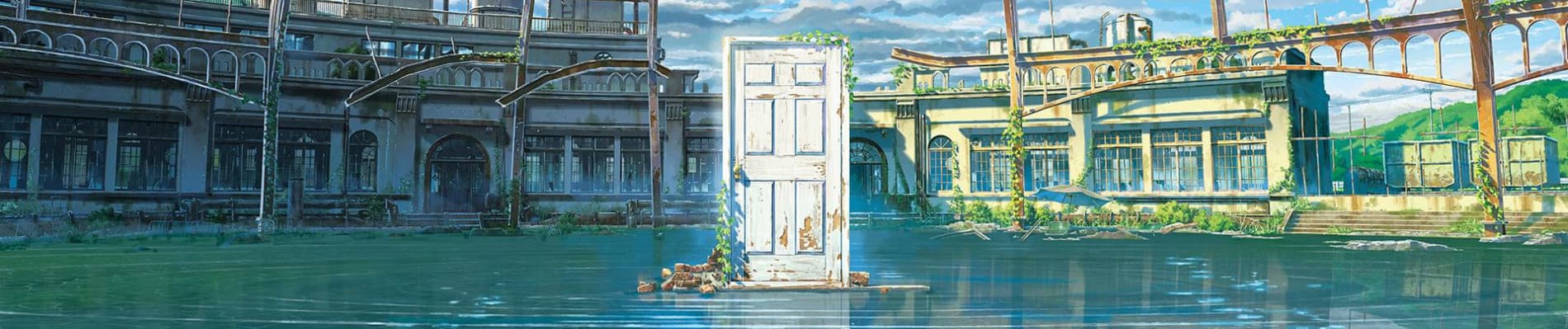
Makoto Shinkai, an anime director famous for the fantasy romance genre, also makes disaster an important story device, at least in his last three films. He presented Suzume as a tribute to the victims of the Tohoku earthquake on March 11, 2011. The film will indeed be heartwarming from how Makoto writes about his character's struggle not only to stop the earthquake but to come to terms with the sense of loss that has continued to overwhelm him since the unfortunate tragedy.
Suzume Iwato, the main character, was still a child when the disaster struck. In the opening scene, we see her little figure looking around for her mother, somewhere cold. The experience must have been traumatic for Suzume to have such a dream. Suzume herself, now 17 years old, is a pretty bubbly high school girl. We'll see her say goodbye to her aunt. We see her going to school by bicycle, and we see her dumbfounded looking at the young man with long hair on the street. The young man's name was Souta Munakata and asked Suzume for directions to the city ruins on the mountain. Suzume, who is curious, skips school and arrives first at the ruins of Souta’s destination. Suzume saw the door Souta was looking for, and the moment Suzume opened that door was the moment the story's fantasy adventure began.
Another feature of Shinkai is that instead of bringing us and the characters into a fantasy world, he brings that fantasy to us. Bringing that fantasy to the world of stories that he always makes grounded and based directly on the real world. Suzume's film immediately became intense because of this. From the door that Suzume opened appeared a giant red worm. The creature that only Souta and Suzume can see is floating above the city and is about to throw itself away. The giant worm is what causes the earthquake disaster. Suzume and Sota have to travel around Japan, closing the doors where the worm comes out so that a terrible earthquake doesn't occur.
The film's imaginative creations contribute to its fun and magical atmosphere. Suzume's ability to think outside the box adds to the out-of-the-ordinary experiences in her everyday life. Alongside the worm, there is a transformative keystone that can turn into a cat, and even Souta himself is cursed to become a kindergarten chair. These elements are intentionally included to give the film a fresh and entertaining feel. The contemporary world of Suzume, where chairs chase cats, further enhances the sense of familiarity.
In addition to the delightful and unique characters, the film showcases extraordinary hand-drawn animation. Shinkai's preference for drawing real locations as story settings is evident, and the backgrounds burst with vibrant colors, even in the gloomiest of places. The animation is enhanced with sparkling visual effects, and the use of perspective shots adds to the dynamic storytelling. Suzume takes on the form of a travel movie, with an action-oriented adventure that sets it apart from Shinkai's previous works. While the stories of these three films are not connected, they share distinct elements that define Shinkai's style.
Together with Souta, Suzume embarks on a journey across Japan, following the trail of the cat suspected of intentionally opening worm doors in various ruined cities to cause earthquakes. The ever-changing atmospheres in each location prevent their mission, which may seem repetitive, from becoming dull. It becomes more exciting as Suzume and Souta encounter new people in every area they visit. The film effectively portrays Suzume's interactions with these individuals, creating a genuine sense of friendship, even within the limited screen time. The story goes beyond a simple romance between two young people, incorporating various elements that enrich Suzume's overall narrative.
What Suzume is doing here is probably the hardest thing a survivor has to do: close the door. Seeing what was behind the door, reminiscing about events before the disaster, only to have it shut and locked tightly. However, the film doesn't think of it as Suzume's actions to forget her tragedy or trauma. Closing the door mentioned in the film is an act of respect, which also strengthens survivors to move on with life. The film wants Suzume to remember that time so that this girl is aware. To see the sacrifice and love behind it all. Another key element in the film is the relationship between Suzume and her aunt who has been raising her. Her Aunt who until now has not married. Her aunt, who at one point exploded, said she had sacrificed her youth for Suzume. Suzume herself didn't see her aunt as a mother figure that she respected at that time. She can't, because deep inside is still looking for her real mother.
The film is more exciting, and the pictures are also really beautiful. Factors that make the anime more urgent, even from Shinkai’s two previous works which were more superior. The decision can finally be locked. It seems that Suzume is a film that is enjoyable for those looking for a coming-of-age story with a focus on emotional growth. The film has great characters and animation, but may not offer much beyond that for some viewers. The story is laser-targeted to make us laugh and cry but may fall short of expectations for some.
18 out of 20 users liked this review
