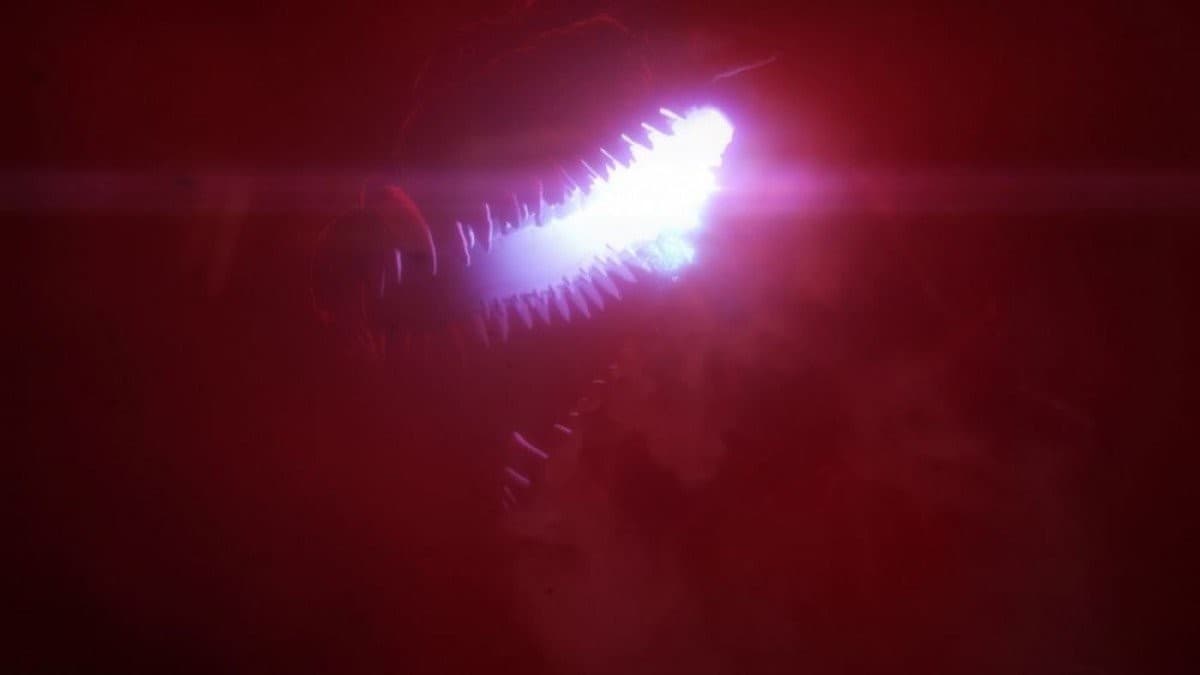
Godzilla Singular Point is far from a flawless series, but it has been unfairly dismissed and largely forgotten — perhaps because audiences weren’t quite prepared for the kind of show it set out to be.
Set in a plausible near-future — essentially ten years from now — the series avoids clichés of dystopia or hyper-advanced fantasy. There are no flying cars, no ruined cities, no authoritarian regimes. Instead, the world feels recognisably ours: modestly advanced technology, early-stage artificial intelligence, and everyday society carrying on as usual. This grounded approach makes the sudden appearance of colossal creatures all the more unsettling, and the viewer immediately feels anchored in a world that could easily be our own.
From the moment the first anomalies appear, the narrative shifts into a steady crescendo of scientific mystery, theoretical puzzles, and escalating stakes. The cast reflects this direction: instead of the typical ensemble of teenagers, superheroes, or fan-service-driven archetypes, we follow engineers, researchers, academics, and professionals who treat the unfolding crisis as a real-world scientific and political problem.
This choice is bold. It also likely alienated younger or more action-oriented viewers, who traditionally expect a central hero figure, frequent battles, or familiar genre tropes. The characters here feel too grounded and competent — real adults doing real work — which is precisely what makes them interesting but also harder to market.
And then there is Godzilla himself — the literal and figurative giant in the room.
As one of cinema’s most iconic figures, Godzilla carries decades of expectations: spectacular monster fights, large-scale destruction, and adrenaline-heavy set pieces. Singular Point defies that template. Action is sparing and back-loaded; the first major battles arrive only toward the end. For long stretches, the series favours theory over spectacle, analysis over explosions. For some fans, this felt like “too much talking.” For others, it was a refreshing attempt to treat the Godzilla mythos as a scientific anomaly rather than an excuse for a brawl.
A huge part of this identity comes from the writing itself. The series was clearly shaped by people with strong scientific backgrounds — physicists, mathematicians, engineers. The jargon, formulas, and theoretical references are not random technobabble; they are rooted in actual research. But this rigor comes with a cost. More than once, I found myself pausing an episode to look up unfamiliar terminology, because the dialogue doesn’t slow down to explain itself.
This is a double-edged sword: it rewards curiosity and patience but risks losing viewers who simply want a straightforward kaiju narrative. I don’t blame anyone who felt overwhelmed — Singular Point asks a lot from its audience.
Despite all this, or perhaps because of it, the show feels strangely realistic. Its fantastical elements are always tied back to systems, patterns, and plausible scientific reasoning. In the end, watching it delivers a sense of discovery rather than just entertainment. There’s a quiet satisfaction in piecing together the puzzle the writers constructed.
And on a lighter note: the opening theme is an absolute standout.
Do yourself a favour and listen to it.
8 out of 9 users liked this review