Kamen Rider
a review by DoctorGlitch
a review by DoctorGlitch
Kamen Rider has a cult following, and its author Shotaro Ishinomori has done a lot for Tokusatsu, making his authorial fixations (armored heroes, futuristic technology, monsters, SF and cyborgs) quickly become genre codes, but even the biggest fans of the license mistakenly forget that this manga was the Rider's first foray into Japanese fiction, and that's a shame, because well, it's a great manga!
The Kamen Rider manga lays the foundations for the character: a man turned cyborg with the grasshopper as his motif, facing off against an evil organization (Shocker) and its cyborgs with links to animals, having to protect a character who is often female and linked to his creator, and questioning his humanity, which is now more that of a super-powered monster (reinforced by stylized scars on his body) than that of a fragile human.
The manga unfolds in two parts, the first in the first volume being pure Kamen Rider, with the introduction of the metamorphosed character (Takeshi Hongo) and his questioning of what little humanity he has left, since he's now a cyborg who can kill very (too) easily, various confrontations with Shocker's henchmen with their varied animal abilities (spider, cobra, bat, etc.), all tinged with iconic special attacks and topical themes in '71, such as ecology and the purity of the air caused by factories. It should be noted, and this applies to the entire manga, that while most Kamen Rider series are accessible from a very young age, with fights that are certainly choreographed and dynamic but light on violence, this manga is very bloody, with the Rider not hesitating to dismember his opponents or impale them, Despite this butchery, the character and even the author like to remind us that his monsters were basically human and therefore victims of modification, notably in the arc on the Cobra Man and his wife Medusa, an arc that begins to show that Shocker's monsters still have some humanity in them, the chapter ending tragically, Medusa accidentally kills her man in the hysteria of battle and can't live with his blood on her hands, preferring to end her life and join her man, followed by a scene in which the Rider gazes with great sadness at the corpses of his opponents, whose humanity has returned in the last moments of their lives, giving the work the advantage of not being Manichean.
The second part of the second volume is innovative: during the 13 Riders arc, in which the Rider confronts 12 of his clones, Takeshi Hongo is seriously injured during the confrontation and is temporarily replaced by one of the clones freed from Shocker's grip during the battle (Hayato Ichimonji), who takes on the role of Kamen Rider to continue the work of Shocker's traitor, A new, less tragic and brighter protagonist, as well as more investigation-oriented chapters tinged with Japanese mythology, Ishinomori also introduces in this second part that toys exist in the work's diegesis, as he begins his final arc (Masked World) with children wearing Kamen Rider and Spider-Man masks, far removed from the horror of murderous confrontation or the loss of one's humanity, and closer to the childlike innocence of seeing a classy good guy against a disgusting bad guy, It's also in this second part that we learn more about Shocker, and the manga doesn't hesitate to bring its reader back to reality: the manga's big bad reveals to the Rider that his plan to control the masses was in fact an idea of the Japanese government, and that Shocker has only taken this plan and made it better, showing the Rider that he's facing a dangerous enemy, but one that has distanced him from the real enemy since the beginning of the manga, if today this kind of "the enemy is the government that manipulates us" message has been overused and misused in a lot of fiction (and incidentally made laughable by boomers on facebook with 240p meme's) in 1971, in Japan, in a superhero manga that at the time of its end of publication was a TV series, the program that all children talk about, well, you had to dare, and he ends his manga with a cold pessimism and the final sentence
"We human have used science, "the weapon of civilisation", to fight the wrong ennemy"
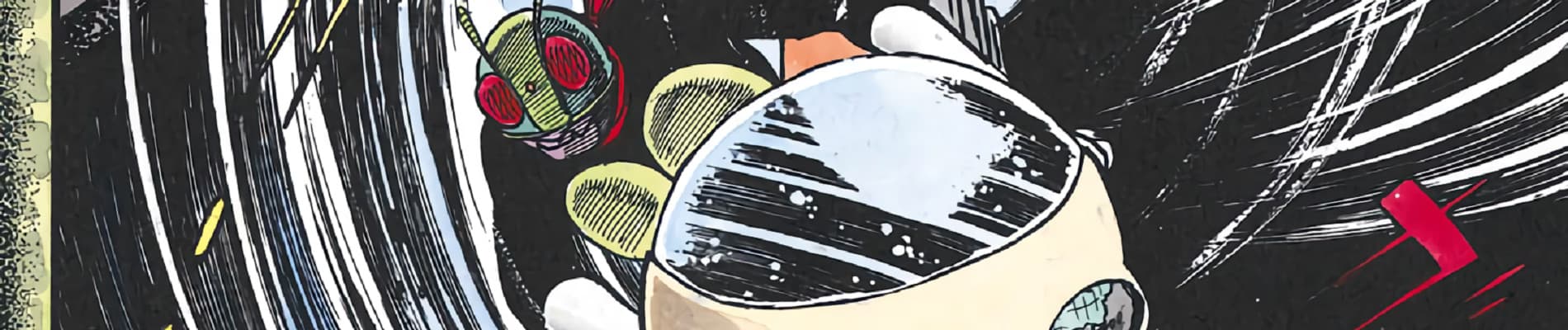
Graphically, Shotaro Ishinomori makes no secret of the fact that he was influenced by Osamu Tezuka, whose assistant and close friend he was, and the manga has this pudgy chara design, with prickly silky hair and highly expressive characters that are more like the cartoon Tezuka is so fond of, and that screams 60s-70s when you see it. This is an era of the manga that I love artistically, but where Ishinomori is impressive is in the action scenes, His cutting is perfectly legible, using gigantic squares that we always (and wrongly) associate with Toriyama, and he doesn't hesitate to show moments of a fight like a fall from the sky in 4-5 pages to make us feel the intensity of the fall, He takes great care with computers, mechanisms, motorcycles, etc. It's clear that the author has mastered this field, and takes pleasure in creating "mecha-porn" during his motorcycle scenes, or during the final arc in a supercomputer.
Kamen Rider is an excellent manga classic whose influence and impact on Japanese culture is unquestionable
12 out of 12 users liked this review
